



A complete pilgrim record drawn from the existing published article data.
Centuries of Devotion: The Rich History of Srikanteshwara
The Srikanteshwara Temple boasts a layered history, with its origins tracing back to the 11th century CE when the Garba Griha was constructed during the Chola period. Subsequent centuries saw significant additions and embellishments by various dynasties. The Hoysala period (13th century CE) contributed the anterior mandapa, while the Vijayanagara rulers (14th-17th century CE) added the brick-and-mortar shikara and shrines for Parvati and Narayana. The Wodeyars of Mysore were primary patrons, commissioning much of its current grandeur, including the towering gopuram in 1845 CE, ensuring the temple's continuous evolution.
Early Foundations
The temple's core, the Garba Griha, dates to the 11th century CE, established during the Chola dynasty. This early construction laid the spiritual bedrock for the temple's future expansion.
Dynastic Contributions
Successive dynasties, including the Ganga, Hoysala, and Vijayanagara, contributed to the temple's architecture. The Wodeyars of Mysore were instrumental in its later development, culminating in the construction of the grand gopuram in 1845 CE.
A Symphony in Stone: The Architecture of Nanjangud Temple
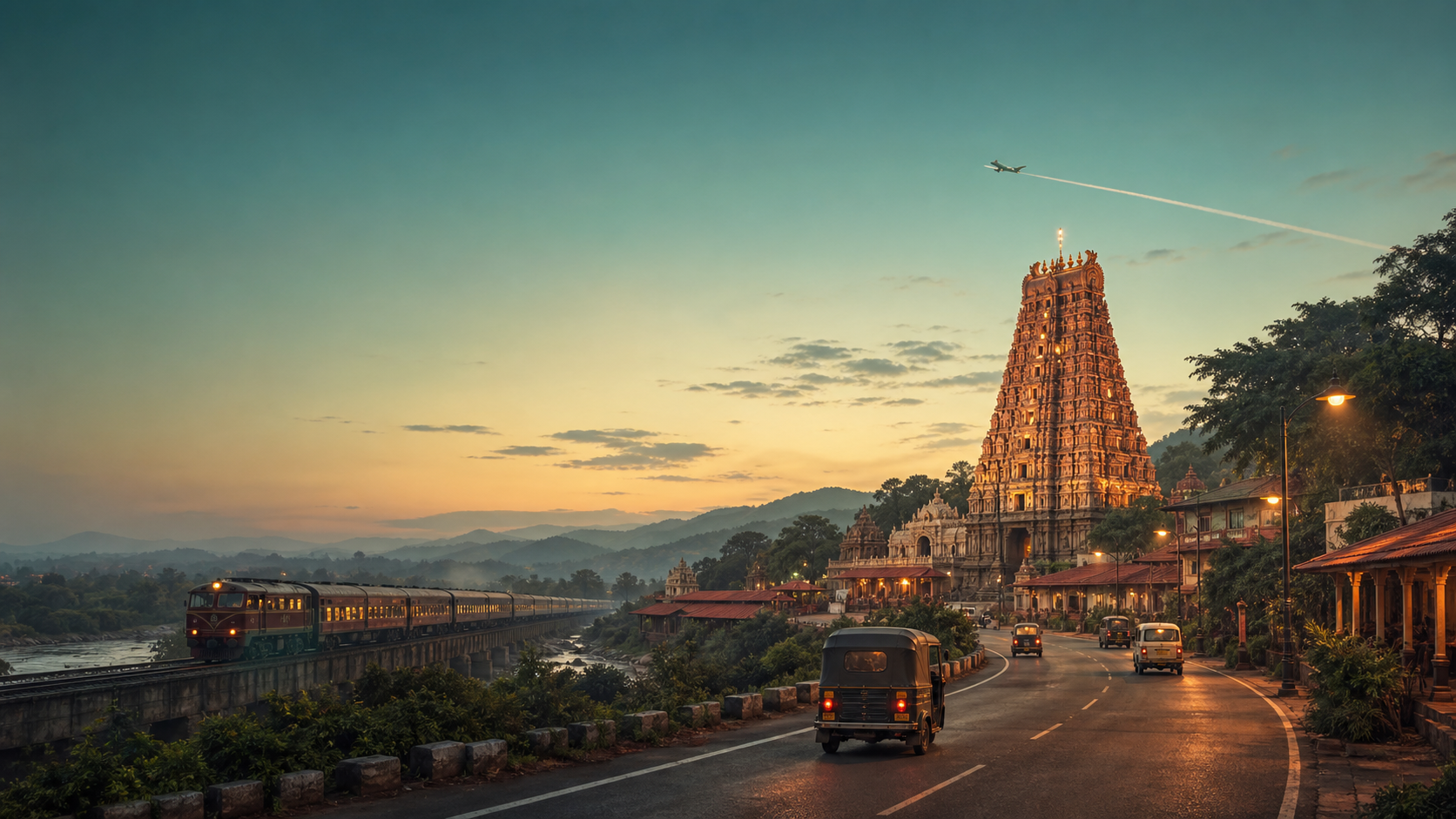
The Srikanteshwara Temple exemplifies the Dravidian architectural style, characterized by its vast expanse and intricate detailing. Constructed primarily from granite, brick, and mortar, it stands as one of Karnataka's largest temples. Its most striking feature is the towering 120-foot gopuram, a monumental gateway adorned with seven gold-plated kalashas, visible from a distance. The temple complex includes numerous shrines, mandapas, and courtyards, reflecting centuries of architectural evolution and patronage, creating a harmonious blend of historical building styles and religious artistry.
The Grand Gopuram
A defining feature is the 120-foot gopuram, constructed in 1845 CE. Adorned with seven gold-plated kalashas, it serves as a magnificent entrance and a landmark for the temple complex.
Dravidian Style and Materials
The temple showcases classic Dravidian architecture, utilizing granite, brick, and mortar. This style is evident in its pyramidal towers, intricate carvings, and expansive layout, reflecting a rich heritage of South Indian temple building.
The Divine Presence: Lord Srikanteshwara and Associated Mythology
At the heart of the Srikanteshwara Temple is Lord Shiva, revered as Srikanteshwara or Nanjundeshwara. The temple's profound religious significance is interwoven with local legends and mythological narratives. One such tale recounts Shiva vanquishing the demon Keshi at this very spot, thereby sanctifying it as a 'papa vinashini,' a destroyer of sins. Another legend speaks of Goddess Parvati's sacred jewel falling into the Kabini River, leading Shiva to declare the site 'Dakshina Manikarnika Ghat,' drawing parallels to the sacred ghats of Varanasi.
The Slaying of Keshi
According to legend, Lord Shiva manifested in Nanjangud to defeat the formidable demon Keshi. After his victory, Shiva declared the site a 'papa vinashini,' where devotees could cleanse their sins.
Dakshina Manikarnika Ghat
The Kabini River at Nanjangud is known as Dakshina Manikarnika Ghat. This name stems from a myth where a jewel from Goddess Parvati's crown fell into the river, consecrating the spot as sacred as Varanasi's Manikarnika Ghat.
Modern Pilgrimage and Community Life
The Srikanteshwara Temple continues to be a vibrant center of faith, attracting thousands of devotees annually from across the region and neighboring states. Modern pilgrimage to Nanjangud is often a multi-day affair, combining spiritual devotion with family outings. Pilgrims undertake specific rituals, including performing 'abhisheka' (ritual bathing) to Lord Srikanteshwara, offering prayers at the various subsidiary shrines, and participating in the daily 'poojas'. Many believe that a dip in the Kapila River, followed by darshan of the deity, can cleanse sins and bestow blessings, particularly for health and prosperity. The temple's accessibility, coupled with improved infrastructure, has made it a popular destination for both fervent devotees and casual visitors seeking spiritual solace.
Beyond individual worship, the Srikanteshwara Temple serves as the heart of Nanjangud's community life, especially during its grand annual festivals. The 'Dodda Jathre' (Great Festival) and 'Teppotsava' (Float Festival) draw massive crowds, transforming the town into a bustling hub of religious fervor and cultural celebration. These events feature elaborate processions, traditional music, dance, and a vibrant marketplace, fostering a strong sense of community and shared heritage. The temple also plays a significant role in local philanthropy and social welfare, often supporting educational initiatives and providing assistance to the needy. Its continuous operation ensures the preservation of ancient traditions and provides a focal point for the spiritual and social fabric of the region.
Srikanteshwara Temple: A Grand Abode of Lord Shiva
The Srikanteshwara Temple, located in Nanjangud, Karnataka, stands as a prominent pilgrimage site dedicated to Lord Shiva. Revered as 'Dakshina Kashi,' this ancient Dravidian-style temple holds immense spiritual significance, believed to be a 'papa vinashini,' a destroyer of sins. Its grandeur is evident in its vast complex, making it one of Karnataka's largest temples. Devotees flock here to seek blessings from Lord Srikanteshwara, often performing purifying dips in the sacred Kabini River, which further enhances its sanctity, earning it the title 'Dakshina Manikarnika Ghat'.
Spiritual Significance
Nanjangud is widely known as Dakshina Kashi, signifying its spiritual equivalence to Varanasi. The temple is considered a 'papa vinashini', where worship and a dip in the Kabini River are believed to absolve sins.
The Main Deity
Lord Shiva is worshipped here as Srikanteshwara, also known as Nanjundeshwara. The temple is a vital center for the Shaiva tradition, attracting devotees from across the region.
Visiting Srikanteshwara Temple: A Comprehensive Guide
Planning a visit to Srikanteshwara Temple is straightforward, with excellent accessibility options. The temple is approximately 20 km from Mysuru, reachable by bus or car. Nanjangud Town Railway Station is less than 1 km away, and Mysuru Airport (MYQ) is also nearby. The ideal time to visit is between October and March, coinciding with pleasant weather and major festivals like Dodda Jaathre (March–April) and Girijakalyana (November–December). Visitors are advised to adhere to a modest dress code, with dhoti or saree preferred for rituals, ensuring a respectful and enriching pilgrimage experience lasting typically 3–4 hours.
Travel and Accessibility
The temple is well-connected, located about 20 km from Mysuru. Nanjangud Town Railway Station is under 1 km away, and Mysuru Airport (MYQ) provides air connectivity, making it easily accessible for pilgrims.
Best Time to Visit
The period from October to March offers the most pleasant weather for visiting. This timeframe also includes significant annual festivals like Dodda Jaathre and Girijakalyana, which provide unique cultural experiences.
Dress Code and Duration
A modest dress code is enforced, with traditional attire like dhoti or saree preferred for religious ceremonies. Visitors should plan for a duration of 3–4 hours to fully explore the temple complex and participate in rituals.
| Deity | Nanjundeshwara |
|---|---|
| Form | Shiva as the 'Poison-Drinker' and healer, associated with a Maragatha (jade) Lingam. |
| Consort | Parvati |
| Sampradaya | Shaiva |
| Significance | Nanjundeshwara signifies Shiva's role as the 'Poison-Drinker' who consumed the halahala poison, making him a healer. He is revered for slaying the demon Keshi and for his curative powers, earning him the epithet Hakim Nanjunda. |
The Slaying of Keshi and the Papa Vinashini
The formidable demon Keshi, blessed with invincibility, terrorized the heavens and earth. Devas and sages, tormented by his cruelty, sought Lord Shiva's intervention. Responding to their pleas, Shiva manifested at Garalapuri, now Nanjangud. There, in a fierce confrontation, the benevolent Lord vanquished Keshi, ending his tyrannical rule. Shiva then sanctified the site, declaring it a 'papa vinashini,' a destroyer of sins, where a purifying dip in the holy Kabini River followed by worship would absolve all transgressions.
Here, Shiva, the 'Poison-Drinker,' offers healing and absolves all transgressions, making Nanjangud a true 'Dakshina Kashi'.
A sacred dip in the Kabini and worship to Nanjundeshwara cleanses the soul, just as Parashurama found redemption here.
Related temples: Ahichchhatra Jain temples | Amethi Temple
🗺 How to Reach
Hover a card to animate the journey on the map
Route to Nanjanagudu
Common Questions
Where is Srikanteshwara Temple: Ancient Shiva Shrine of Karnataka located?
Srikanteshwara Temple: Ancient Shiva Shrine of Karnataka is documented at Nanjanagudu, Uttar Pradesh.
Which deity is associated with Srikanteshwara Temple: Ancient Shiva Shrine of Karnataka?
Srikanteshwara Temple: Ancient Shiva Shrine of Karnataka is associated with Shiva.
Related Temples


A Living Covenant