



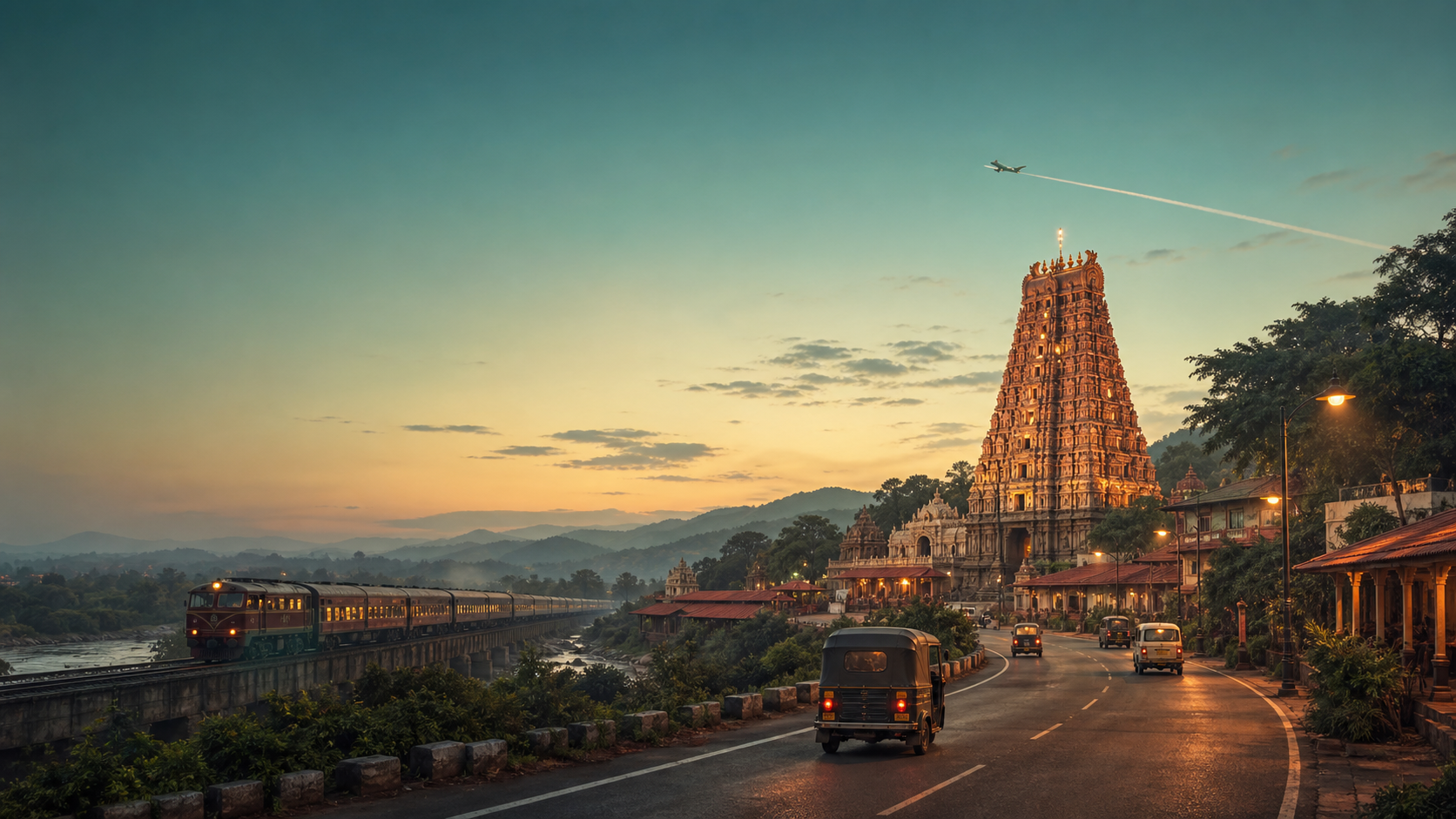
A complete pilgrim record drawn from the existing published article data.
Historical Foundation
Imperial Patronage Across Dynasties
The Mughal Interregnum & Layered Sovereignty
Colonial-Era Continuity & Modern Resurgence
Architecture & Craftsmanship
Nagara Revival in Braj Idiom
The Underground Garbhagriha: Engineering Sanctity
Frescoes, Inscriptions & Narrative Architecture
The Presiding Deity
Keshavdeva: The Infant Lord of the Prison Cell
Form: Infant Krishna (Balakrishna) in swaddling clothes, lying on a stone slab within the underground Garbhagriha
Iconography: Eight-armed Yogmaya shrine adjacent; garbha (womb-like) architecture; absence of jewellery—emphasising vulnerability and divine descent
Significance: Represents Krishna’s avatarana—deliberate descent into mortal limitation to restore dharma. The prison cell is not a site of confinement but of cosmic revelation.
Radha-Krishna: The Divine Couple of Bhagavata Bhavan
Form: 180 cm tall standing murti of Radha and Krishna in tender embrace
Iconography: Krishna holds flute and butter ball; Radha wears gopika attire with peacock feather crown; both adorned with fresh flowers daily
Significance: Embodies madhurya bhava (sweet, intimate love) as perfected in Braj. Their joint installation (1982) affirms Vallabhacharya’s doctrine that Radha is Krishna’s hladini shakti—his intrinsic bliss-energy.
Composite Theology in Stone
The complex uniquely houses eight distinct deity ensembles within one prakara: Radha-Krishna, Balarama-Subhadra-Jagannatha (linking Mathura to Puri), Rama-Lakshmana-Sita (affirming Vaishnava unity), Durga (Shakti aspect), Shiva (as Shivalinga), Hanuman (devotion personified), Chaitanya Mahaprabhu (Gaudiya lineage), and Garuda (divine vehicle). This is not syncretism but sampradaya-samavesh—the harmonious convergence of Vaishnava lineages, acknowledging that Krishna’s lila encompasses all manifestations of the divine.
Festivals & Living Traditions
Krishna Janmashtami: Midnight Revelation
Radhashtami & the Feminine Divine
Holi in Braj: The Festival of Colours & Liberation
Plan Your Visit
How to Reach & Best Time to Visit
Temple Etiquette & Visitor Guidelines
Full-Circuit Experience

Related temples: A. C. Bhaktivedanta Swami Prabhupada | Abhimanyu Temple, Vayotthidam
Sacred Stories & Mythology
The Midnight Birth & Yogmaya’s Deception
According to the Bhagavata Purana and Harivamsa, Devaki and Vasudeva were imprisoned by King Kamsa in Mathura’s dungeon after a prophecy foretold his death at the hands of Devaki’s eighth child. As the stars aligned on the eighth day of Bhadrapada, Krishna manifested—divine light filling the cell, chains falling away, guards falling into deep sleep. At that precise moment, Yogmaya—the goddess of divine illusion and Krishna’s internal potency—appeared as the infant’s sister. When Kamsa rushed to kill the newborn, the baby slipped from his grasp and ascended skyward, declaring, “Your destroyer is already born elsewhere.” This story is not mythic allegory but lived geography: the very stones beneath the Garbhagriha are believed to retain the vibration of that midnight revelation.
Vasudeva’s Yamuna Crossing
As Krishna’s birth concluded, Vasudeva received divine instruction to carry the infant to Gokul to protect him from Kamsa. Stepping out into torrential rain, he found the Yamuna river miraculously calmed, its waters parting to form a dry path. Serpents held their hoods above him as shelter; the night sky blazed with benevolent stars. This event—re-enacted annually during Janmashtami processions—is commemorated at the nearby Potra Kund, where Krishna is said to have taken his first ritual bath. Pilgrims believe the tank’s waters retain the sanctity of that inaugural purification—“To bathe in Potra Kund is to touch Krishna’s first breath.”
The Enduring Power of the Birthplace
Folk belief holds that the underground cell possesses inherent shakti: devotees report spontaneous tears, overwhelming peace, or visions when meditating there. Mothers bring infants for blessings; couples seeking progeny perform putrakameshti rituals; students pray for wisdom before examinations. These practices span millennia—Tavernier noted in 1650 that pilgrims would kiss the prison floor, while modern visitors leave cotton threads tied to iron grilles as vows. Such continuity transforms archaeology into living theology: the site’s power does not reside in its age alone, but in the unbroken chain of human longing it has witnessed and absorbed.
Saints, Poets & Devotees
Chaitanya Mahaprabhu: The Dancing Avatar
Vallabhacharya & the Philosophy of Pure Non-Duality
Modern Pilgrims & National Consciousness
Records, Marvels & Heritage
Archaeological Stratigraphy: A Timeline in Soil
Engineering Marvels: Potra Kund & Structural Integration
One-of-a-Kind Distinctions
🗺 How to Reach
Hover a card to animate the journey on the map
Route to Mathura
Common Questions
Where is Krishna Janmasthan Temple Complex: Birthplace of Krishna in located?
Krishna Janmasthan Temple Complex: Birthplace of Krishna in is documented at Mathura, Uttar Pradesh — within 1 km of Mathura Junction Railway Station.
Which deity is associated with Krishna Janmasthan Temple Complex: Birthplace of Krishna in?
Krishna Janmasthan Temple Complex: Birthplace of Krishna in is associated with Krishna.
Related Temples

A Living Covenant