A complete pilgrim record drawn from the existing published article data.
Historical Foundation
Origins and Early Legends
The Exodus to Barsana and Nandgaon
In a time of great peril, when the tyrannical King Kamsa wreaked havoc, the venerable leaders Nanda and Vrishbhanu took their communities to safety. Nanda, Krishna's father, migrated from Gokula to Nandgaon, establishing a new kingdom atop Nandishvar hill. Simultaneously, Vrishbhanu, Radha's father, led his people from Rawal to the serene Bhanugarh hill. This strategic move ensured the safety and flourishing of their families, with Bhanugarh becoming Radha's eternal dwelling place. Thus, Barsana and Nandgaon emerged as twin towns, each bearing historical temples dedicated to their respective divine children, Krishna and Radha.
Construction and Patronage
Architecture & Craftsmanship

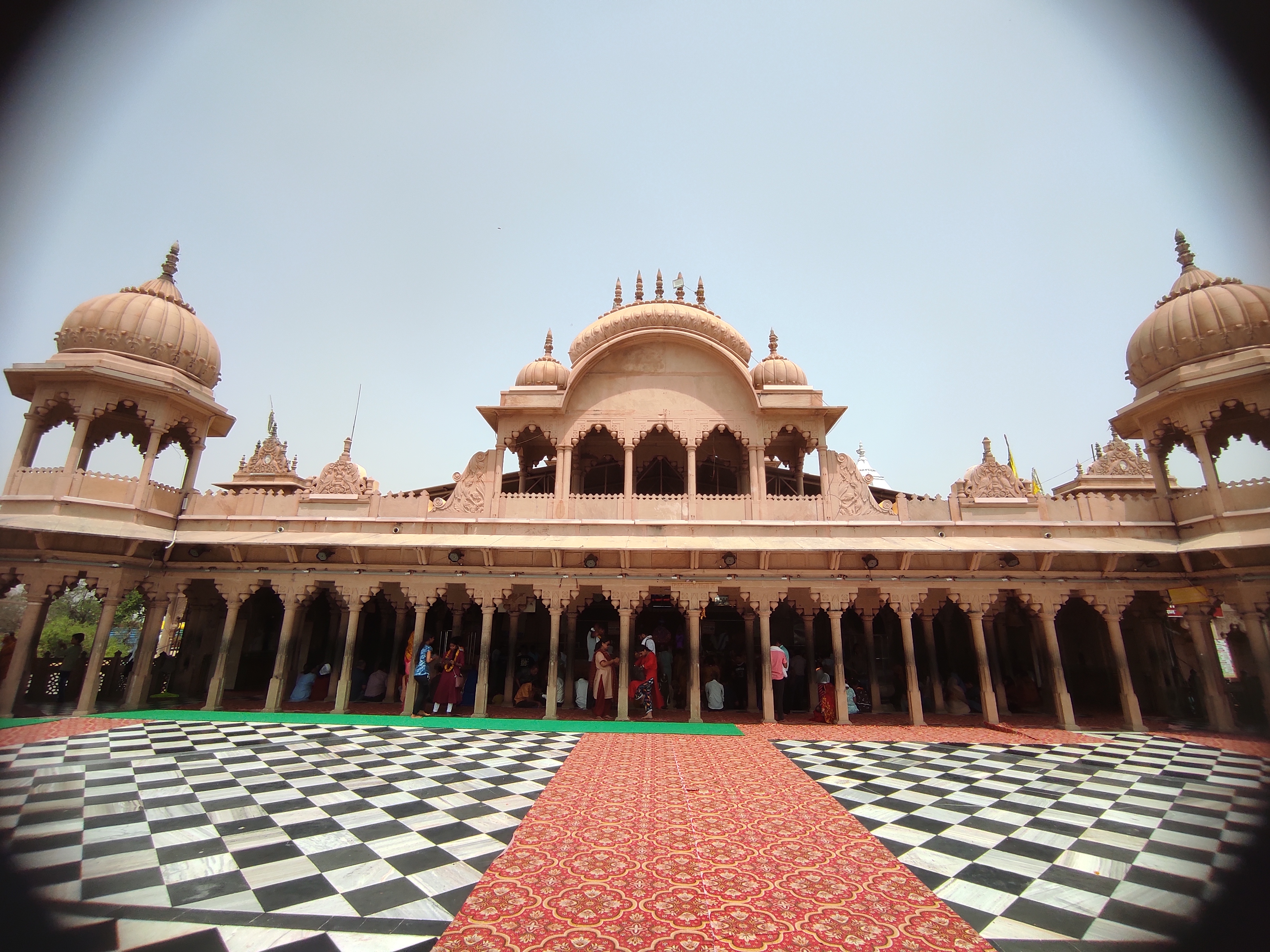
The grand exterior of Radha Rani Temple, showcasing its Rajput architectural elegance atop Bhanugarh Hill.
Rajput Grandeur and Mughal Influences
Elevation: Perched at an impressive 250 meters (820 feet) above sea level on Bhanugarh Hill, the temple offers breathtaking panoramic views of the surrounding Braj landscape.
Rajput Architecture
A distinctive architectural style that flourished in the kingdoms of Rajasthan and surrounding regions from the 16th century onwards. It is characterized by ornate carvings, intricate jharokhas (balconies), chhatris (domed pavilions), and often a fortified palace-like aesthetic, frequently blending Hindu and Islamic decorative motifs.
Artistic Details and Symbolism

Intricate wall paintings and carvings inside the Radha Rani Temple, depicting scenes from Radha-Krishna's pastimes.
The Presiding Deity
Shri Laadli Lal
Primary Deity: Radha
Deity Form: Shri Laadli Lal (Radha-Krishna together, emphasizing Radha as the beloved daughter of Barsana)
Consort Deity: Krishna
Significance: Represents the inseparable divine love and the theological elevation of Radha as the supreme energy (Shakti) and embodiment of divine love (Mahabhava) in Gaudiya Vaishnavism. The term 'Laadli Lal' affectionately refers to Radha as the 'beloved daughter' of Barsana, and Krishna as the 'beloved son' of Nandgaon, who is equally cherished in Barsana.
Secondary Deities: Vrishabhanu Maharaj, Kirtida, Shridama, Brahma, and the Ashtasakhi (Lalita, Vishakha, Champakalata, Chitra, Tungavidya, Indulekha, Rangadevi, Sudevi – Radha's eight principal companions).
Shri Laadli Lal: Radha as Supreme

The sacred idols of Shri Laadli Lal (Radha and Krishna) within the temple sanctum.
The Ashtasakhi and Companion Deities
Festivals & Living Traditions

Vibrant scenes from Lathmar Holi, a unique celebration centered around the Radha Rani Temple.
Radhashtami and Janmashtami Grandeur
The Vibrant Lathmar Holi
Peak Season Visitors: The temple receives several million visitors annually, with numbers soaring exponentially during major festivals like Lathmar Holi and Radhashtami.
Plan Your Visit
Getting There and Best Time
Visitor Guidelines and Nearby Attractions
Pro-Tip for Pilgrims
To fully immerse yourself in the local culture and explore all the associated sacred sites, allocate a minimum of half a day, though a full day is recommended. This allows ample time to visit the main temple, Vrishabhanu Palace, the Ashtasakhi Temple, and Pili Pokhar (Priya Kund) at a leisurely pace.
Related temples: Ahichchhatra Jain temples | Amethi Temple
Sacred Stories & Mythology
The Braj Lila and Radha's Abode
Radha's Childhood in Barsana
Barsana is celebrated as the sacred ground where Radha spent her childhood, indulging in countless divine pastimes with Krishna. From playful chases across the verdant hills to secret rendezvous in secluded groves, every aspect of her early life is imbued with spiritual significance. It is here that Radha honed her unparalleled beauty and charm, captivating Krishna and inspiring devotion throughout Braj. The tales of her innocence, her fierce love, and her profound spiritual connection with Krishna are deeply embedded in the local folklore, making Barsana a living testament to their eternal bond.
Lathmar Holi: A Playful Divine Saga
The Legend of Lathmar Holi
The legend of Lathmar Holi harks back to the playful antics of Krishna. It is said that Krishna, ever the mischievous prankster, would often visit Barsana from Nandgaon with his friends to tease Radha and her sakhis. The women of Barsana, known for their spirited nature, would not take this teasing lightly. Armed with sticks (lathis), they would playfully chase and beat the men, who would protect themselves with shields. This endearing, spirited exchange became a cherished tradition, culminating in the annual Lathmar Holi, which is celebrated with unmatched fervor at the Radha Rani Temple, drawing participants and spectators from across the globe to witness this unique spectacle of divine play.
Saints, Poets & Devotees
Narayan Bhatt and Gaudiya Vaishnavism
Literary Tributes and Devotional Streams
Records, Marvels & Heritage
Unique Theological Significance
Conservation and Modern Impact
Key Takeaway
The Radha Rani Temple stands as a unique monument of devotion, distinctively positioning Radha as the supreme deity in her own right. Its historical grandeur, vibrant traditions, and profound theological significance ensure its enduring legacy as a spiritual heartland of Braj Bhumi.
🗺 How to Reach
Hover a card to animate the journey on the map
Route to Barsana
Common Questions
Where is Radha Rani Temple, Barsana: Home of Shri Laadli Lal located?
Radha Rani Temple, Barsana: Home of Shri Laadli Lal is documented at Barsana, Uttar Pradesh.
Which deity is associated with Radha Rani Temple, Barsana: Home of Shri Laadli Lal?
Radha Rani Temple, Barsana: Home of Shri Laadli Lal is associated with Radha.
Related Temples


A Living Covenant