



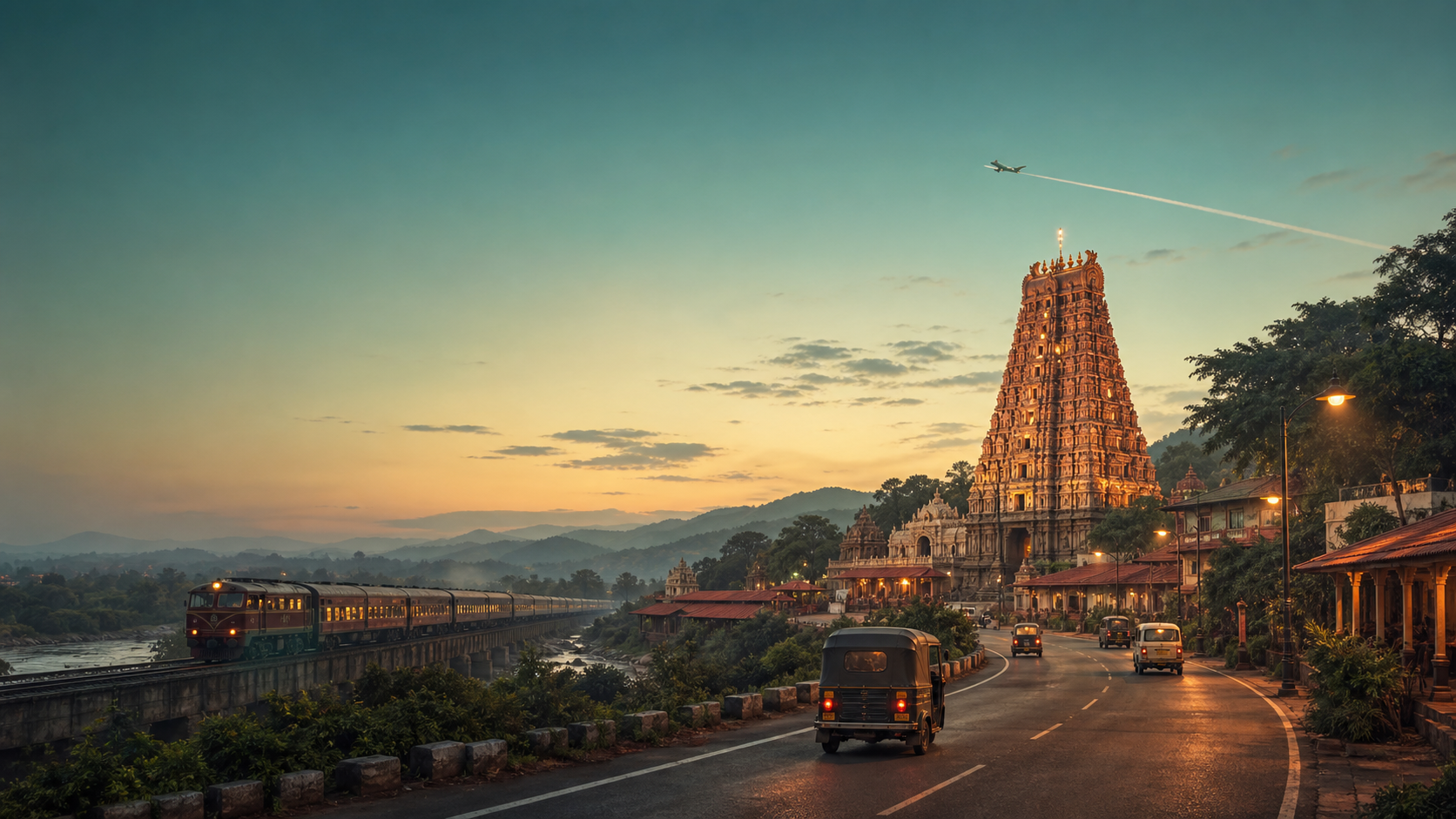
A complete pilgrim record drawn from the existing published article data.
Historical Foundation
The Divine Mandate: Rani Rashmoni’s Vision
The Tortoise-Shaped Land
Acting with unwavering faith, Rani Rashmoni immediately halted her pilgrimage and began searching for suitable land along the Hooghly. She acquired a 12,000-hectare tract—later narrowed to the core 8.1-hectare (20-acre) plot known as Saheban Bagicha—purchased from an Englishman named Jake Hastie. Crucially, local geomancers and Tantric scholars confirmed the site’s sacred topography: the land bore a natural contour resembling a tortoise (kurma).
In the Devi Bhagavata Purana and Tantra Sara, the tortoise symbolizes stability, primordial support, and the foundation upon which cosmic energy (Shakti) manifests. This alignment was not mere symbolic ornamentation; it represented deliberate, esoteric engineering, making Dakshineswar one of the few temples in India where geography itself functions as a ritual mandala.
From Vision to Vastu: Construction & Consecration
Legal Legacy & Modern Stewardship
Architecture & Craftsmanship
Navaratna Brilliance: Form, Symbolism, and Structural Ingenuity
What is Navaratna Architecture?
Navaratna (“nine-jewel”) is a distinctive temple typology originating in medieval Bengal. It features a central sanctum surmounted by nine spires arranged in a quincunx pattern (four corners + one center on lower tier; four corners + one center on upper tier). Unlike North Indian nagara or South Indian dravida styles, navaratna temples prioritize vertical rhythm and symbolic geometry over sculptural density. At Dakshineswar, this style achieves unprecedented scale and harmony—the tallest spire soars over 30 meters, visible from the Hooghly ferry crossings.
The Sacred Compound: Courtyard, Ghat, and Nahabat Acoustics
Terracotta Narratives & Folk-Art Vitality
The Presiding Deity
Bhavatarini Kali: Iconography, Theology, and Manifestation
Name: Bhavatarini (“She who saves from the ocean of worldly existence”)
Form: Standing on the supine chest of Shiva, right foot on His heart, left foot on His thigh; four arms holding sword, severed head, bowl of blood, and blessing gesture (varada mudra).
Throne: Silver thousand-petaled lotus (sahasrara padma), symbolizing the crown chakra and ultimate consciousness.
Attire: Red silk sari, garland of human skulls (mundamala), tongue protruding—signifying consumption of ego.
Theological Significance: Embodies the Para Shakti aspect—beyond form, time, and duality—yet accessible through compassionate grace. Her stance on Shiva affirms that even Absolute Consciousness (Shiva) is inert without Creative Power (Shakti).
This specific iconography is exceptionally rare. While Kali often appears standing on Shiva in Tantric texts, few temples install such a form as the primary deity. Dakshineswar’s Bhavatarini uniquely combines explicit Shakta-Tantric iconography (tortoise land, supine Shiva, silver lotus) with mainstream devotional accessibility, evidenced by her alternate name Jagadishwari (Goddess of the Universe), invoked in daily arati songs.
Radha-Krishna & the Sankirtana Tradition
Rani Rashmoni & Sarada Devi: Deified Devotees
Festivals & Living Traditions
Kali Puja: Illuminating the Darkness
Snana Yatra: The Anniversary of Divine Descent
Durga Puja & Kalpataru Day: Syncretic Celebrations
Plan Your Visit
Logistics & Accessibility
Temple Map & Key Zones

Nearby Temple Circuit & Cultural Integration


Sacred Stories & Mythology
The First Vision: Ramakrishna’s Ecstatic Breakthrough (c. 1857)
After assuming priesthood in 1856, young Gadadhar Chatterjee (later Sri Ramakrishna) entered a state of intense spiritual yearning. He performed rigorous tantric sadhanas, worshipping Kali with mantras, flowers, and tears—yet felt no tangible response. Overwhelmed by despair one afternoon, he seized a sword from the temple armory and rushed toward the Kali shrine, vowing to end his life if She did not reveal Herself.
As he raised the sword, a wave of infinite, blissful light erupted from the idol—not as a physical form but as an all-consuming consciousness. He fell unconscious. When he awoke, the world transformed: every leaf, every stone, every face shimmered with divine presence. This marked his first God-vision, documented in The Gospel of Sri Ramakrishna (Chapter IV). The temple’s Snana Yatra inscription, dated 31 May 1855, thus marks not just the idol’s installation but the beginning of a continuous, embodied revelation.
The Miracle of the Hibiscus: A Test of Faith
A lesser-known but widely recounted miracle involves a skeptical Brahmin priest who doubted Ramakrishna’s visions. He challenged him: “If Kali truly manifests, let Her make this hibiscus flower bloom out of season.” It was mid-winter, a time when hibiscus does not typically bloom. Ramakrishna bowed before the idol, wept, and prayed.
Within minutes, a single crimson hibiscus, identical to the summer variety, unfurled on a bare winter stem beside the shrine. The priest immediately prostrated himself, became Ramakrishna’s lifelong devotee, and later served as chief priest during Kali Puja. This story, preserved in oral tradition and Ramakrishna Kathamrita, underscores Dakshineswar’s role as a site of ongoing, verifiable divine intervention, not just historical memory.
The Kalpataru Vision: Tree of Fulfillment
“The Mother is not in the temple alone. She is in the heart of the devotee—and the heart of the devotee is Her true temple.”
— Sri Ramakrishna, The Gospel of Sri Ramakrishna
Saints, Poets & Devotees
Sri Ramakrishna: The Sadhaka Who Became the Scripture
Sarada Devi: The Holy Mother’s Silent Strength
Swami Vivekananda: From Narendranath to World Teacher
Records, Marvels & Heritage
Engineering Marvels: Topography, Acoustics, and Endurance
Documentary Legacy: Inscriptions, Trust Records, and Ethnography
Conservation & Contemporary Challenges
“This land shaped like a tortoise is not geography—it is a yantra. To stand here is to stand within the body of the Divine.”
— Dr. S. K. Mitra, Rani Rashmoni: A Biography
🗺 How to Reach
Hover a card to animate the journey on the map
Route to Bally
Common Questions
Where is Dakshineswar Kali Temple: Bhavatarini’s Sacred Abode & Ramakrishn located?
Dakshineswar Kali Temple: Bhavatarini’s Sacred Abode & Ramakrishn is documented at Uttar Pradesh.
Which deity is associated with Dakshineswar Kali Temple: Bhavatarini’s Sacred Abode & Ramakrishn?
Dakshineswar Kali Temple: Bhavatarini’s Sacred Abode & Ramakrishn is associated with Kali.
Related Temples


A Living Covenant