A complete pilgrim record drawn from the existing published article data.
Divine Origins: The Elephant's Penance and Shiva's Grace
The Airavatesvara Temple derives its name from a profound legend involving Airavata, the white elephant mount of Lord Indra. According to mythology, Airavata suffered a curse from Sage Durvasa, causing its skin to lose its pristine white color. To regain its original hue and alleviate its suffering, Airavata worshipped Lord Shiva at this very spot. Pleased by the elephant's devotion, Shiva restored Airavata's color and bestowed upon him a boon. The temple tank, known as Yamateertham, is believed to have restorative powers, reflecting the legend of Airavata's penance and Shiva's compassion.
Airavata's Curse
Airavata, Indra's celestial elephant, was cursed by Sage Durvasa, leading to discoloration and suffering, prompting its penance to Lord Shiva.
Shiva's Blessing
Through devout worship and bathing in the sacred tank, Airavata regained its white complexion, symbolizing Shiva's grace and the power of devotion.
Yamateertham's Significance
The temple's sacred tank, Yamateertham, is associated with the legend, believed to possess healing properties and is named after Yama, who also worshipped Shiva here.
Experiencing Airavatesvara: A Visitor's Guide
Visitors to Airavatesvara Temple can immerse themselves in its spiritual and artistic ambiance. The temple is open from 6:00 AM to 12:30 PM and 4:00 PM to 9:00 PM. The best time to visit is between October and March, when the weather is pleasant. While there is no strict dress code, traditional attire is preferred, and footwear must be removed before entering. Allow 1-2 hours to explore the intricate carvings and soak in the serene atmosphere. Parking is available near the temple premises, making it easily accessible.
Timings and Best Season
The temple welcomes devotees and tourists during specific morning and evening hours, with the cooler months offering the most comfortable visiting experience.
Etiquette and Duration
Respectful attire and removal of footwear are customary. A typical visit allows ample time to appreciate the temple's art and architecture.
Accessibility and Facilities
Located conveniently near Kumbakonam, the temple offers parking and is well-connected by road, ensuring ease of access for all visitors.
| Deity | Shiva |
|---|---|
| Form | Shiva is often depicted in various forms, including the cosmic dancer Nataraja, the ascetic yogi, or as a lingam, representing his aniconic presence. |
| Consort | Parvati |
| Sampradaya | Hindu |
| Significance | Shiva is one of the principal deities of Hinduism, known as the Destroyer or Transformer within the Trimurti. He is revered as the supreme being who creates, protects, and transforms the universe. |
The Elephant's Redemption
Legend has it that Airavata, the white elephant of Lord Indra, was cursed with a loss of its pristine white color. Distressed, Airavata sought salvation and worshipped Lord Shiva at this very spot. It is said that the elephant bathed in the temple tank, now known as Airavata Tirtham, and through its sincere devotion, was cured of the affliction, regaining its radiant white hue. This miraculous event gave the temple its name, Airavatesvara, signifying 'Lord of Airavata,' and underscores the temple's profound spiritual power and the compassionate nature of Shiva.
In Shiva, the cosmic dance of creation and destruction finds its eternal rhythm.
Every stone whispers tales of devotion, every sculpture a hymn to the divine.
Dravidian Masterpiece: Carved in Stone
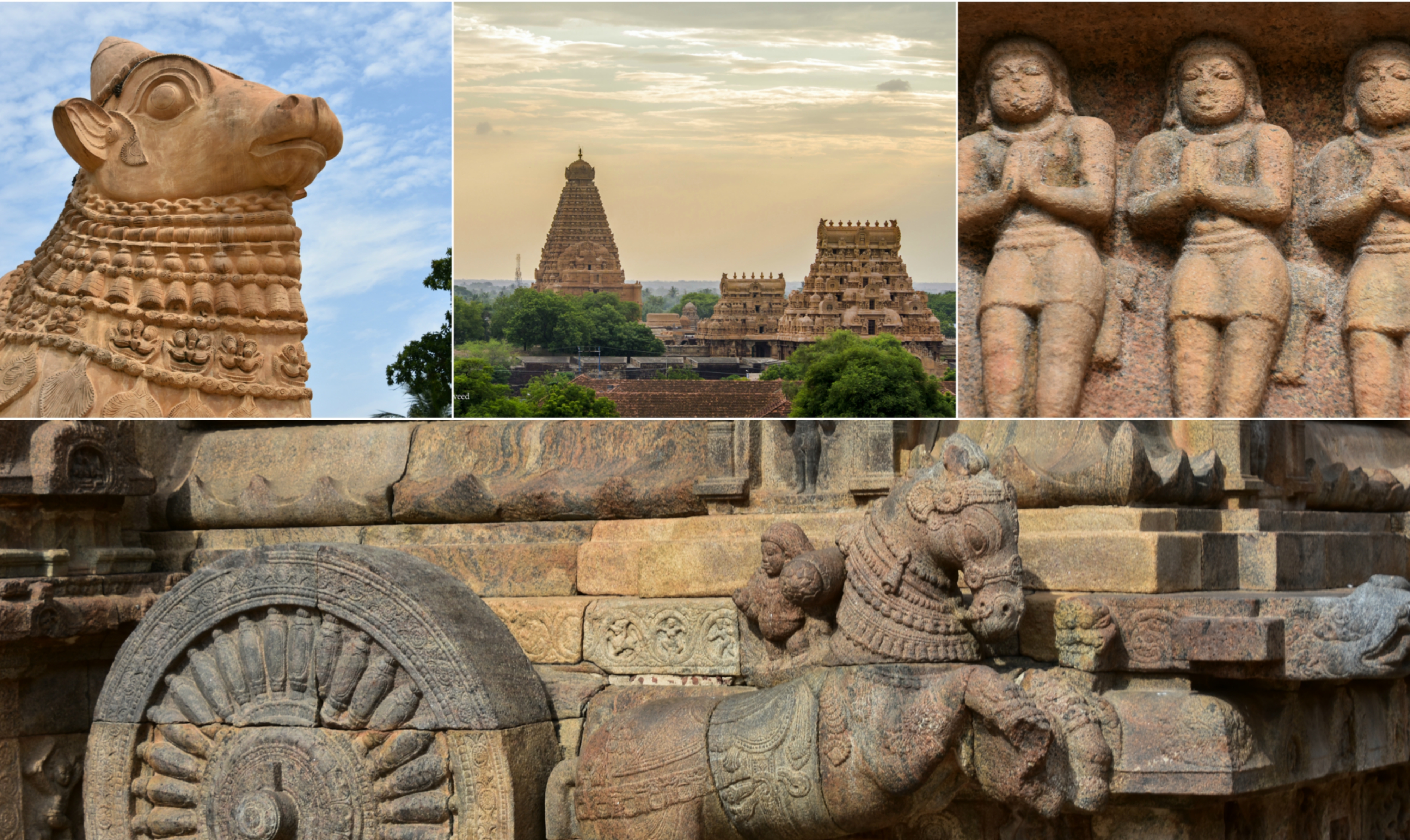
The Airavatesvara Temple is a quintessential example of Dravidian architecture, distinguished by its compact yet elaborate design. The vimana, or main shrine tower, though smaller than its counterparts in Thanjavur and Gangaikondacholapuram, is exquisitely detailed. The maha mandapa (great hall) and mukha mandapa (front hall) feature pillars adorned with intricate carvings of deities, celestial beings, and narrative panels. A unique feature is the stone wheel chariot, a recurring motif in Chola temples. The plinth, resembling a chariot, is pulled by sculpted elephants and horses, a visual marvel.
The Vimana and Mandapas
The vimana rises gracefully, while the mandapas are supported by numerous pillars, each a canvas for detailed mythological scenes and decorative motifs.
Musical Steps and Chariot Base
The temple's balustrade contains "musical steps" that produce different notes when tapped. The upapitha (sub-base) is carved to resemble a chariot, a distinctive architectural element.
Iconographic Richness
Sculptures depict Shiva in various forms, along with other Hindu deities, apsaras, gandharvas, and scenes from the Periya Puranam, a Tamil epic on Shaivite saints.
Airavatesvara Temple: A Jewel of Chola Artistry
The Airavatesvara Temple, located in Darasuram, Tamil Nadu, stands as a magnificent testament to the architectural prowess of the Chola dynasty. Consecrated to Lord Shiva, this 12th-century temple is recognized as a UNESCO World Heritage Site, forming part of the "Great Living Chola Temples." Its intricate carvings, sculptural brilliance, and unique structural design exemplify the zenith of Dravidian art, captivating visitors with its historical and artistic grandeur. It remains an active place of worship and a vital cultural landmark.
UNESCO Recognition
In 2004, Airavatesvara Temple was designated a UNESCO World Heritage Site, acknowledging its outstanding universal value as a masterpiece of human creative genius and its significance in the history of architecture.
Chola Architectural Zenith
The temple showcases the mature phase of Chola architecture, characterized by its refined proportions, detailed iconography, and harmonious integration of various art forms.
Sculptural Narratives
Every surface of the temple narrates stories from Hindu mythology, epic poems, and daily life, carved with exceptional skill and artistic sensitivity.
The Chola Legacy: Building Airavatesvara
Constructed during the reign of King Rajaraja Chola II (1146-1172 CE), the Airavatesvara Temple reflects the artistic and religious fervor of the Chola empire. Built as a "miniature" version of the larger Brihadisvara temples, it was part of a grand scheme to project Chola power and devotion. Rajaraja II named the deity Rajarajeshwaramudaiyar, signifying his personal devotion. The temple served as a royal temple, a center for arts, and a repository of cultural knowledge, embodying the Chola state's patronage of religion and art.
Royal Patronage
King Rajaraja Chola II commissioned the temple, demonstrating the Chola monarchs' deep commitment to temple building as a form of devotion and political expression.
Architectural Evolution
The temple represents a stylistic evolution within Chola architecture, showcasing a transition towards more ornate and intricate detailing compared to earlier Chola temples.
Cultural Hub
Beyond its religious function, Airavatesvara served as a vibrant cultural hub, fostering dance, music, and scholarly pursuits under royal patronage.
🗺 How to Reach
Hover a card to animate the journey on the map
Verified routes to Airavatesvara Temple Darasuram: Legends and Mythology: Sacred Stories and Divine Origins
Common Questions
Where is Airavatesvara Temple: Unraveling Divine Legends located?
Airavatesvara Temple: Unraveling Divine Legends is documented at Tamil Nadu.
Which deity is associated with Airavatesvara Temple: Unraveling Divine Legends?
Airavatesvara Temple: Unraveling Divine Legends is associated with Shiva.