



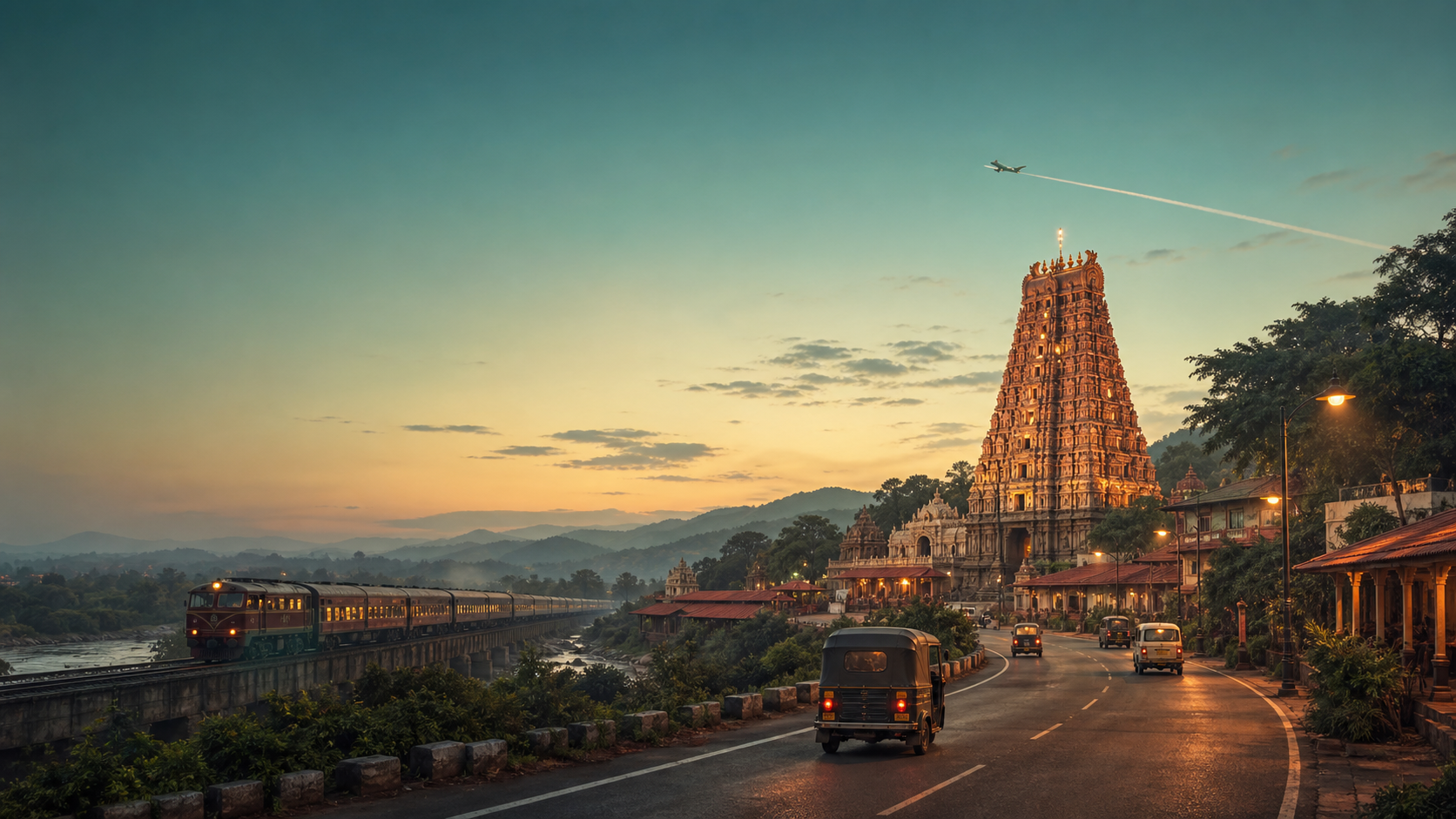
A complete pilgrim record drawn from the existing published article data.
Historical Foundation
The Imperial Mandate Behind Stone
Post-Chola Continuity & Adaptation
Inscriptions as Living Archives
Architecture & Craftsmanship
The Granite Revolution
Vimanam: The Cosmic Mountain Ascendant
Mandapas & Acoustic Mastery

Sculptural Narrative as Theology
The Presiding Deity
Shiva as Brihadisvara (Thanjavur)
Form: Cosmic Sovereign (Maheshvara)
Iconography: Massive granite linga (one of India’s largest), flanked by Nandi facing east, Dakshinamurti in the southern niche, and Chandeshvarar in the southwest.
Theological Significance: Embodies Shiva as the supreme ruler of time, space, and consciousness — mirroring Rajaraja I’s imperial authority. The temple’s orientation ensures the first rays of the equinoctial sunrise strike the linga, symbolising perpetual creation.
Unique Ritual: Nataraja Puja performed daily with rhythmic bell sequences — referencing the 11th-century canonical Nataraja bronze commissioned here, now a global icon of Indian art.
Shiva as Gangai Konda (Gangaikonda Cholapuram)
Form: Conqueror of Sacred Geography
Iconography: Linga installed with Ganges water brought by Rajendra Chola’s army; Harihara (half-Shiva, half-Vishnu) and Ardhanarishvara (half-Shiva, half-Parvati) as central theological statements.
Theological Significance: Asserts Shiva’s dominion over all sacred rivers and traditions — the Ganges representing North Indian orthodoxy, integrated into Tamil Shaiva cosmology.
Unique Ritual: Annual Gangai Abhishekam where sanctified Ganges water is poured over the linga, re-enacting the emperor’s triumphant return.
Shiva as Airavatesvara (Darasuram)
Form: Purifier and Compassionate Healer
Iconography: Linga worshipped by Airavata (depicted in multiple reliefs); Saptamatrikas (Seven Mothers), Durga, Saraswati, and Lakshmi in subsidiary shrines.
Theological Significance: Emphasises Shiva’s grace (anugraha) over destruction (samhara), accessible through penance and devotion — embodied by Airavata’s story.
Unique Ritual: Airavata Snanam — ceremonial bathing of the elephant icon with milk and honey, believed to confer protection from curses and misfortune.
Consorts & Cosmic Complementarity
Secondary Deities: A Pan-Indian Pantheon
Festivals & Living Traditions
Mahashivaratri: The Night of Cosmic Dissolution
Aipassi Annabhishekam: Rice as Divine Offering
Chithirai Festival: Divine Marriage Re-enacted
Plan Your Visit
Visiting all three temples meaningfully requires contextual preparation — they are not drive-by attractions, but immersive experiences demanding time, reverence, and awareness.
Logistics & Accessibility
Etiquette & Practicalities
Suggested Itinerary
Related temples: Aakkoor Thanthondreeswarar Temple | Aazhimala Shiva Temple
Sacred Stories & Mythology
Airavata’s Penance at Darasuram
According to the Darasuram Sthala Purana, Indra’s celestial elephant Airavata once grew arrogant, trampling sacred lotus ponds in Kailash. Cursed to lose his whiteness and strength, he wandered earth until guided by sages to this site. There, he fashioned a linga from river clay and performed intense penance for a thousand years. Moved by his devotion, Shiva appeared, restored his radiance, and declared the place Airavatesvara — 'Lord of Airavata'. The temple’s very layout mirrors this narrative: the main sanctum faces east (where Airavata first saw Shiva), the western gopuram depicts his supplication, and the stone chariot — said to have "moved spontaneously during festivals in ancient times" — symbolises his regained celestial mobility. Devotees still circumambulate the chariot seven times seeking liberation from ego-driven suffering.
Rajaraja’s Divine Blueprint
Thanjavur’s origin story, recorded in inscriptions and the Periya Puranam, tells of Rajaraja I’s insomnia during a military campaign. In a dream, Shiva appeared as a radiant youth, sketching temple plans on his palm and declaring, "Build this, and your dynasty shall endure as long as this stone stands." Upon waking, the king summoned his chief architect, Kunjara Mallan Raja Raja Perunthachan, and dictated every dimension from memory. The resulting temple — with its precise 1:1 ratio between vimanam height and base width — became a physical manifestation of divine geometry. Modern surveys confirm its cardinal alignment is accurate to within 0.05 degrees — a testament to the king’s remembered vision and the architect’s flawless execution.
The Ganges Conquest & Sacred Hydrology
Rajendra Chola I’s northern campaign (1022–1024 CE) was not merely territorial — it was a ritual conquest of sacred geography. His inscriptions boast of digging a canal from the Ganges to his new capital, filling temple tanks with its water, and establishing a 'Ganga Tirtha' (Ganges pilgrimage site) in the heart of Tamilakam. The Gangaikonda Cholapuram Brihadisvara thus performs a theological alchemy: transforming the distant, abstract Ganges into an immediate, tangible source of spiritual power. Pilgrims bathing in its tank aren’t merely cleansing physically — they’re participating in the emperor’s cosmic triumph, merging North Indian tirtha (pilgrimage) with Tamil sthala (sacred place) traditions. This act established a precedent for later South Indian temples to incorporate 'Ganges water' in consecration rites — a practice continuing unbroken for a millennium.
Saints, Poets & Devotees
The Tevaram Triumvirate
Devadasis: Architects of Sacred Sound
Modern Pilgrims & Cultural Stewards
Records, Marvels & Heritage
These temples are archives of human achievement — recording feats of engineering, artistry, and administration that continue to astonish experts.
Thanjavur’s Engineering Enigmas
Airavatesvara’s Narrative Uniqueness
UNESCO Recognition & Conservation Ethics
🗺 How to Reach
Hover a card to animate the journey on the map
Route to Thanjavur
Common Questions
Where is Great Living Chola Temples: UNESCO Heritage of Tamil Shaivism located?
Great Living Chola Temples: UNESCO Heritage of Tamil Shaivism is documented at Tamil Nadu.
Which deity is associated with Great Living Chola Temples: UNESCO Heritage of Tamil Shaivism?
Great Living Chola Temples: UNESCO Heritage of Tamil Shaivism is associated with Shiva.
Related Temples


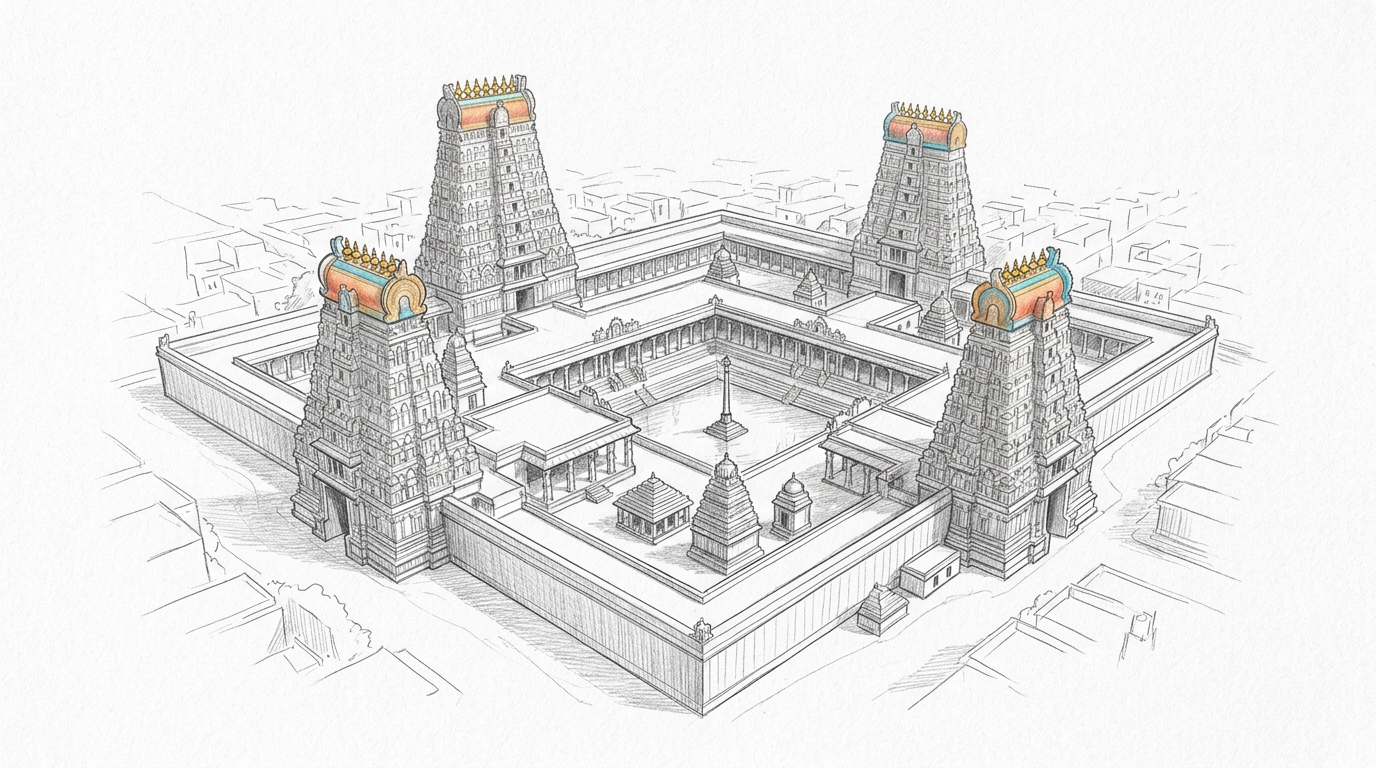
A Living Covenant