



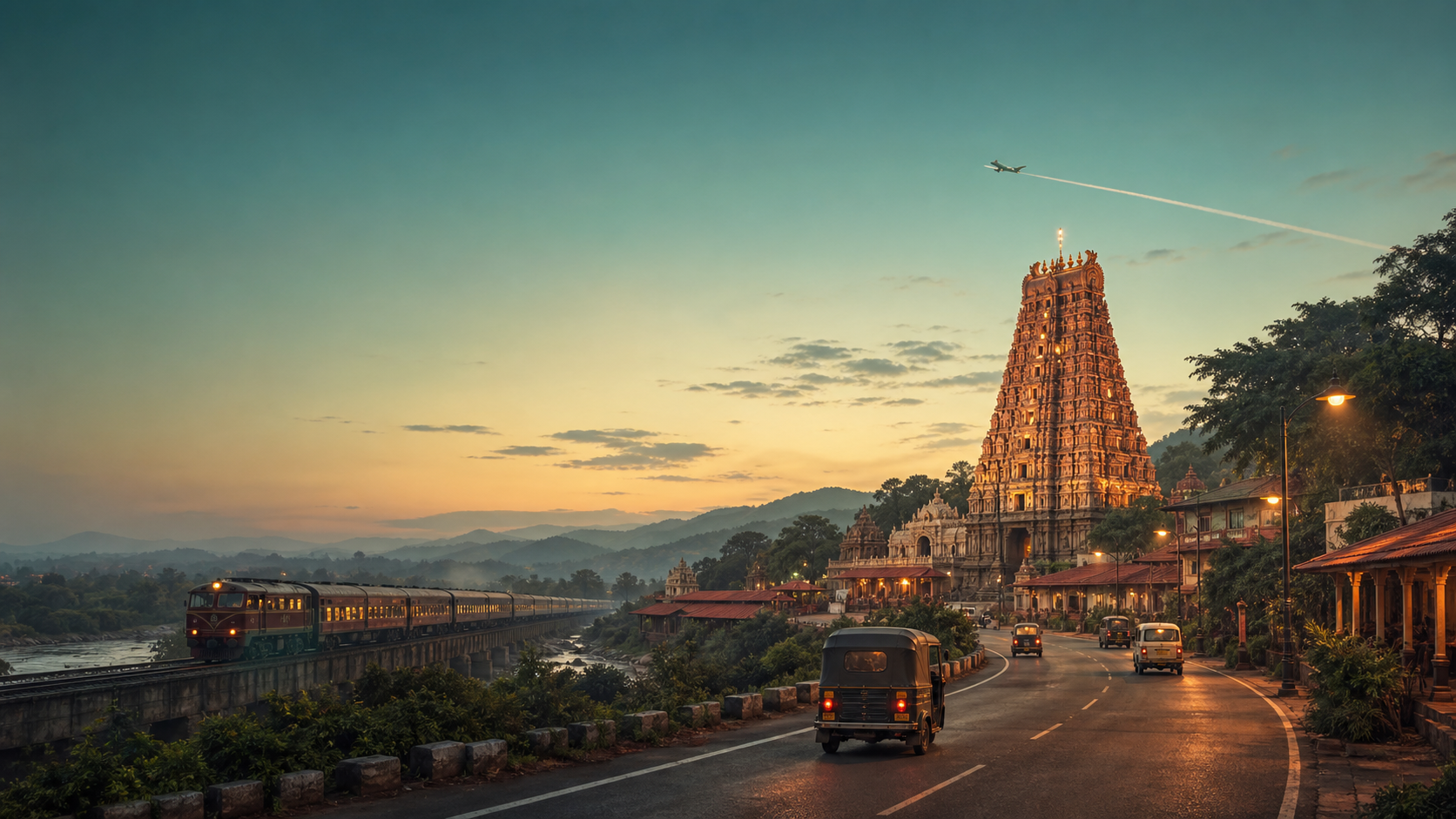
A complete pilgrim record drawn from the existing published article data.
Brihadisvara Temple: A Testament to Chola Grandeur
The Brihadisvara Temple, completed in 1010 CE by the Chola dynasty, stands as a monumental example of Dravidian architecture. Constructed primarily of granite, it showcases the Chola empire's unparalleled architectural prowess, profound religious devotion, and artistic excellence. Recognized as a UNESCO World Heritage Site and an Archaeological Survey of India (ASI) protected monument, its sheer scale and intricate details continue to captivate visitors, reflecting a golden age of South Indian artistry and engineering. The temple's enduring presence is a testament to the Chola's lasting cultural legacy.
Architectural Prowess
Built between 1003 and 1010 CE, the temple's construction from granite demonstrates advanced engineering and artistic skill.
UNESCO World Heritage Site
The Brihadisvara Temple is a designated UNESCO World Heritage Site, celebrated for its outstanding universal value.
Artistic Excellence
The temple complex is adorned with intricate carvings and sculptures, reflecting the peak of Chola artistic expression.
Planning Your Pilgrimage: Experiencing the Great Living Chola Temple
A visit to the Brihadisvara Temple offers an immersive journey into ancient Indian heritage. The temple is open to visitors with free entry, though specific timings should be confirmed locally. The best time to visit is from October to March, or during the Chithirai (April–May) and Aipassi (October–November) festivals for a vibrant experience. Modest dress is required, covering shoulders and knees, and footwear must be removed before entering the complex. Allow 3-4 hours to appreciate its historical, architectural, and spiritual significance. The temple is well-connected by bus and train within Thanjavur city.
Visitor Information
Entry is free, but modest dress is required, and footwear must be removed. Allow 3-4 hours for a comprehensive visit.
Best Time to Visit
The ideal period is October to March, or during the Chithirai and Aipassi festivals for cultural immersion.
Reaching the Temple
The temple is easily accessible by bus and train, located within Thanjavur city limits. Tiruchirappalli International Airport is 55 km away.
| Deity | Shiva |
|---|---|
| Form | Shiva is primarily worshipped in the form of a Lingam, specifically a massive Karuvarai linga standing 8.7 meters tall within the sanctum. |
| Consort | Parvati |
| Sampradaya | Shaiva |
| Significance | Shiva is revered as the supreme cosmic sovereign, embodying both creation and destruction, and is central to the temple's identity as Dakshina Meru, the southern axis mundi. |
The Cosmic Axis of Rajaraja
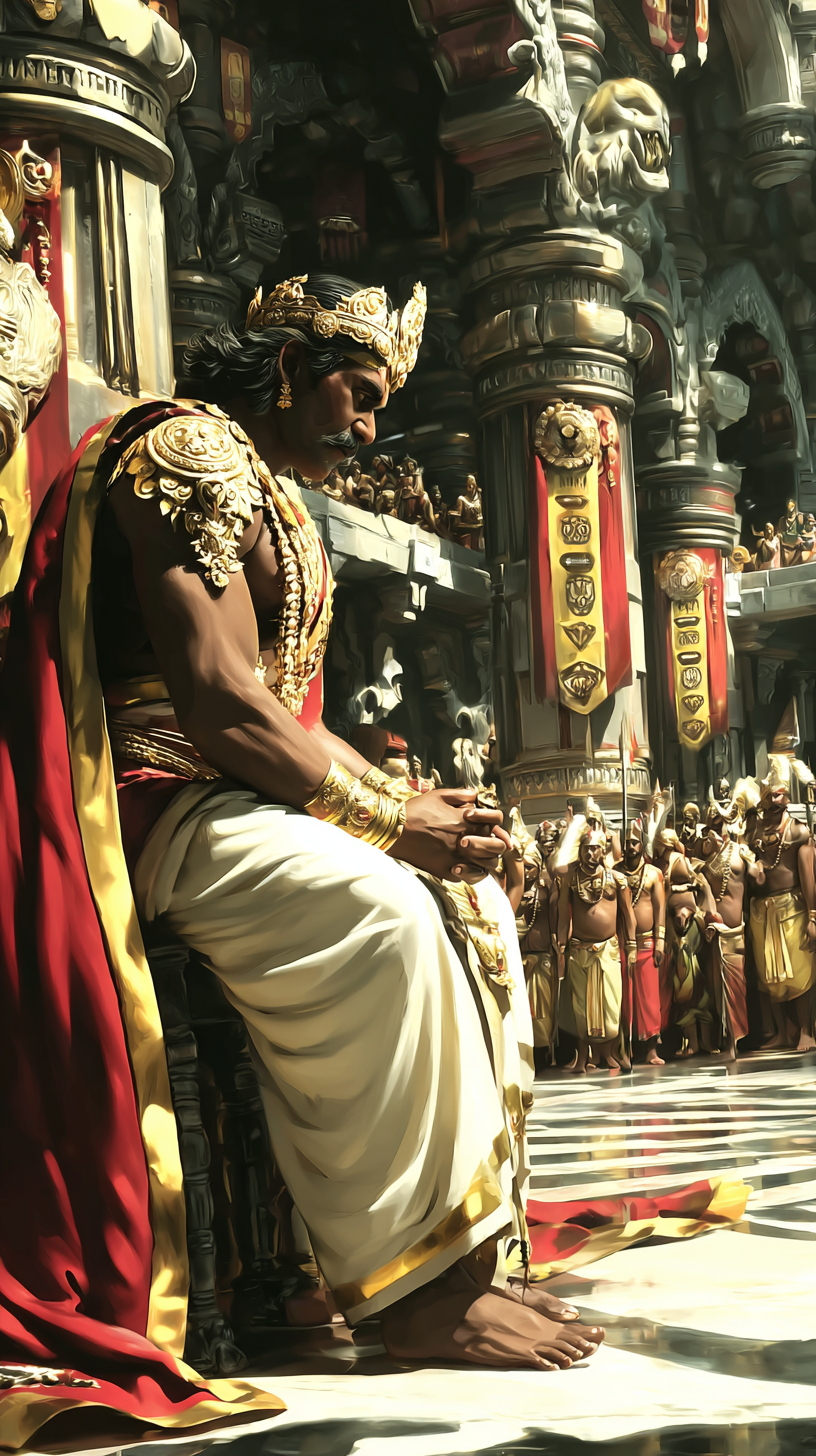
Long ago, the mighty Chola emperor Rajaraja I harbored a divine vision: to erect a temple that would stand as Shiva's supreme cosmic abode on Earth, a majestic Dakshina Meru, the southern axis mundi. This grand Brihadisvara Temple was not merely a structure of stone but a celestial alignment in granite, a profound act of devotion meant to enshrine Shiva as both the cosmic destroyer and regenerator, consolidating the Chola empire's spiritual and temporal power. Legends whisper that the temple's colossal vimana casts no shadow on the ground, an acoustic and optical marvel attributed to the precise astronomical calculations and engineering genius guided by divine inspiration. This architectural wonder is believed to pulse with a self-sustaining energy field, a 'kshetra shakti,' stemming from its profound Meru symbolism and the sheer scale of its sacred Lingam, making it a living testament to Shiva's omnipresence.
The Brihadisvara Temple stands as Shiva's supreme cosmic abode on Earth, a majestic Dakshina Meru, a celestial alignment in granite.
This architectural wonder is believed to pulse with a self-sustaining energy field, a 'kshetra shakti,' a living testament to Shiva's omnipresence.
Related temples: Aakkoor Thanthondreeswarar Temple | Abhaya Varadeeswarar Temple, Adirampattinam
The Vision of Raja Raja Chola I: Building a Divine Legacy
Commissioned by the mighty Chola emperor Rajaraja I, construction of the Brihadisvara Temple began in 1003 CE and concluded in 1010 CE. This ambitious undertaking marked a pivotal moment in South Indian history, embodying the empire's power and profound cultural and religious aspirations. Rajaraja I envisioned it as a "cosmic axis," a grand Shiva temple reflecting the Chola dominion and spiritual might. The temple's construction consolidated the Chola empire's spiritual and temporal power, making it a living testament to Shiva's omnipresence.
Imperial Patronage
Emperor Rajaraja I initiated the temple's construction, dedicating it to Shiva and solidifying his empire's spiritual authority.
Founding and Consecration
Construction commenced in 1003 CE and was completed seven years later, with the temple consecrated in 1010 CE.
The Cosmic Axis Narrative
Legend states Rajaraja I sought to build a temple representing Shiva's cosmic abode, a 'Dakshina Meru' or southern axis mundi.
Dravidian Masterpiece: Engineering and Artistry in Stone
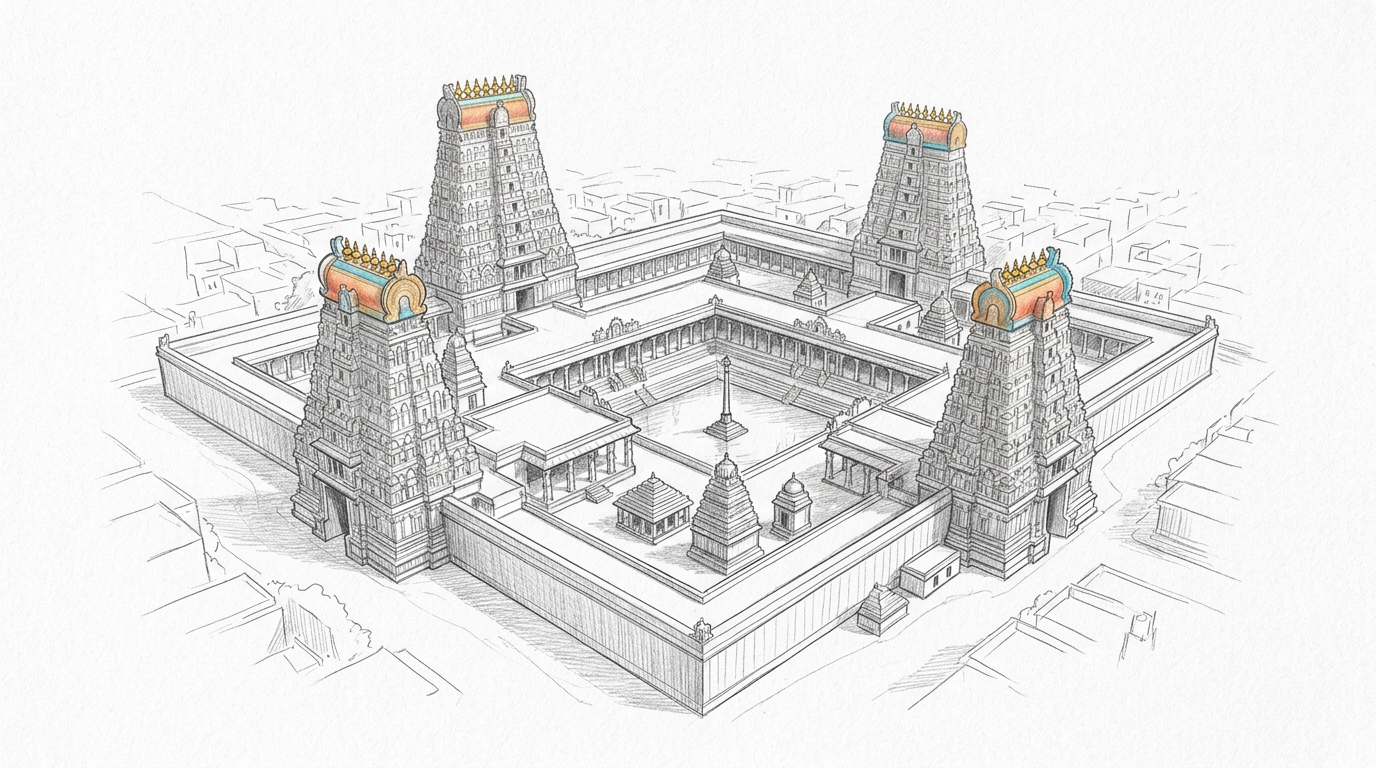
The Brihadisvara Temple exemplifies the pinnacle of Dravidian architecture, a style characterized by its towering vimana (temple tower) and intricate sculptural work. Its vimana, standing approximately 60 meters high, is a marvel of engineering, built from precisely cut granite blocks. Within the temple complex, a massive monolithic Nandi statue, carved from a single rock, faces the main shrine. The temple's walls are adorned with intricate carvings and frescoes, including depictions of Shiva's Lingodbhava, showcasing advanced engineering techniques and sophisticated artistic expression of the Chola period. This architectural wonder is believed to pulse with a self-sustaining energy field, a 'kshetra shakti,' stemming from its profound Meru symbolism.
The Soaring Vimana
The temple's towering vimana, a pyramidal structure, is a testament to Chola engineering, built without mortar.
Monolithic Nandi
A colossal Nandi statue, carved from a single piece of granite, is housed in a mandapa facing the main shrine.
Sculptural Detail and Frescoes
Walls are adorned with detailed sculptures of deities and mythological scenes, alongside original Chola frescoes and later Nayaka murals.
Lord Shiva as Peruvudaiyar: The Heart of the Temple
Dedicated to Lord Shiva, the Brihadisvara Temple reveres the deity as Peruvudaiyar, meaning "The Great Lord," or Rajarajeswaramudaiyar. It stands as a vibrant center for Shaivism, embodying the spiritual beliefs and mythological narratives central to Hindu tradition. The temple is a Paadal Petra Sthalam, venerated in the hymns of the Nayanars, and its presiding deity is central to festivals like Maha Shivaratri. The monumental Lingam within the sanctum is one of the largest in India, symbolizing Shiva's infinite and unfathomable nature, as depicted in the Lingodbhava narrative.
The Presiding Deity
The temple's main deity is Shiva, worshipped as Peruvudaiyar (Brihadisvara) or Rajarajeswaramudaiyar.
Shaivite Significance
As a prominent Shaiva tradition temple, it is a Paadal Petra Sthalam, glorified by the Nayanars in their Tevaram hymns.
Festivals and Rituals
Major festivals like Maha Shivaratri and Aipassi Annabhishekam are celebrated with great devotion, centering on the main Lingam.
Restoration & Conservation
The Brihadisvara Temple, despite its robust construction from enduring granite, has faced the relentless march of time, necessitating continuous restoration and conservation efforts throughout its long history. Over centuries, environmental factors such as monsoons, humidity, and biological growth have taken their toll on the intricate carvings and the structural integrity of the towering vimana. While early interventions were likely undertaken by various ruling dynasties to maintain the temple, systematic conservation began more earnestly during the British Raj and intensified significantly post-independence. These initial efforts focused primarily on structural stabilization and clearing overgrown vegetation, laying the groundwork for more scientific approaches to preserve this architectural marvel. The sheer scale and complexity of the temple, with its thousands of sculptures and massive stone blocks, present unique challenges to conservators. Modern conservation of the Brihadisvara Temple is primarily spearheaded by the Archaeological Survey of India (ASI), often in collaboration with international bodies like UNESCO, which designated it a World Heritage Site in 1987. These efforts employ advanced techniques, including laser cleaning for delicate sculptures, chemical treatment to prevent biodeterioration, and meticulous structural monitoring to detect and address any signs of stress or movement. A key principle guiding these restorations is minimal intervention, aiming to preserve the original fabric and aesthetic while ensuring the monument's long-term survival. Community engagement and public awareness campaigns also play a crucial role, fostering a sense of shared responsibility for this invaluable heritage. The ongoing work ensures that future generations can continue to marvel at the engineering prowess and artistic brilliance of the Chola era.🗺 How to Reach
Hover a card to animate the journey on the map
Route to Thanjavur
Common Questions
Where is Brihadisvara Temple: Chola's Grand Shiva Shrine located?
Brihadisvara Temple: Chola's Grand Shiva Shrine is documented at Unknown.
Which deity is associated with Brihadisvara Temple: Chola's Grand Shiva Shrine?
Brihadisvara Temple: Chola's Grand Shiva Shrine is associated with Murugan.
Related Temples

A Living Covenant