



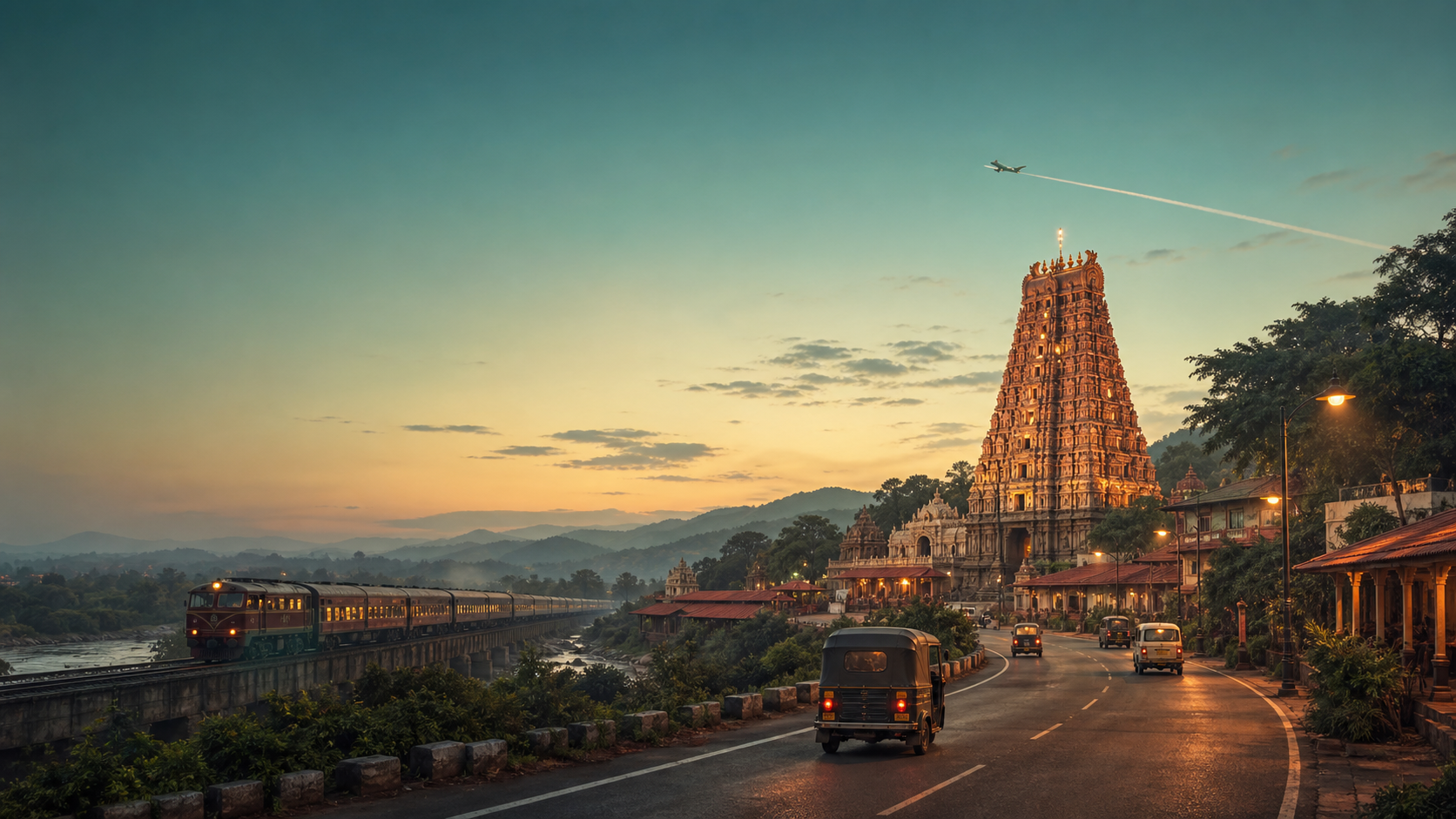
A complete pilgrim record drawn from the existing published article data.
Vadakkunnathan Temple: An Ancient Abode of Shiva
The Vadakkunnathan Temple in Thrissur, Kerala, stands as a monumental testament to ancient Hindu devotion and architectural prowess, revered as the first among the 108 Shiva temples of Kerala. Traditionally dated to the 2nd century CE, its origins are steeped in legend, with its sacred grounds mentioned in the Brahmanda Purana as 'Shrimad-Dakshina Kailasam'. This pre-Dravidian Kavu evolved into a significant temple complex, embodying a profound spiritual legacy. Dedicated primarily to Lord Shiva, the temple is a vibrant center of worship and cultural heritage.
Divine Origin
Legend attributes the temple's establishment to Parashurama, who consecrated the land of Kerala with the manifestation of Lord Shiva. The deity appeared as a resplendent lingam beneath a banyan tree, marking the sacred Sri Moola Sthana.
Sacred Significance
Revered as the 'Dakshina Kailasam' (Southern Kailash), the temple holds immense spiritual importance. It is believed that Adi Shankara was born after prayers offered here and attained videha mukti within its precincts, further cementing its sanctity.
Kerala's Architectural Gem: Design and Murals of Vadakkunnathan
Exemplifying the classic Kerala style, the Vadakkunnathan Temple is a masterpiece of traditional architecture, distinguished by its intricate wooden carvings, multi-tiered roofs, and some of the oldest extant murals in Kerala. Constructed primarily from granite, teak wood, and laterite, the temple complex features numerous shrines, including the circular srikovils for Shiva and Rama. The Koothambalam, a theatre hall for performing arts, is an architectural marvel, reconstructed in the 19th century under Diwan T. Sankunni Menon, showcasing exquisite craftsmanship.
Distinctive Kerala Style
The temple showcases the quintessential Kerala architectural style, characterized by its sloped, multi-tiered roofs covered with copper sheets, intricate wooden gables, and a prominent nalambalam (outer enclosure).
Artistic Details
The Koothambalam, a unique structure within the complex, is renowned for its elaborate wooden carvings and sculptural details. The temple also houses ancient murals depicting scenes from the Mahabharata and other Hindu epics.
Construction Materials
The temple's durable construction utilizes traditional materials such as granite for the base, laterite for walls, and extensive use of teak wood for roofs and intricate carvings, ensuring its longevity and aesthetic appeal.
Lord Shiva's Unique Manifestation: The Ghee-Covered Lingam
At the heart of Vadakkunnathan Temple lies the unique and revered Shiva lingam, perpetually concealed beneath layers of accumulated ghee, a profound symbol of devotion and an extraordinary spiritual phenomenon. Unlike most Shiva shrines where the lingam is visible, here the deity is a mound of solidified ghee, believed to have formed over centuries from daily abhishekam (anointing rituals). This sacred offering, far from decaying, is said to possess medicinal properties and is never removed, symbolizing the eternal presence and blessings of Lord Shiva. This distinctive feature makes the temple a rare and spiritually potent site.
The Anointed Deity
The main Shiva lingam is not directly visible but is covered by a massive mound of solidified ghee. This ghee accumulation is the result of continuous ghee abhishekam performed over centuries, a unique practice of devotion.
Spiritual Significance
The ghee-covered lingam is considered highly sacred, symbolizing the cool, benevolent aspect of Lord Shiva. Devotees believe the ghee has divine properties and its perpetual presence signifies unending blessings and spiritual energy.
Planning Your Visit to Vadakkunnathan Temple
To fully appreciate the spiritual and historical grandeur of Vadakkunnathan Temple, visitors should be aware of its customs, timings, and the best ways to explore its sacred precincts and artistic treasures. The temple is easily accessible, located less than 1 km from Thrissur Railway Station and under 2 km from Thrissur KSRTC Bus Stand. Cochin International Airport is approximately 55 km away. The best time to visit is from December to March for pleasant weather, or during major festivals like Thrissur Pooram and Maha Shivaratri for a vibrant cultural experience.
Visitor Guidelines
Traditional attire is preferred, with men typically wearing dhoti/veshti and women wearing saree/salwar. Footwear must be removed before entering the temple complex. Entry to the temple is free, but specific timings for darshan should be confirmed.
Best Time to Visit
The months from December to March offer cool and comfortable weather. For a truly immersive experience, consider visiting during Thrissur Pooram (April-May) or Maha Shivaratri (February-March), when the temple is at its most festive.
Getting There
The temple is centrally located in Thrissur. Thrissur Railway Station (TCR) is less than 1 km away, and the KSRTC Bus Stand is within 2 km. Cochin International Airport (COK) is the nearest airport, about 55 km distant.
| Deity | Shiva |
|---|---|
| Form | Shiva is worshipped as a 16-foot-high lingam, entirely concealed by a centuries-old mound of ghee. |
| Consort | Parvati |
| Sampradaya | Hindu |
| Significance | This unique, non-visible form is adorned with thirteen gold crescents and three serpent hoods, symbolizing his ancient and powerful divine presence. |
Parashurama's Sacred Offering
After the mighty sage Parashurama, through his profound penance and divine grace, reclaimed the lush land of Kerala from the vast ocean, he yearned for a divine presence to consecrate his creation. He offered fervent prayers to Lord Shiva, imploring the deity to bless this new territory. Responding to his devotee's earnest plea, Lord Shiva, accompanied by his divine consort Parvati, and his beloved sons Ganesha and Subrahmanya, manifested gloriously at Thrissur. He appeared as a resplendent lingam, radiating divine energy, beneath a grand banyan tree. This hallowed spot became known as the Sri Moola Sthana, marking the very foundation of divine blessing upon Kerala.
The sacred Shiva lingam, entirely concealed by a centuries-old mound of ghee, radiates a unique and powerful divine energy.
A testament to enduring faith, where a miraculous relocation paved the way for a grand temple, blessed by Parashurama's prayers.
Related temples: Aazhimala Shiva Temple | Abhimanyu Temple, Vayotthidam
Tracing the Centuries: History and Heritage of Vadakkunnathan
With roots stretching back centuries, the temple's history is a rich narrative of royal patronage, shifting political control, and enduring spiritual significance. Its traditional dating to the 2nd century CE marks it as one of Kerala's oldest. The temple came under the control of the Zamorin of Calicut between 1750 and 1762, before the Cochin Kingdom, particularly Maharaja Sakthan Thampuran in the late 18th century, undertook major structural developments. This enduring legacy has earned it a place on UNESCO's tentative World Heritage list.
Ancient Roots
The temple's structure is traditionally dated to the 2nd century CE, with its origins possibly in a pre-Dravidian Kavu. It is mentioned in ancient scriptures like the Brahmanda Purana.
Royal Patronage
Prior to 1750, the temple was under the Nambudiri Yogiatirippads. Significant development occurred under Sakthan Thampuran, Maharaja of Cochin, in the late 18th century, solidifying its architectural grandeur.
UNESCO Recognition
Acknowledging its profound historical and cultural value, the Vadakkunnathan Temple was included in UNESCO's World Heritage tentative list in 2012, based on the recommendation of the Archaeological Survey of India.
Restoration & Conservation Efforts
Vadakkunnathan Temple, a monumental example of Kerala architecture, has been the subject of numerous restoration and conservation efforts throughout its long history. Given its age, dating back over a millennium, the wooden structures, intricate murals, and laterite stone foundations have required continuous attention to withstand the tropical climate and natural decay. Early records suggest periodic repairs undertaken by local rulers and temple authorities to maintain its structural integrity and aesthetic beauty. A significant phase of restoration occurred in the 17th and 18th centuries, particularly after invasions or natural calamities, focusing on rebuilding damaged sections and reinforcing the existing structures. These historical interventions, often documented in temple chronicles, highlight the continuous reverence and commitment of generations to preserve this sacred site. The traditional methods employed, utilizing local materials and craftsmanship, were crucial in ensuring the authenticity and longevity of the temple's unique architectural style.
In modern times, the conservation of Vadakkunnathan Temple has become a more systematic and scientifically guided endeavor. The Archaeological Survey of India (ASI), in collaboration with the Cochin Devaswom Board, plays a pivotal role in overseeing major restoration projects. These efforts often involve detailed structural analysis, chemical treatment of murals to prevent deterioration, and the replacement of decayed wooden elements with meticulously carved replicas, adhering strictly to traditional techniques and materials. The temple's inclusion as a UNESCO World Heritage Site tentative list nominee further emphasizes the international recognition of its cultural significance and the need for rigorous conservation standards. Ongoing challenges include managing environmental factors like humidity and pests, ensuring proper drainage, and balancing the needs of active worship with the imperative of preserving its ancient fabric for future generations.
🗺 How to Reach
Hover a card to animate the journey on the map
Route to Temple
Common Questions
Where is Vadakkunnathan Temple: Kerala's Ancient Shiva Shrine located?
Vadakkunnathan Temple: Kerala's Ancient Shiva Shrine is documented at Thrissur, Kerala.
Which deity is associated with Vadakkunnathan Temple: Kerala's Ancient Shiva Shrine?
Vadakkunnathan Temple: Kerala's Ancient Shiva Shrine is associated with Shiva.
Related Temples



A Living Covenant