



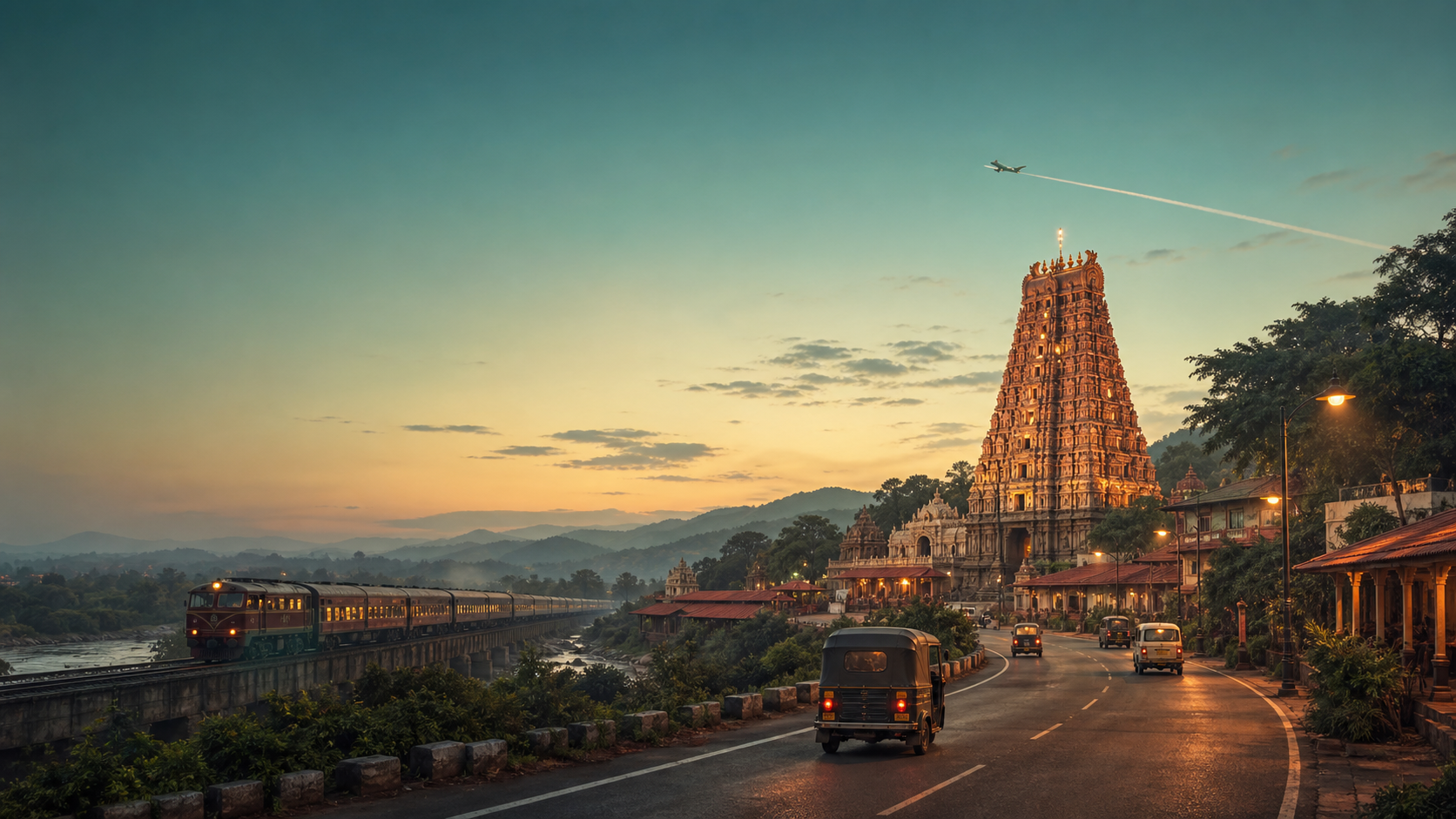
A complete pilgrim record drawn from the existing published article data.
Architectural Marvels: Dravidian Style and Sacred Geometry
Showcasing classic Dravidian architectural elements, the Thyagaraja Temple is a masterpiece built predominantly with granite. It features towering gopurams that serve as impressive gateways, intricate mandapams (pillared halls), and sanctums that reflect centuries of artistic and engineering excellence. The design embodies sacred geometry and symbolic principles, evident in the precise layout and sculptural details. Each stone carving and structural component contributes to a cohesive spiritual narrative, making the temple a living example of traditional South Indian temple architecture.
Towering Gopurams
The temple complex is adorned with majestic gopurams, multi-tiered pyramidal gateways that are richly decorated with sculptures of deities, mythological figures, and intricate motifs. These structures are characteristic of the Dravidian style and guide devotees into the sacred space.
Intricate Mandapams
Within the temple, numerous mandapams or pillared halls provide spaces for rituals, gatherings, and artistic expression. These halls often feature elaborately carved pillars depicting various deities, celestial beings, and scenes from Hindu mythology, showcasing exceptional craftsmanship.
Sacred Geometry and Symbolism
The temple's layout and construction adhere to principles of sacred geometry, believed to channel divine energy. Every aspect, from the placement of the sanctums to the orientation of the structures, is imbued with symbolic meaning, reflecting cosmic order and spiritual harmony.
Planning Your Pilgrimage: A Guide to Thyagaraja Temple
Visitors to the Thyagaraja Temple can immerse themselves in its spiritual ambiance, explore its rich historical significance, and witness its vibrant daily rituals, making for a deeply enriching cultural and religious experience. Entry to the temple is free, and traditional attire is preferred to show respect for the sacred space. The best time to visit is during the Maasi Bramotsavam in February–March, or Karthigai in November–December for the armour removal ritual. Allow 2–3 hours to fully appreciate the temple's grandeur and participate in its devotional atmosphere.
Optimal Visiting Times
The Maasi Bramotsavam (February–March) is the prime annual festival, offering a vibrant experience. Another significant time is Karthigai (November–December) for the unique armour removal ritual, providing a different spiritual insight.
Access and Transportation
The temple is conveniently located within walking distance of Tiruvottiyur Railway Station. Chennai International Airport is approximately 15 km away, and local buses provide connectivity. It is advisable to contact the temple office for precise timings and routes.
Visitor Etiquette and Facilities
While entry is free, traditional attire is encouraged, and footwear must be removed before entering. The temple premises offer a serene environment for contemplation, though specific timings for rituals should be confirmed with the temple office.
| Deity | Aadhipureeswarar |
|---|---|
| Form | Aadhipureeswarar is enshrined as a mud mound covered by armour, revealed annually on Karthigai Pournami. He is also worshipped in the Somaskanda form as Thyagaraja. |
| Consort | Vadivudaiamman (Tripurasundari) |
| Sampradaya | Hindu |
| Significance | As Aadhipureeswarar, he represents the primordial form of Shiva. The Thyagaraja cult iconography emphasizes his cosmic dance and presence, making him a significant spiritual figure. |
The Sacred Purification of the Vedas
Long ago, when the demon brothers Madhu and Kaithaba stole the sacred Vedas and plunged them into the depths of the cosmic ocean, it was Lord Vishnu, in his divine Matsya (fish) avatar, who bravely retrieved them. But the Vedas, having been defiled, needed purification. Vishnu brought them to this very hallowed ground of Thyagaraja Temple, where Lord Shiva and Goddess Parvati, in their infinite grace, undertook the sacred task of cleansing them. It was during this divine event that the makizha (wishing) tree, standing majestically within the temple precincts, became eternally sacred, a silent witness to this profound cosmic restoration.
The sacred makizha tree stands as an eternal witness to the Vedas' divine purification by Shiva and Parvati.
Here, great saint Pattinathar attained Samadhi, transforming into a Shiva Lingam, a testament to unwavering faith.
Related temples: Aakkoor Thanthondreeswarar Temple | Abhaya Varadeeswarar Temple, Adirampattinam
Thyagaraja Temple, Tiruvottiyur: A Nexus of Devotion and Heritage
The Thyagaraja Temple in Tiruvottiyur is a monumental testament to South Indian religious and architectural prowess. Revered as a Paadal Petra Sthalam, it is one of the 275 Shiva Sthalams glorified in the Tevaram hymns. It is also recognized as a Shakti Peetham, a significant pilgrimage site for devotees of the Goddess. Furthermore, the temple is a vital center of the unique Sapthavitankam Thyagaraja cult, celebrating Lord Shiva's cosmic dance. Its ancient origins, dating back to the 7th century CE, combined with extensive expansions by the Chola and Vijayanagara dynasties, make it a profound site of cultural and spiritual heritage in Tamil Nadu.
Paadal Petra Sthalam Significance
This designation marks the temple as one of the most sacred abodes of Lord Shiva, having been praised in devotional hymns by the Nayanar saints, including Appar, Sambandar, and Sundarar. These hymns form a cornerstone of Tamil Shaivism.
Shakti Peetham Recognition
The temple is revered as a Shakti Peetham, places where body parts of Goddess Sati are believed to have fallen. This aspect highlights the integral worship of Goddess Parvati alongside Lord Shiva, emphasizing the divine feminine energy.
Sapthavitankam Thyagaraja Cult
Thyagaraja Temple is one of the seven Sapthavitankam temples, each housing a vitankar (Shiva lingam) that is a replica of the one at Tiruvarur. This unique cult celebrates the ajapa natanam, a soundless cosmic dance of Lord Thyagaraja, drawing devotees to witness its spiritual essence.
Tracing the Dynastic Footprints: Pallava, Chola, and Vijayanagara Legacies
The Thyagaraja Temple's rich history is etched in the contributions of powerful South Indian dynasties. Originally built in the 7th century CE under Pallava rule, it stands as an early example of Dravidian temple architecture. The Chola kings, particularly Rajendra Chola I in the 11th century, undertook major expansions, transforming the temple complex into its current grand scale. Later, the Vijayanagara rulers in the 15th century further enriched the temple, contributing significant bronze installations and renovations that added layers to its spiritual and structural grandeur.
Pallava Origins
The temple's foundation dates back to the 7th century CE, credited to the Pallavas. This initial construction laid the groundwork for the future architectural splendor, establishing a significant center for Shiva worship in the region.
Chola Expansions
The Chola period, especially under Rajendra Chola I in the 11th century, marked a golden era of expansion. Inscriptions from this time record substantial donations and the installation of numerous bronze statues, including the 64 Nayanmars, vastly increasing the temple's size and artistic wealth.
Vijayanagara Contributions
During the 15th century, the Vijayanagara rulers played a crucial role in the temple's development. They commissioned major bronze installations and carried out renovations, ensuring the temple's continued prominence and preserving its architectural integrity for future generations.
Lord Shiva as Thyagaraja: Shakti Peetham and Star Worship Traditions
At its heart, the Thyagaraja Temple venerates Lord Shiva in his unique Thyagaraja form, a manifestation associated with the ajapa natanam, the soundless dance. This distinct representation is central to the temple's identity. Alongside, its recognition as a Shakti Peetham underscores the profound reverence for Goddess Parvati, emphasizing the dual aspects of divine power. The temple also upholds a distinctive tradition of 27-star worship, where each of the 27 nakshatras (lunar mansions) is associated with specific rituals and offerings, weaving a rich tapestry of profound spiritual narratives and astrological significance.
Lord Thyagaraja's Unique Form
Lord Shiva is worshipped here as Thyagaraja, specifically embodying the ajapa natanam, a subtle, internal dance that represents the cosmic pulsation of the universe. This form is particularly revered among the Sapthavitankam temples.
Goddess Tripura Sundari (Shakti Peetham)
The temple is home to Goddess Tripura Sundari, a powerful manifestation of Parvati, and is considered one of the Shakti Peethams. Devotees seek her blessings for strength, prosperity, and spiritual liberation, acknowledging her supreme divine energy.
27-Star Worship Tradition
A distinctive feature is the worship dedicated to each of the 27 nakshatras or birth stars. Devotees perform specific poojas and offerings corresponding to their birth star, believing it brings auspiciousness and mitigates planetary influences.
Cultural Impact
The Thyagaraja Temple in Tiruvottiyur has profoundly influenced the cultural landscape of Tamil Nadu, particularly in the realms of music and performing arts. While the temple is dedicated to Lord Shiva, its very name resonates with the great Carnatic composer Thyagaraja, whose compositions often drew inspiration from divine themes. Although not directly linked to the saint Thyagaraja, the temple's rich history and spiritual ambiance have fostered a vibrant tradition of devotional music and dance. Many classical artists and musicians consider performing here a significant honor, contributing to the preservation and evolution of traditional art forms. The temple's architectural grandeur and intricate sculptures have also served as muses for countless artisans, reflecting its deep integration into the region's artistic heritage. Beyond its artistic contributions, the Thyagaraja Temple acts as a central pillar of community life in Tiruvottiyur, fostering social cohesion and preserving age-old customs. Throughout the year, its numerous festivals, such as the Brahmotsavam and the Arudra Darisanam, draw large crowds, transforming the temple premises into a bustling hub of cultural exchange and celebration. These events are not merely religious observances but also significant social gatherings, reinforcing local identity and strengthening community bonds. The temple's legacy extends to its role in perpetuating traditional rituals and practices, serving as a living museum of spiritual and cultural heritage for generations, and influencing the daily lives and beliefs of the local populace.🗺 How to Reach
Hover a card to animate the journey on the map
Route to Temple
Common Questions
Where is Tiruvottiyur Thyagaraja: Chola Grandeur, Shiva's Blessings located?
Tiruvottiyur Thyagaraja: Chola Grandeur, Shiva's Blessings is documented at Tiruvottiyur, Tamil Nadu.
Which deity is associated with Tiruvottiyur Thyagaraja: Chola Grandeur, Shiva's Blessings?
Tiruvottiyur Thyagaraja: Chola Grandeur, Shiva's Blessings is associated with Aadhipureeswarar.
Related Temples


A Living Covenant