



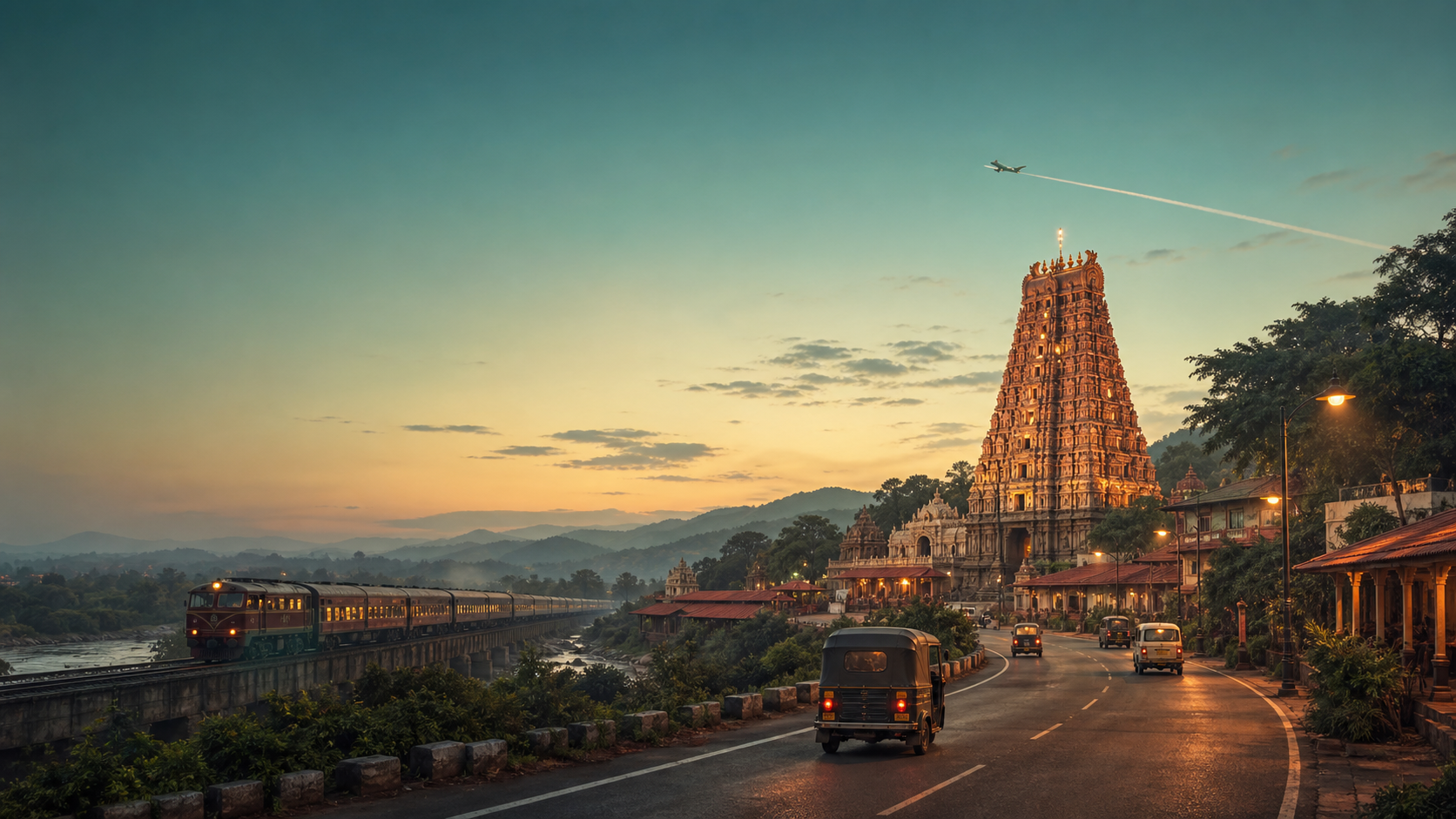
A complete pilgrim record drawn from the existing published article data.
Dravidian Grandeur: The Unique Architecture of Chidambaram
The Thillai Nataraja Temple exemplifies the pinnacle of Dravidian architecture, showcasing unparalleled artistic and engineering prowess. Its sprawling complex features four towering gopurams, each adorned with intricate sculptures depicting mythological narratives. Unique to this temple are the Sabha structures, particularly the Chit Sabha and Kanaka Sabha, where the main deity resides. The temple's walls also feature carvings of the 108 karanas of Bharatanatyam, demonstrating its deep connection to classical dance. Constructed primarily from granite, brick, and wood, with gold accents, the architecture profoundly reflects its spiritual symbolism.
Iconic Gopurams and Sabha Structures
The temple is famed for its four majestic gopurams, each facing a cardinal direction and richly sculpted with deities and mythological scenes. Within the complex, the Chit Sabha, the innermost sanctuary, houses the Nataraja idol and the Chidambaram Rahasyam. The Kanaka Sabha, or Golden Hall, is where daily rituals are performed, its roof covered with gold plates.
The 108 Karanas of Bharatanatyam
A unique architectural feature is the depiction of the 108 karanas, fundamental poses of Bharatanatyam, carved on the eastern gopuram. These detailed sculptures illustrate the ancient treatise on dance, the Natya Shastra, directly linking the temple's artistic expression to Lord Nataraja, the cosmic dancer himself, and his divine art.
Nataraja: The Lord of Cosmic Dance and Spiritual Mysteries
Lord Nataraja, Shiva in his dynamic Ananda Tandava pose, is the presiding deity of the Thillai Nataraja Temple and the embodiment of cosmic energy. His dance symbolizes the five divine acts: creation, preservation, destruction, illusion, and salvation, representing the continuous cycle of existence. Central to the temple's spiritual core is the Chidambaram Rahasyam, the 'secret of Chidambaram,' where Shiva is worshipped as the formless Akasha Lingam, signifying consciousness beyond physical form. This profound symbolism attracts devotees seeking deeper spiritual understanding and union with the divine.
The Ananda Tandava: Five Divine Acts
Nataraja's iconic dance, the Ananda Tandava, is a powerful visual metaphor for the universe's continuous cycle. Each element of his posture — the drum for creation, the flame for destruction, the raised hand for protection, the foot on the demon for liberation from ignorance, and the raised foot for salvation — represents one of Shiva's five divine actions.
Chidambaram Rahasyam: The Secret of Space
The Chidambaram Rahasyam refers to the empty space within the Chit Sabha, symbolizing the Akasha Lingam, the formless aspect of Shiva. Behind a curtain, devotees are shown a golden vilva garland, representing the formless divine presence. This profound concept signifies that God is ultimately beyond form and attributes, existing as pure consciousness.
Plan Your Pilgrimage: Experiencing the Thillai Nataraja Temple
Visiting the Thillai Nataraja Temple offers a profound spiritual and cultural journey. To fully appreciate its sacred ambiance and historical grandeur, planning is essential. The best time to visit is from October to March, avoiding the intense summer heat. While entry is free, modest dress is required, and leather items are not permitted inside the sanctum. Removing footwear before entering the temple complex is customary. Witnessing the daily rituals and grand festivals, especially Arudra Darshanam, provides a deep insight into the temple's vibrant traditions and spiritual significance.
Optimal Visit Times and Dress Code
For a comfortable visit, the cooler months between October and March are recommended. The temple is open daily, though specific timings should be confirmed. A strict dress code mandates modest attire; shoulders and knees should be covered. Additionally, all leather items, such as belts and bags, must be removed before entering the inner sanctum, and footwear must be left outside the temple premises.
Key Festivals and Rituals
The temple hosts several significant festivals. The 40-day Marghazhi Thiruvaizh culminates in Arudra Darshanam (December–January), the most important celebration of Lord Nataraja's cosmic dance, drawing vast crowds. The Natyanjali Dance Festival during Maha Shivaratri (February–March) features classical dancers performing as an offering, highlighting the temple's connection to the arts.
| Deity | Nataraja |
|---|---|
| Form | Nataraja is a dancing form of Shiva, performing the Ananda Tandava (dance of bliss) in the golden hall (Pon Ambalam/Chit-sabha). This form depicts Shiva with four arms, one leg raised in dance, symbolizing the cosmic cycles. |
| Consort | Sivakami Amman |
| Sampradaya | Hindu |
| Significance | Nataraja symbolizes the cosmic dance of creation, preservation, and destruction, representing the universe's continuous cycle of existence. The temple also features the rare 'formless' Akasa Lingam (Chidambara Rahasyam), symbolizing consciousness beyond form and the subtlest of all Shiva temples. |
The Cosmic Dance and the Secret of Chidambaram
Long ago, in the ancient Tillai forest, where mangroves grew dense, Lord Shiva performed his mesmerizing Ananda Tandava – the dance of bliss. Sages, deep in meditation, were drawn to this divine spectacle. Amidst the cosmic rhythm, Shiva revealed the Chidambara Rahasyam, the formless Akasa Lingam, symbolizing consciousness beyond all physical manifestation. This profound revelation, witnessed by enlightened beings, signifies the very 'atmosphere of consciousness' from which the temple derives its name, 'Chidambaram', a sacred space where the divine is both seen and unseen.
Here, Shiva performs the Ananda Tandava, the dance of bliss, revealing the universe's continuous cycle of creation, preservation, and destruction.
The Chidambara Rahasyam unveils consciousness beyond form, a sacred space where the divine is both seen and unseen.
Related temples: Aakkoor Thanthondreeswarar Temple | Abhaya Varadeeswarar Temple, Adirampattinam
A Legacy Etched in Stone: The Temple's Enduring History
The history of the Thillai Nataraja Temple is ancient, with its origins affirmed by 7th-century CE hymns. It flourished significantly under the patronage of the Chola dynasty, particularly Parantaka Chola I, who undertook major renovations and added the golden roof in the early 10th century CE. The temple served as a vital center for the Shaiva Bhakti movement, witnessing the composition of devotional literature and later, the miraculous recovery of the lost Tevaram hymns during the reign of Rajaraja Chola I, solidifying its enduring religious and cultural legacy.
Chola Dynasty Patronage
The Chola dynasty played a pivotal role in shaping the temple's grandeur. While early inscriptions date to the early 10th century CE, Parantaka Chola I (c. 907–955 CE) is credited with significant renovations, including the construction of the iconic golden roof. Subsequent Chola kings continued to expand and enrich the temple complex, defining its Dravidian style.
The Recovery of Tevaram Hymns
A significant historical event was the recovery of the revered Tevaram hymns. During Rajaraja Chola I's reign, these devotional compositions were found in an ant-infested chamber within the temple. Their retrieval by Nambiyandar Nambi was crucial for the Shaiva Bhakti movement, underscoring the temple's role as a repository of sacred literature.
Thillai Nataraja Temple: The Cosmic Dance of Chidambaram
The Thillai Nataraja Temple, located in Chidambaram, Tamil Nadu, is a highly revered Hindu temple dedicated to Lord Shiva in his iconic form as Nataraja, the cosmic dancer. This ancient shrine holds immense spiritual and cultural significance, standing as a unique pilgrimage site. It is one of the five Pancha Bhoota Sthalas, representing the Akasha (ether) element, and also one of the Pancha Sabha Thalams, where Shiva performed his cosmic dance. The temple's sanctity is deeply intertwined with the legend of Shiva's Ananda Tandava and the revelation of the Chidambaram Rahasyam.
Lord Nataraja: The Cosmic Dancer
The principal deity of the Thillai Nataraja Temple is Lord Shiva, worshipped here as Nataraja, the 'Lord of Dance.' This unique form depicts Shiva performing the Ananda Tandava, the dance of bliss, symbolizing creation, preservation, destruction, illusion, and salvation. The idol is typically cast in bronze, showcasing intricate details of his dynamic posture.
Pancha Bhoota Sthalam and Pancha Sabha Thalam
Chidambaram is one of the five Pancha Bhoota Sthalas, temples dedicated to Shiva representing the five primary elements. Here, Shiva embodies Akasha, the element of ether or space. It is also one of the Pancha Sabha Thalams, sacred halls where Shiva performed his cosmic dance, making it a site of profound spiritual energy.
Cultural Impact
The Thillai Nataraja Temple holds an unparalleled position in the cultural tapestry of India, particularly within the performing arts. As the abode of Nataraja, the cosmic dancer, it is considered the birthplace and spiritual heart of Bharatanatyam, one of India's most ancient classical dance forms. The temple's intricate sculptures depicting various karanas (dance postures) from the Natya Shastra have served as a living textbook for dancers and choreographers for centuries. Its iconic Ananda Tandava (Dance of Bliss) pose of Shiva symbolizes the cosmic cycles of creation and destruction, inspiring countless poets, musicians, and sculptors throughout history. The temple thus became not merely a place of worship but a vibrant center for artistic expression, fostering a deep connection between spirituality and the performing arts, making it a revered pilgrimage site for artists seeking divine inspiration and perfection in their craft. Beyond its artistic influence, the Thillai Nataraja Temple exerts a profound cultural impact through its unique religious and social significance. It is one of the five Pancha Bhoota Sthalams, representing Akasha (ether), and stands as a pivotal center for Shaivism. The temple's administration by the hereditary Podu Dikshitars, a community of Vedic Brahmins, is a distinctive feature, reflecting centuries of unbroken tradition and devotion. This unique governance structure has preserved ancient rituals and practices, making the temple a living repository of Tamil religious heritage. Its grand festivals, particularly the annual Ani Thirumanjanam and Margazhi Thiruvadirai, draw millions, reinforcing community bonds and cultural identity. The temple's enduring presence in folklore, literature, and daily spiritual practices underscores its irreplaceable role in shaping the collective consciousness and cultural landscape of Tamil Nadu.🗺 How to Reach
Hover a card to animate the journey on the map
Route to Chidambaram
Common Questions
Where is Thillai Nataraja Temple: Chidambaram's Cosmic Dancer Shrine located?
Thillai Nataraja Temple: Chidambaram's Cosmic Dancer Shrine is documented at Tamil Nadu.
Which deity is associated with Thillai Nataraja Temple: Chidambaram's Cosmic Dancer Shrine?
Thillai Nataraja Temple: Chidambaram's Cosmic Dancer Shrine is associated with Shiva.
Related Temples


A Living Covenant