



A complete pilgrim record drawn from the existing published article data.
Tracing the Millennia: History of Thayumanaswami Temple
The Thayumanaswami Temple's history is deeply intertwined with the Rockfort's strategic importance, with its origins dating back to the Pallava period. Earlier rock-cut cave temples were established by the Pallavas. The major complex, however, was commissioned by the Pandyan Empire in the 8th century CE, marking a significant expansion. By the 7th century CE, saints Sambandar and Appar composed Tevaram hymns here, classifying it as a Paadal Petra Sthalam. Subsequent centuries saw renovations and additions by the Vijayanagara and Madurai Nayak rulers, further enriching its architectural and historical fabric.
Pallava Origins
The earliest structures at the site are rock-cut cave temples dating back to the Pallava period, laying the foundation for the later grand complex.
Pandyan Expansion
The 8th century CE saw the Pandyan Empire undertaking the construction of the major temple complex, significantly expanding the existing religious site.
Later Dynastic Contributions
The temple underwent renovations and additions during the Vijayanagara Period (14th-17th Century) and the Madurai Nayak Period (16th-18th Century), reflecting continuous patronage.
Rock-Cut Grandeur: The Architecture of Thayumanaswami
The Thayumanaswami Temple showcases a unique blend of rock-cut cave architecture and later structural additions, making it a distinctive example of Dravidian temple building. The temple complex is primarily carved from monolithic granite, characteristic of its Pallava origins for the rock-cut caves. The major 8th-century complex built by the Pandyas further developed the Dravidian style with intricate carvings and towering gopurams. This fusion of natural rock formations with sculpted stone creates a visually striking and historically rich architectural landscape.
Monolithic Granite Construction
The temple extensively uses monolithic granite, especially in its earlier rock-cut cave temples, demonstrating ancient engineering and artistic skill.
Dravidian Style Evolution
The overall architectural style is Dravidian, evolving from the Pallava rock-cut tradition to the more elaborate structural temples of the Pandya period.
Rockfort Integration
The temple's design ingeniously integrates with the natural rock formation of the Rockfort, utilizing the terrain as part of its structure.
Thayumanaswami Temple: A Spiritual Ascent at Rockfort
Perched majestically atop the historic Rockfort complex in Tiruchirappalli, the Thayumanaswami Temple is a profound testament to ancient Dravidian architecture and deep spiritual devotion. Dedicated to Lord Shiva, the temple is a significant pilgrimage site, revered as a Paadal Petra Sthalam. Its unique location offers devotees and visitors not only a spiritual journey but also panoramic views of the surrounding city. The complex blends natural rock formations with intricate temple construction, reflecting centuries of religious and architectural evolution.
Location and Significance
The temple is centrally located in Rockfort, Tiruchirappalli, Tamil Nadu. It is a prominent landmark and a site of immense religious importance for Shaivites.
Dravidian Architectural Marvel
Built primarily in the Dravidian style, the temple complex showcases the architectural prowess of various dynasties, including the Pandyas and later Vijayanagara and Madurai Nayak rulers.
Visiting Thayumanaswami Temple: A Pilgrim's Guide
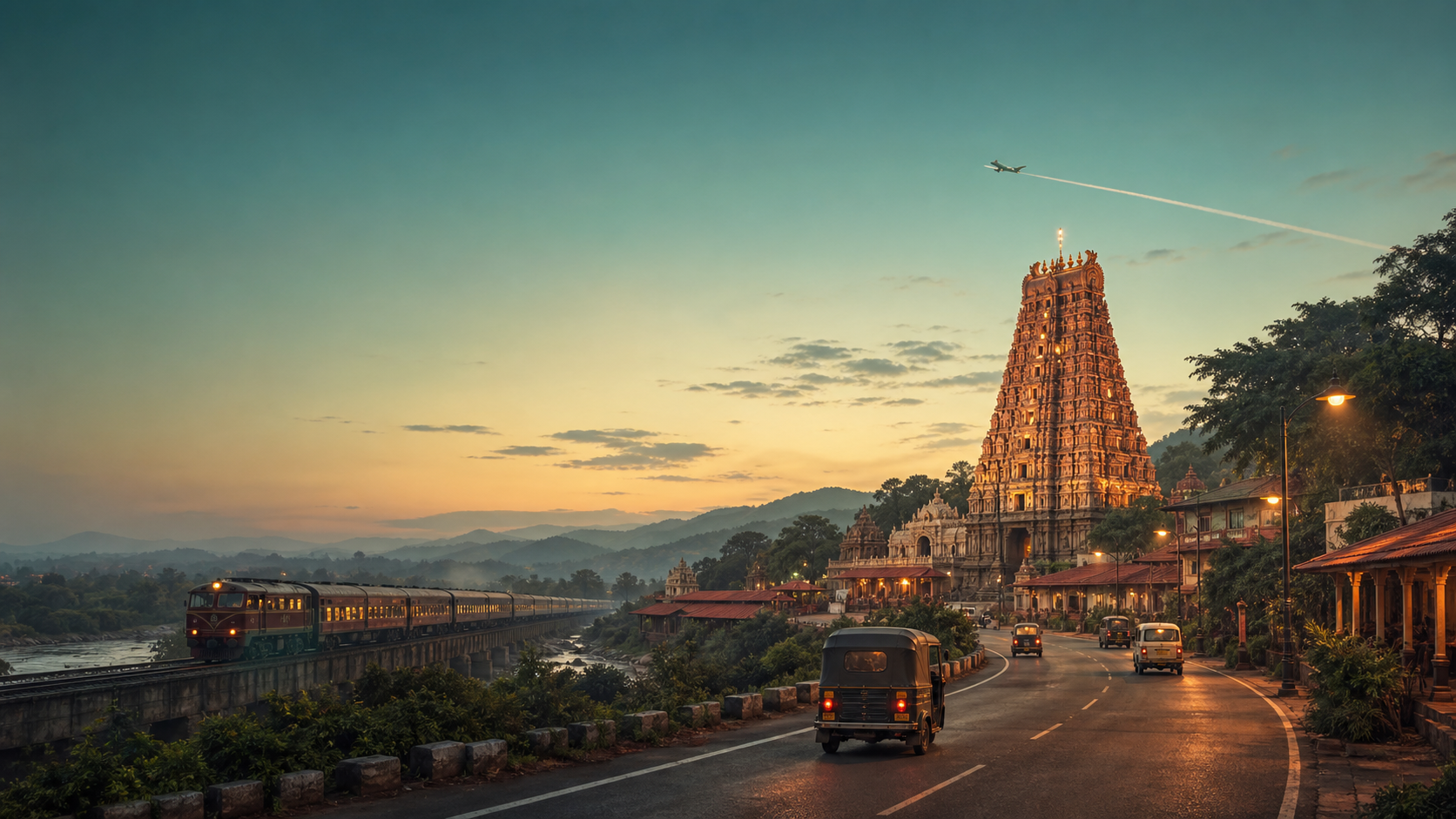
A visit to the Thayumanaswami Temple offers not only spiritual solace but also a panoramic view of Tiruchirappalli, making it a must-see destination. The temple is easily accessible by various modes of transport, including bus, train, and flight, with Tiruchirappalli International Airport approximately 5 km away. The best time to visit is from October to March for pleasant weather, or during major festivals like Chittirai and Karthigai Deepam for a vibrant cultural experience. Modest dress is expected, and footwear must be removed.
Accessibility and Transport
The temple is well-connected by road, rail (Tiruchirappalli Junction), and air (Tiruchirappalli International Airport), making it convenient for national and international visitors.
Best Time and Festivals
The period from October to March offers ideal weather. Major festivals like Chittirai (April–May) and Karthigai Deepam (Nov–Dec) are significant times for devotees to visit.
Visitor Information
Entry is free, and visitors should plan for 3–4 hours. Modest attire is required, and footwear must be removed before entering the sacred precincts.
| Deity | Thayumanaswamy |
|---|---|
| Form | Thayumanaswamy is a unique iconographic concept of Shiva in a maternal form, represented as a lingam. This form signifies Shiva's compassionate and nurturing aspect. |
| Consort | Mattuvar Kuzhalammai (form of Parvati) |
| Sampradaya | Shaiva |
| Significance | The deity is worshipped as 'the one who became mother,' stemming from a legend where Shiva assumed the form of a mother to assist Rathnavathi in childbirth. This highlights Shiva's divine intervention and boundless compassion. |
The Divine Mother of Rockfort
In the ancient city now known as Tiruchirappalli, lived a devout woman named Rathnavathi. Heavy with child, she faced a perilous delivery. Her mother, who was to assist her, was stranded across the raging Cauvery River, swollen by unprecedented floods. Desperate, Rathnavathi cried out to Lord Shiva. Moved by her fervent prayers, Shiva assumed the form of Rathnavathi's own mother. He lovingly attended to her, easing her suffering and safely bringing her child into the world. As soon as the delivery was complete, the divine disguised mother vanished. Moments later, Rathnavathi's real mother arrived. Realizing the miraculous intervention, they understood that Lord Shiva himself had come to her aid, embodying ultimate maternal love. Hence, the deity is revered as Thayumanaswamy, 'the one who became mother,' a testament to his boundless compassion.
Lord Shiva, the ultimate embodiment of compassion, became a mother to answer a devotee's fervent prayer.
The Rockfort stands as a timeless testament to divine intervention and boundless love, where Shiva's maternal grace forever resides.
Related temples: Aakkoor Thanthondreeswarar Temple | Abhaya Varadeeswarar Temple, Adirampattinam
Lord Thayumanaswamy: The Mother Who Became God
Dedicated to Lord Shiva, known here as Thayumanaswamy, the temple is steeped in a poignant legend that underscores the deity's boundless compassionate nature. The central story recounts Rathnavathi, a devout woman in Tiruchirappalli, facing a difficult childbirth while her mother was stranded by a flooded Cauvery River. Her fervent prayers led Lord Shiva to miraculously appear in the guise of her own mother, assisting her safely. Upon the real mother's arrival, the divine intervention was realized, leading to Shiva being revered as Thayumanaswamy, meaning 'the one who became mother.'
The Legend of Rathnavathi
The temple's name derives from the miraculous intervention of Lord Shiva, who, in the form of Rathnavathi's mother, assisted in her childbirth during a flood.
Shiva's Compassion
This legend highlights Lord Shiva's profound compassion and his readiness to answer the prayers of his devotees in times of dire need.
Shaiva Tradition
The temple is a significant site within the Shaiva tradition, celebrating Shiva as the ultimate protector and benevolent deity.
Modern Pilgrimage and Accessibility
The Thayumanaswami Temple, perched atop the iconic Rockfort in Tiruchirappalli, continues to be a vibrant center for modern Hindu pilgrimage. Despite the challenging ascent of over 400 steps carved into the rock face, devotees from across Tamil Nadu and beyond undertake the journey, especially during auspicious days like Pradosham, Shivaratri, and Karthigai Deepam. The climb itself is often considered an act of penance and devotion, culminating in the darshan (sacred viewing) of Lord Shiva as Thayumanaswami. For many, the panoramic views of the city from the summit, encompassing the Kaveri River and the Srirangam Ranganathaswamy Temple, add to the spiritual grandeur of the experience, offering a unique blend of physical exertion and profound spiritual solace.
In recent years, efforts have been made to enhance the pilgrimage experience, although the fundamental nature of the ascent remains. While no elevators or escalators are available due to the ancient structure of the rock, the steps are well-maintained, and resting points are provided along the way. The temple administration, often in collaboration with the HR&CE department, ensures basic facilities like drinking water and security are available. Furthermore, the temple's prominence has made it a key attraction in religious tourism circuits, drawing visitors who combine their pilgrimage with visits to other significant sites in Tiruchirappalli. Digital platforms and social media also play a role, allowing devotees worldwide to engage with the temple's festivals and rituals, fostering a sense of community even for those unable to make the physical journey.
🗺 How to Reach
Hover a card to animate the journey on the map
Route to Tiruchirappalli
Common Questions
Where is Thayumanaswami Temple: Rockfort's Ancient Peak located?
Thayumanaswami Temple: Rockfort's Ancient Peak is documented at Tiruchirappalli, Tamil Nadu.
Which deity is associated with Thayumanaswami Temple: Rockfort's Ancient Peak?
Thayumanaswami Temple: Rockfort's Ancient Peak is associated with thus named Thayumanaswamy.
Related Temples


A Living Covenant