



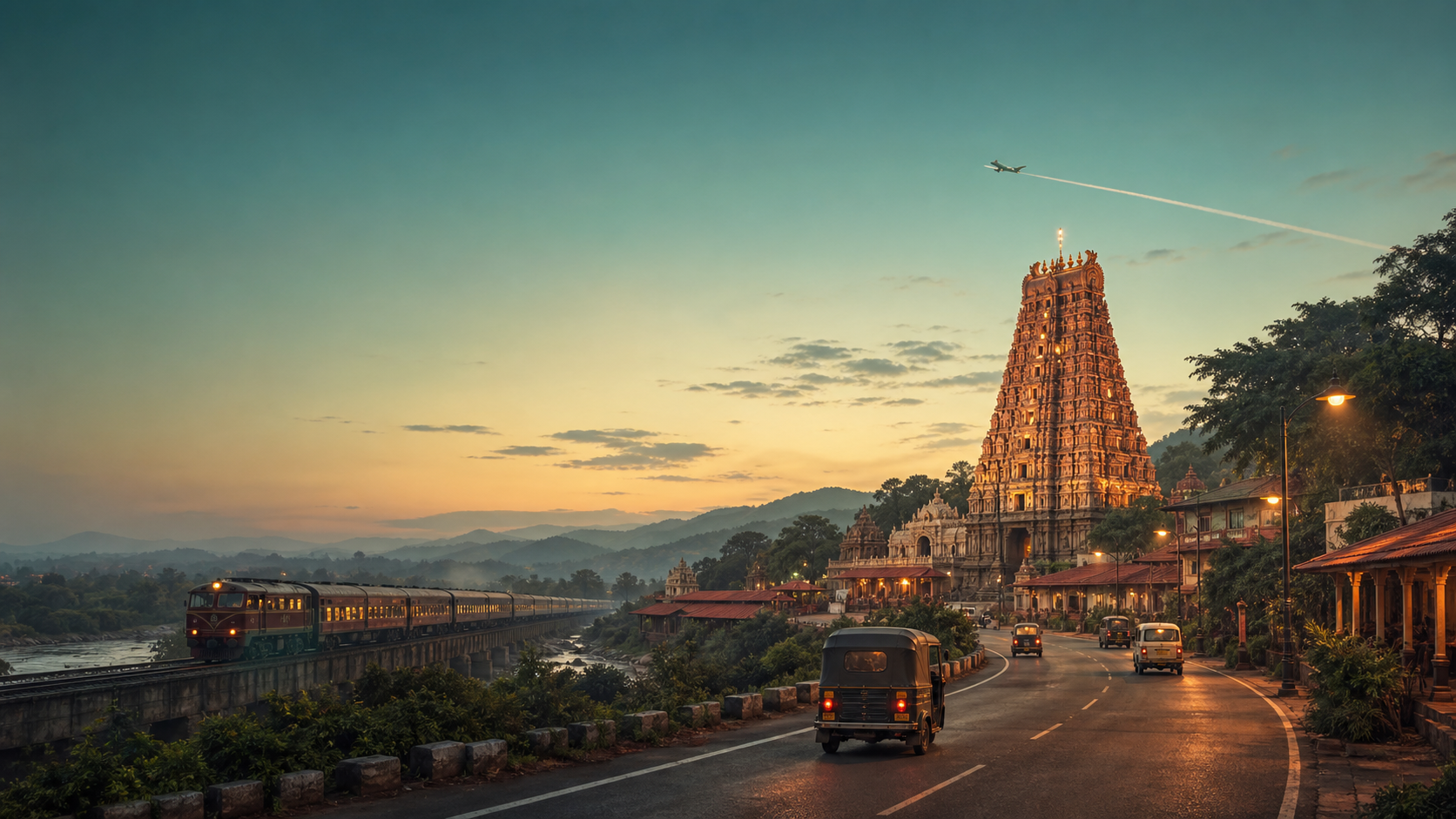
A complete pilgrim record drawn from the existing published article data.
Historical Foundation
Ancient Origins & Scholarly Debates
What is Advaita Vedanta?
Advaita Vedanta is a philosophical school of Hinduism, one of the classical Darshanas, whose fundamental premise is the non-duality (Advaita) of the individual soul (Atman) and the Ultimate Reality (Brahman). Propounded by Adi Shankara, it asserts that Brahman is the sole reality, and the world we perceive is ultimately illusory (Maya). The goal is to realize the identity of Atman with Brahman, leading to liberation (Moksha).
The Vijayanagara Era & Royal Patronage
Successive Dynasties and Continued Growth
Architecture & Craftsmanship
Vijayanagara Dravidian Grandeur
"The Vidyashankara Temple at Sringeri is not merely a place of worship, but a meticulously engineered cosmic diagram in stone, reflecting profound astronomical knowledge."
The Astronomical Marvel of Vidyashankara Temple

The Vidyashankara Temple, a marvel of Vijayanagara architecture and astronomical precision.
Artistic Embellishments and Iconographic Richness
Key Takeaway:
Sringeri Sharada Peetham is unique among the four Amnaya Pithams for housing both a major Sharada temple and serving as the historic, continuously operating seat of the Jagadguru Shankaracharya lineage, tracing its spiritual authority back to Adi Shankara. Its Vidyashankara Temple is a rare example of astronomical engineering integrated with sacred architecture.
The Presiding Deity
Sri Sharada Devi: Goddess of Wisdom

The main Sharada Temple, dedicated to the Goddess of Wisdom.
Syncretic Iconography & Secondary Deities
Deity Profile: Sri Sharada Devi
- Main Deity: Sri Sharada Devi (Saraswati)
- Deity Form: Shakti form, Goddess of Wisdom, Knowledge, and Arts.
- Iconographic Uniqueness: Syncretic iconography reflecting Advaita Vedanta philosophy, harmonizing diverse divine forms.
- Associated Symbols: Veena (lute), book (Vedas), rosary, lotus.
- Significance: Patron Goddess of learning, central to the matha's mission of propagating knowledge.
Festivals & Living Traditions
Annual Celebrations: A Spiritual Calendar
The year at Sringeri is punctuated by several major festivals that draw pilgrims and scholars from across the globe:
- Shankara Jayanti (Vaishakha - April–May): This festival celebrates the birth anniversary of Adi Shankara. It is observed with great fervor, featuring special pujas, elaborate discourses on Advaita Vedanta, and grand processions, highlighting his monumental contributions to Hindu philosophy.
- Guru Purnima (Vyasa Purnima) (Ashadha - June–July): A significant day honoring the guru-shishya parampara (teacher-disciple tradition) and paying homage to all gurus, especially Sage Vyasa. The day involves rituals, recitations of Vedanta texts, and profound expressions of gratitude to the lineage of pontiffs.
- Sharada Navaratri (Ashwin - September–October): This nine-day festival is the most elaborate celebration dedicated to Sri Sharada Devi. It features intense Vedic chanting, special Saraswati pujas, cultural programs, and grand scholarly assemblies (Vidwat Sabhas) where learned scholars engage in debates and present their insights. The entire matha complex comes alive with spiritual energy and devotional activities.

Devotees gather for Sharada Navaratri celebrations at Sringeri, a vibrant display of devotion and culture.
Daily Rituals & Scholarly Pursuits
Over 500,000 pilgrims and scholars visit Sringeri Sharada Peetham annually, seeking spiritual solace and intellectual enrichment from its ancient traditions.
Pro-Tip for Visitors:
To fully appreciate the spiritual ambiance and history of Sringeri, consider attending one of the daily Advaita discourses or Vedic chanting sessions. These usually occur in the mornings or evenings and offer a profound insight into the living traditions of the matha. Dress modestly and be prepared to remove footwear before entering shrine areas.
Plan Your Visit
Getting There
- Nearest City: Chikmagalur (approx. 45 km)
- Nearest Airport: Mangaluru International Airport (IXE), approximately 100 km away. From the airport, taxis and buses are readily available to Sringeri.
- Nearest Railway: Chikmagalur Railway Station (CMGR) is about 45 km, but major railway hubs like Mangaluru (100 km) and Shivamogga (100 km) offer better connectivity.
- Road: Sringeri is well-connected by road to major cities in Karnataka and neighboring states. State-run and private buses operate regularly.
Best Time & Etiquette
- Best Season to Visit: October to March. The weather is cool and dry, making it ideal for exploration and pilgrimage. Visiting during major festivals like Sharada Navaratri or Guru Purnima offers a particularly vibrant and immersive experience.
- Suggested Duration: 1-2 days. This allows ample time for darshan of all shrines, attending discourses, visiting the library, and absorbing the spiritual atmosphere.
- Visit Rules:
- Modest dress is required; avoid shorts, sleeveless tops, and revealing attire.
- Footwear must be removed before entering any shrine or temple premises.
- Photography is generally prohibited inside the garbhagriha (sanctum sanctorum) and during rituals.
- Maintain silence and decorum, respecting the sanctity of the place.
Nearby Temple Circuit & Attractions
Extend your spiritual journey by visiting other significant sites in the region:
- Kollur Mookambika Temple: A renowned Shakti Peetham dedicated to Goddess Mookambika, about 100 km away.
- Horanadu Annapoorneshwari Temple: Dedicated to Goddess Annapoorneshwari, approximately 60 km from Sringeri.
- Belur and Halebidu Hoysala Temples: Marvel at the exquisite Hoysala architecture and intricate sculptures at these UNESCO World Heritage sites, about 80-90 km away.
- Jog Falls: While a bit further (approx. 140 km), the magnificent Jog Falls, formed by the Sharavathi River, offers a spectacular natural detour, especially after the monsoon.
Related temples: Akkana Basadi | Amareshwar Temple
Sacred Stories & Mythology
The Snake and the Pregnant Frog: Adi Shankara's Vision
The Serpentine Protector
As Adi Shankara journeyed, seeking the perfect location to establish centers for Advaita Vedanta, he arrived at the verdant banks of the Tunga River in Sringeri. There, he beheld a sight that would forever mark the place as sacred: a large cobra, instead of preying, had spread its hood to provide shade and shelter to a pregnant frog, protecting it from the harsh midday sun. This unprecedented act of non-violence and harmony among natural adversaries convinced Shankara that the spot possessed an extraordinary spiritual vibration, a place where all beings lived in peace and innate goodness, making it the ideal ground for his first monastic institution. This miracle underscores Sringeri’s sanctity as a land of inherent virtue and compassion.
Sage Rishyasringa's Hermitage and Ramayana Connection

A panoramic view of Sringeri town from the temple complex, with the Tunga River flowing.
Saints, Poets & Devotees
Adi Shankara: The Illustrious Founder
Illustrious Pontiffs & Scholars
Records, Marvels & Heritage
Sringeri Sharada Peetham holds an unparalleled position in India's spiritual and architectural heritage, marked by its unique records, engineering marvels, and enduring cultural significance.
A Premier Seat of Advaita Learning
Architectural & Engineering Wonders
Cultural Significance & Preservation

The Jagadguru of Sringeri Sharada Peetham, continuing the unbroken spiritual lineage.
🗺 How to Reach
Hover a card to animate the journey on the map
Route to Sringeri
Common Questions
Where is Sringeri Sharada Peetham: Advaita's Southern Seat located?
Sringeri Sharada Peetham: Advaita's Southern Seat is documented at Sringeri, Karnataka.
Which deity is associated with Sringeri Sharada Peetham: Advaita's Southern Seat?
Sringeri Sharada Peetham: Advaita's Southern Seat is associated with Durga.
Related Temples


A Living Covenant