



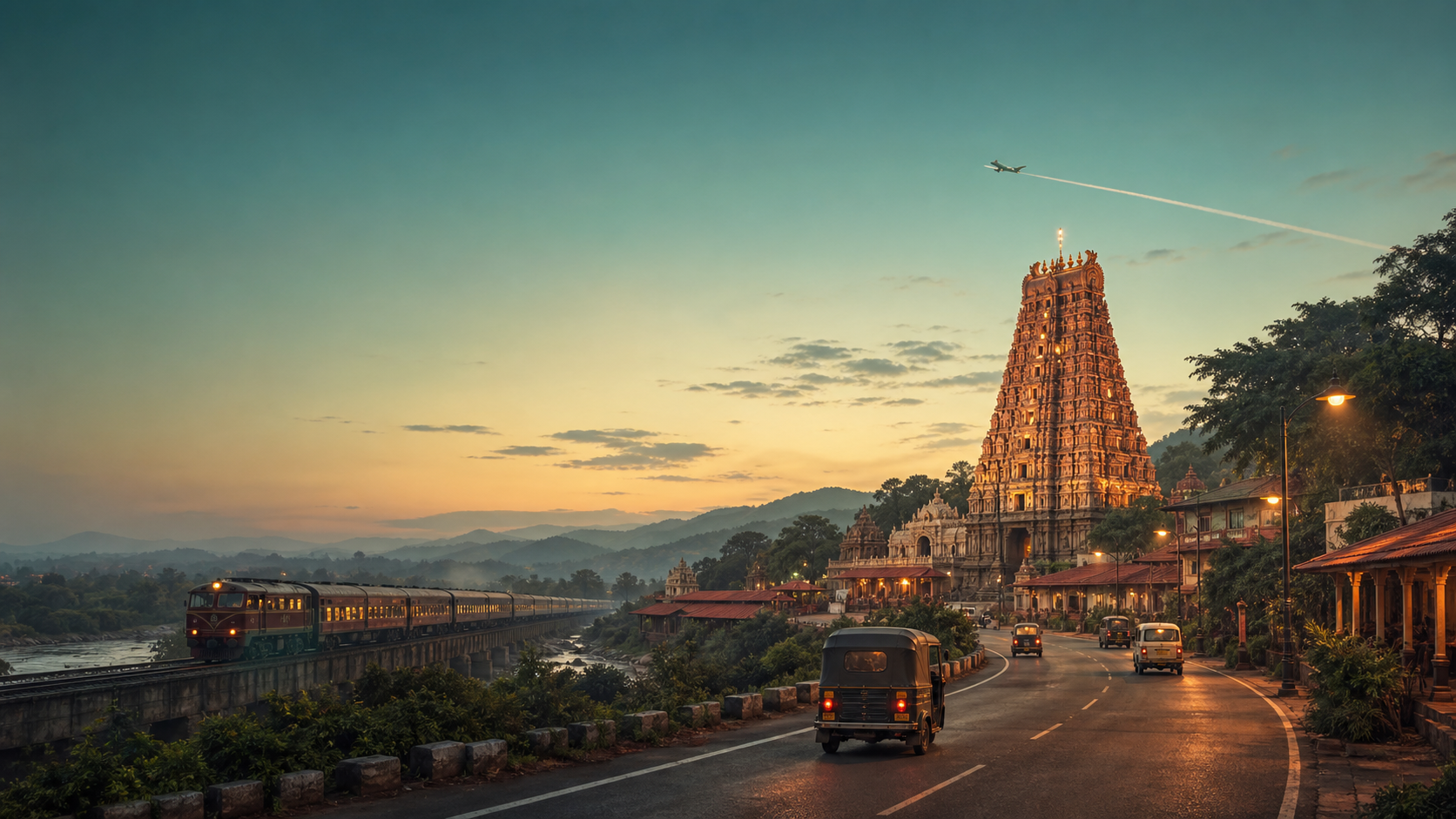
A complete pilgrim record drawn from the existing published article data.
A Glimpse into Pallava Dynasty's Grandeur
The Shore Temple represents a pinnacle of Pallava dynasty architecture, commissioned by King Narasimhavarman II, also known as Rajasimha. Completed around 725 CE, it stands as one of South India's earliest and finest examples of structural stone temples, moving beyond rock-cut architecture. The use of durable granite and black basalt reflects the advanced engineering skills of the Pallava period. Inscriptions from the early 8th century CE within the complex identify the Shiva shrines as Kshatriyasimha Pallavesvara-gruham and Rajasimha Pallavesvara-gruham, marking its historical significance.
Pallava Patronage
King Narasimhavarman II, also known as Rajasimha, was the visionary Pallava ruler responsible for the construction of this monumental temple complex.
Architectural Evolution
The Shore Temple is a crucial example of the shift from monolithic rock-cut temples to freestanding structural temples in South Indian architecture, primarily utilizing granite and black basalt.
Royal Inscriptions
Early 8th-century inscriptions found at the site provide specific names for the Shiva and Vishnu shrines, linking them directly to Pallava royal titles.
Experiencing the Ancient Splendor: A Visitor's Guide
Visitors can experience the ancient splendor of the Shore Temple from 6:00 AM to 6:00 PM daily. The ideal time to visit is between October and March, offering pleasant weather. Modest attire is required, and footwear must be removed before entering the complex. The temple is well-connected; it's approximately 60 km from Chennai International Airport and accessible via the East Coast Road (ECR) by car, with parking available. Regular bus services from Chennai to Mahabalipuram provide convenient access for a visit typically lasting 2–3 hours.
Optimal Visiting Hours
The temple is open from 6:00 AM to 6:00 PM, with the cooler months from October to March being the most comfortable for a visit.
Travel and Accessibility
Located about 60 km from Chennai, the temple is easily reachable by car via the East Coast Road (ECR) or by regular bus services from major towns.
Visitor Etiquette
Guests are requested to wear modest attire and remove their footwear before entering the temple complex, respecting the sacred nature of the site.
| Deity | Shiva (Kshatriyasimhesvara) |
|---|---|
| Form | Shiva is primarily worshipped here in the form of Kshatriyasimhesvara, represented by a 16-faced Dharalinga carved from black basalt. This unique lingam is the central icon of the main sanctum. |
| Consort | Parvati |
| Sampradaya | Shaiva and Vaishnava (syncretic) |
| Significance | As part of a complex conceived as 'Jalashayana' (lying in water), Shiva's presence here connects to the temple's coastal location and its symbolic relationship with water. The temple is also associated with the Pancha Bhoota Sthala concept, specifically representing the element of water. |
The Temple Born of the Waves
Perched majestically at the edge of the vast ocean, the Shore Temple was envisioned as 'Jalashayana', a divine abode lying in the water's embrace. Ancient lore whispers of a grander complex, much of which has since surrendered to the relentless sea. The exquisite Vishnu shrine, perhaps the first to rise, was ingeniously designed to channel the sacred waters, hinting at profound rituals of immersion or symbolic aquatic repose. This architectural marvel is often linked to the fabled 'Seven Pagodas', a navigational beacon for ancient mariners. Tsunami-revealed ruins further attest to a sprawling sacred ensemble, a testament to a divine realm partially reclaimed by the very ocean it reveres.
Perched majestically at the edge of the vast ocean, envisioned as 'Jalashayana', a divine abode lying in the water's embrace.
A testament to a divine realm partially reclaimed by the very ocean it reveres, a marvel of ancient Dravidian architecture.
Related temples: Aakkoor Thanthondreeswarar Temple | Aazhimala Shiva Temple
The Enduring Legacy of the Shore Temple
The Shore Temple, located in Mahabalipuram, Tamil Nadu, stands as a testament to ancient Indian structural architecture. Built around 725 CE, this magnificent complex is a designated UNESCO World Heritage Site, part of the Group of Monuments at Mahabalipuram. Its granite and black basalt structures, overlooking the Bay of Bengal, showcase the early Pallava structural style. Ancient lore suggests a larger complex, much of which has been claimed by the sea, hinting at its enduring legacy and resilience against the coastal elements.
UNESCO Recognition
The Shore Temple is recognized globally as a UNESCO World Heritage Site, part of the larger Group of Monuments at Mahabalipuram, acknowledged for its outstanding universal value.
Coastal Marvel
Perched at the water's edge, the temple's strategic coastal location highlights its unique interaction with the marine environment and its historical role as a landmark.
Ancient Origins
Dating back to approximately 725 CE, the temple represents a significant phase in South Indian temple architecture, transitioning from rock-cut to structural forms.
Sculpted by the Sea: Shore Temple's Unique Design
Exhibiting the distinctive Dravidian and Pallava structural style, the Shore Temple complex is a unique architectural ensemble. It features two principal Shiva shrines, one facing east and the other west, alongside a reclining Vishnu shrine positioned between them. A notable element is the Bhuvaraha shrine, dedicated to Vishnu's boar avatar, which uniquely features a circular shikara. The temple's design ingeniously incorporates the natural coastal setting, with the Vishnu shrine possibly designed to channel sacred waters, reflecting a profound connection to the ocean.
Dravidian and Pallava Style
The temple showcases the characteristic features of Dravidian architecture, refined and adapted by the Pallava dynasty, evident in its multi-tiered pyramidal shikaras and intricate carvings.
Triple Shrine Configuration
Uniquely, the complex comprises three main shrines: two dedicated to Shiva, facing opposite directions, and a central shrine for a reclining form of Vishnu.
Bhuvaraha's Circular Shikara
The shrine dedicated to Varaha, Vishnu's boar incarnation, stands out with its distinctive circular shikara, a rare architectural feature within the complex.
Sacred Sanctuaries: Honoring Shiva and Vishnu
The Shore Temple complex is a syncretic site, honoring both Lord Shiva and Lord Vishnu. The two prominent shrines are dedicated to Shiva, known through inscriptions as Kshatriyasimha Pallavesvara-gruham and Rajasimha Pallavesvara-gruham. Interspersed is a reclining Vishnu shrine, reflecting the Vaishnava tradition. The site also houses a Bhuvaraha shrine, intimately linked to the Puranic legend of Varaha, Vishnu's boar avatar, who rescued the Earth goddess from the cosmic ocean. Festivals like Mahashivaratri for Shiva and Vaikuntha Ekadashi for Vishnu are observed, underscoring its dual devotional significance.
Shaiva and Vaishnava Devotion
The temple complex is notable for its harmonious dedication to both Shaiva (Shiva) and Vaishnava (Vishnu) traditions, featuring shrines for both deities.
Varaha's Cosmic Rescue
The Bhuvaraha shrine within the complex symbolically represents the Puranic narrative of Vishnu's Varaha avatar, who saved the Earth from the cosmic ocean.
Festival Traditions
Major festivals such as Mahashivaratri are celebrated at the Shiva shrines, while Vaikuntha Ekadashi is observed at the Anantashayana Vishnu shrine, reflecting its active spiritual life.
Restoration & Conservation
The Shore Temple, standing sentinel against the relentless forces of the Bay of Bengal, has faced significant challenges from erosion, salt spray, and the passage of time. Its granite structures, while robust, are susceptible to weathering, and the intricate carvings have gradually deteriorated. Early conservation efforts, particularly since its recognition as a UNESCO World Heritage site in 1984, have focused on mitigating these natural threats. The Archaeological Survey of India (ASI) has been instrumental in implementing measures such as the construction of a breakwater to protect the temple from tidal waves and the application of chemical preservatives to the stone surfaces. These initial interventions were crucial in stabilizing the monument and preventing further rapid decay, ensuring its survival for future generations despite its precarious coastal location.
Contemporary restoration projects at the Shore Temple employ advanced scientific techniques to address the complex issues of stone conservation. This includes detailed photogrammetry and laser scanning to create precise 3D models of the structure, aiding in documentation and planning. Desalination processes are regularly applied to remove harmful salt deposits that crystallize within the stone, causing it to flake and crumble. Furthermore, efforts are made to consolidate weakened stone, re-establish structural integrity where necessary, and meticulously clean the surfaces to reveal original details without causing damage. The ongoing work is a delicate balance between preserving the authenticity of the ancient structure and employing modern engineering and chemical solutions to combat the harsh marine environment, ensuring the temple's longevity as a testament to Pallava artistry.
🗺 How to Reach
Hover a card to animate the journey on the map
Route to Mahabalipuram
Common Questions
Where is Shore Temple: UNESCO Heritage, Pallava Marvel by the Bay located?
Shore Temple: UNESCO Heritage, Pallava Marvel by the Bay is documented at Mahabalipuram, Tamil Nadu.
Which deity is associated with Shore Temple: UNESCO Heritage, Pallava Marvel by the Bay?
Shore Temple: UNESCO Heritage, Pallava Marvel by the Bay is associated with Shiva.
Related Temples


A Living Covenant