Temple No. 4760Tamil NaduShiva

Nellaiappar Temple

{ "title": "Nellaiappar Temple: Tamil Nadu’s Tambra Sabha & Paadal Petra Sthalam", "meta_description": "Discover the 7th-century Nellaiappar Temple in...

Direct answer: Nellaiappar Temple: Tamil Nadu’s Tambra Sabha & Paadal Petra Stha is a Hindu temple guide on Hindu Mandir Yatra covering the temple's location in Tirunelveli, Tamil Nadu and its association with Shiva.

Tirunelveli, Tamil NaduShivaTamil Nadu

01 / Temple Snapshot

Nellaiappar Temple at a glance

  • Temple location: Tirunelveli, Tamil Nadu
  • Primary worship: Shiva
  • Comfortable season: October–March (pleasant climate)
  • Plan around Minimum 3–4 hours (full darshan + Mani Mandapam + riverbank visit) Wear traditional attire (dhoti/saree) for seamless entry

02 / Hours and Darshan

Check darshan before you go

  • Entry details may vary by queue and ritual
  • Typical visit: Minimum 3–4 hours (full darshan + Mani Mandapam + riverbank visit) Wear traditional attire (dhoti/saree) for seamless entry
  • Located in Tirunelveli, Tamil Nadu
  • Confirm current opening hours before travel

03 / When To Go

Best time: October–March (pleasant climate)

  • Best time: October–March (pleasant climate)
  • Early morning visits are usually calmer
  • Festival days are memorable but crowded
  • Weather and crowds follow the Tirunelveli, Tamil Nadu season

04 / Dress and Etiquette

Dress modestly and move with the ritual flow

  • Remove footwear before entering shrine areas
  • Offer prayers to Shiva with local customs in mind
  • Photography rules can change by temple zone
  • Carry a small bag for phones, offerings, and receipts

05 / Getting There

Getting there: Tirunelveli, Tamil Nadu

  • Nearest airport: Tuticorin Airport (TCR), 45 km (taxi/bus: 1
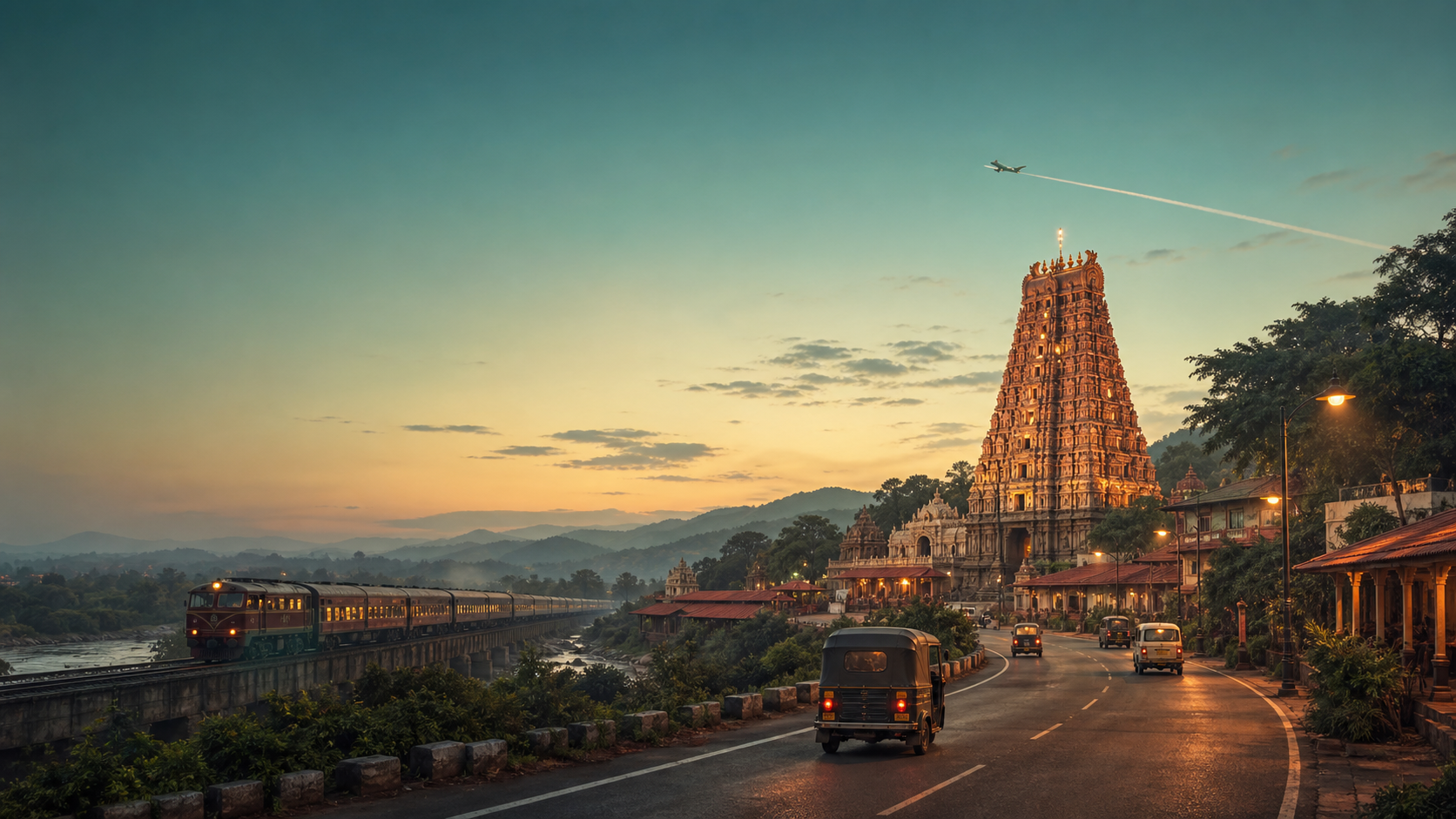
A visual visitor summary generated from this temple's article data.

A complete pilgrim record drawn from the existing published article data.

{ "title": "Nellaiappar Temple: Tamil Nadu’s Tambra Sabha & Paadal Petra Sthalam", "meta_description": "Discover the 7th-century Nellaiappar Temple in Tirunelveli — one of five Pancha Sabhai Shiva temples, famed for musical pillars, divine wedding lore, and dual Shaiva-Vaishnava sanctity.", "primary_keyword": "Nellaiappar Temple", "secondary_keywords": ["Tirunelveli temple", "Tambra Sabha", "Paadal Petra Sthalam", "Nellaiappar Temple history", "musical pillars Tamil Nadu", "Kanthimathi Amman", "Thamirabarani river temple"], "tags": ["Dravidian architecture", "Pandya dynasty", "Tevaram temples", "Shiva temples Tamil Nadu", "Vaishnava Abhimana Kshetram", "temple car Tamil Nadu", "Tamil Saivism", "classical music pillars"], "categories": ["hindu", "tamil-nadu-temples", "shaivism", "pancha-sabhai", "paadal-petra-sthalam"], "html": "
Did You Know? Nellaiappar Temple is built in the Dravidian style, embodying the artistic and devotional traditions of its era.
Key Takeaway: Nellaiappar Temple stands as a living monument to the spiritual, architectural, and cultural traditions of Tamil Nadu.

Built7th century CE (original core); expanded continuously till 18th century
Commissioned ByNindraseer Nedumaran (Koon Pandian), Pandya ruler
Ruling DynastiesPandyas, Cholas, Pallavas, Cheras, Vijayanagara, Madurai Nayaks
Architectural StylePandya Dravidian with Chola, Vijayanagara & Nayak accretions
Primary DeityNellaiappar (Venuvananathar), lingam form of Shiva
ConsortKanthimathi Amman (Parvati)
Dance Hall DesignationTambra Sabha — one of five Pancha Sabhai (Copper Hall)
UNIQUE FEATUREOnly temple where Vishnu appears as wedding witness with gindi; only Paadal Petra Sthalam recognised as Abhimana Kshetram
Heritage StatusPaadal Petra Sthalam (ASI-recognised); State Protected Monument
Managing AuthorityHindu Religious and Charitable Endowments (HR&CE) Department, TN

Historical Foundation

Timeline

7th century CE (original complex), with major additions from 7th to 18th centuriesOriginal construction by Nindraseer Nedumaran (Koon Pandian), 7th-century Pandya ruler.
LaterRenovated by Cholas.
LaterRenovated by Pallavas.
LaterRenovated by Cheras.
ModernPaadal Petra Sthalam (ASI-recognized category); maintained by HR&CE Department — classified as State Protected Monument.

The Venuvana Genesis & Pandya Sovereignty

7th c. CENindraseer Nedumaran builds core sanctum, vimana, and Mani Mandapam
c. 950 CEVeerapandiyan’s inscription refers to deity as 'Woodayar' and goddess as 'Nachiar'
1012–1044 CERajendra Chola I donates land grants and records temple administration
1070–1122 CEKulothunga Chola I adds inscriptions confirming royal endowments
13th c. CEKulasekara Pandyan I defeats Chera, Chola, and Hoysala kings; uses war spoils to build outer prakara walls
1647 CEThiru Vadamalaiappa Pillaiyan constructs the Sangili Mandapam, physically unifying Nellaiappar and Kanthimathi shrines
1654 CESivanthiappa Nayakar builds the Nandi Mandapam
1756 CEThiruvengadakrishna Mudaliar establishes the flower garden west of Sangili Mandapam
2009 CEInauguration of India’s first fully automatic temple chariot (2nd largest in TN)

Epigraphic Memory: Stones That Speak in Tamil

Unification & Modern Stewardship

Architecture & Craftsmanship

Dravidian Stratigraphy: A Timeline in Stone

The Mani Mandapam: Where Geometry Becomes Music

The Mani Mandapam’s pillars produce authentic shruti-gana-laya notes—verified by the Tamil Nadu State Department of Archaeology and the Central University of Tamil Nadu’s acoustics lab. Each sub-pillar’s pitch is determined by its precise length-to-diameter ratio, a principle encoded in the Shilpa Shastras.

The Tambra Sabha: Copper Hall of Cosmic Dance

The Presiding Deity

Deity Profile

Shiva is the presiding deity worshipped at this temple.

  • Main Deity: Shiva
  • Form: Nellaiappar (Venuvananathar), lingam form
  • Consort: Kanthimathi Amman (Parvati)
  • Tradition: Shaiva

Nellaiappar (Venuvananathar)

Kanthimathi Amman

Vishnu as Wedding Witness

Festivals & Living Traditions

Brahmotsavam: The 12-Day Cosmic Drama

Arudra Darisanam & Thirukkalyanam: Dance & Union

Thai Aaratu & Thaipoosam: Riverine Purification

Plan Your Visit

Visitor Tip: Plan your visit during October–March (cooler months); ideal during Aani Brahmotsavam (June–July) and Arudra Darisanam (December–January) for the most pleasant pilgrimage experience.

Logistics & Accessibility

Wear traditional attire (dhoti/saree) for seamless entry. Remove footwear before the first prakara—free storage is available near the eastern entrance. Photography is prohibited inside the garbhagriha and Mani Mandapam, but allowed in courtyards.

Nearby Temple Circuit & Cultural Immersion

What is a Paadal Petra Sthalam?

“The bamboo grove does not house the Lord—it is the Lord. To walk its courtyards is to tread upon Shiva’s skin, to hear its pillars is to listen to his breath.” — Dr. R. Balasubramanian, Tamil University
“In the Tambra Sabha, copper does not reflect light—it transmits truth. Every note struck is a syllable of the primal Om.” — Prof. K. S. Ramaswamy, Central University of Tamil Nadu
\"Nellaiappar
\"Musical
\"Deity
\"Tambra

Cited Sources & Further Reading

  • Tevaram (First, Fourth, Fifth Tirumurai) — Tamil Saiva Canon
  • ASI Epigraphia Indica, Volumes XXIII, XXXVI, XLII
  • HR&CE Official Website: kanthimathinellaiappar.tnhrce.in
  • Wikipedia: Nellaiappar Temple
  • “Dravidian Temples of the Pandya Realm” — Dr. S. Rajeshwari, Oxford University Press

The temple’s 5.9-hectare expanse makes it the largest temple complex in Southern Tamil Nadu, exceeding even the Meenakshi Temple’s inner precinct area.
Vishnu’s

"Every stone here carries the prayers of generations who came before."

"Nellaiappar Temple is not just a temple — it is a living chronicle of faith."

7th century CE (original complex), with major additions from 7th to 18th centuries — a defining mark of this sacred site.

Nellaiappar Temple — figure 1
Nellaiappar Temple — figure 2
Nellaiappar Temple — figure 3
Nellaiappar Temple — figure 4
Nellaiappar Temple — figure 5
Nellaiappar Temple — figure 6
Nellaiappar Temple — figure 7
Nellaiappar Temple — figure 8
Nellaiappar Temple — figure 9

Related temples: Aakkoor Thanthondreeswarar Temple | Aazhimala Shiva Temple

Sacred Stories & Mythology

Sthala Purana

The site was originally Venuvana — a bamboo forest — where Shiva appeared as Nellaiappar (Venuvananathar). Parvati worshipped him here, and Vishnu witnessed their celestial wedding. The temple thus embodies both Shaiva and Vaishnava sanctity through this foundational event.

The Bamboo Forest Revelation

The Celestial Wedding & Vishnu’s Gindi

The Musical Pillars’ Origin

Saints, Poets & Devotees

The Tevaram Trinity: Sambandar, Appar & Sundarar

Modern Devotees & Cultural Stewards

Records, Marvels & Heritage

Engineering Firsts & Acoustic Wonders

The temple’s musical pillars are not acoustic curiosities—they are dhvani-shastra (sound science) made manifest. Each sub-pillar’s resonance frequency is mathematically calibrated to the 72 melakarta ragas, transforming ritual into vibrational medicine.

Conservation & Digital Legacy

🛕
Nellaiappar Temple: Tamil Nadu’s Tambra Sabha & Paadal Petra Stha
Tamil Nadu · India
Tamil Nadu
Loading map…
✈️Delhi
🚂Mumbai
🚌Bengaluru

🗺 How to Reach

Hover a card to animate the journey on the map

✈️
By Air
Chennai (MAA) / Madurai (IXM)
🚂
By Train
Madurai Jn / Chennai Central
🚌
By Road
Buses & taxis from Tamil Nadu
Pro tip: Book well in advance during major festival seasons.
Animated path

Route to Nellaiappar Temple: Tamil Nadu’s Tambra Sabha & Paadal Petra Stha

📍
Bengaluru
🚌
NH 44100 km · 2.5 hrs
Krishnagiri
NH 4495 km · 2 hrs
Salem
NH 44165 km · 3 hrs
Dindigul
NH 4465 km · 1.5 hrs
🛕
Madurai
🚌 Exit Bengaluru via Hosur Road
🚌BengaluruKrishnagiriSalemDindigulMaduraiNH 44

Common Questions

Where is Nellaiappar Temple: Tamil Nadu’s Tambra Sabha & Paadal Petra Stha located?

Nellaiappar Temple: Tamil Nadu’s Tambra Sabha & Paadal Petra Stha is documented at Tirunelveli, Tamil Nadu.

Which deity is associated with Nellaiappar Temple: Tamil Nadu’s Tambra Sabha & Paadal Petra Stha?

Nellaiappar Temple: Tamil Nadu’s Tambra Sabha & Paadal Petra Stha is associated with Shiva.

A Living Covenant

The temple article remains powered by the same published content pipeline. This view is only a presentation layer over the existing Hindu Mandir Yatra article data.