



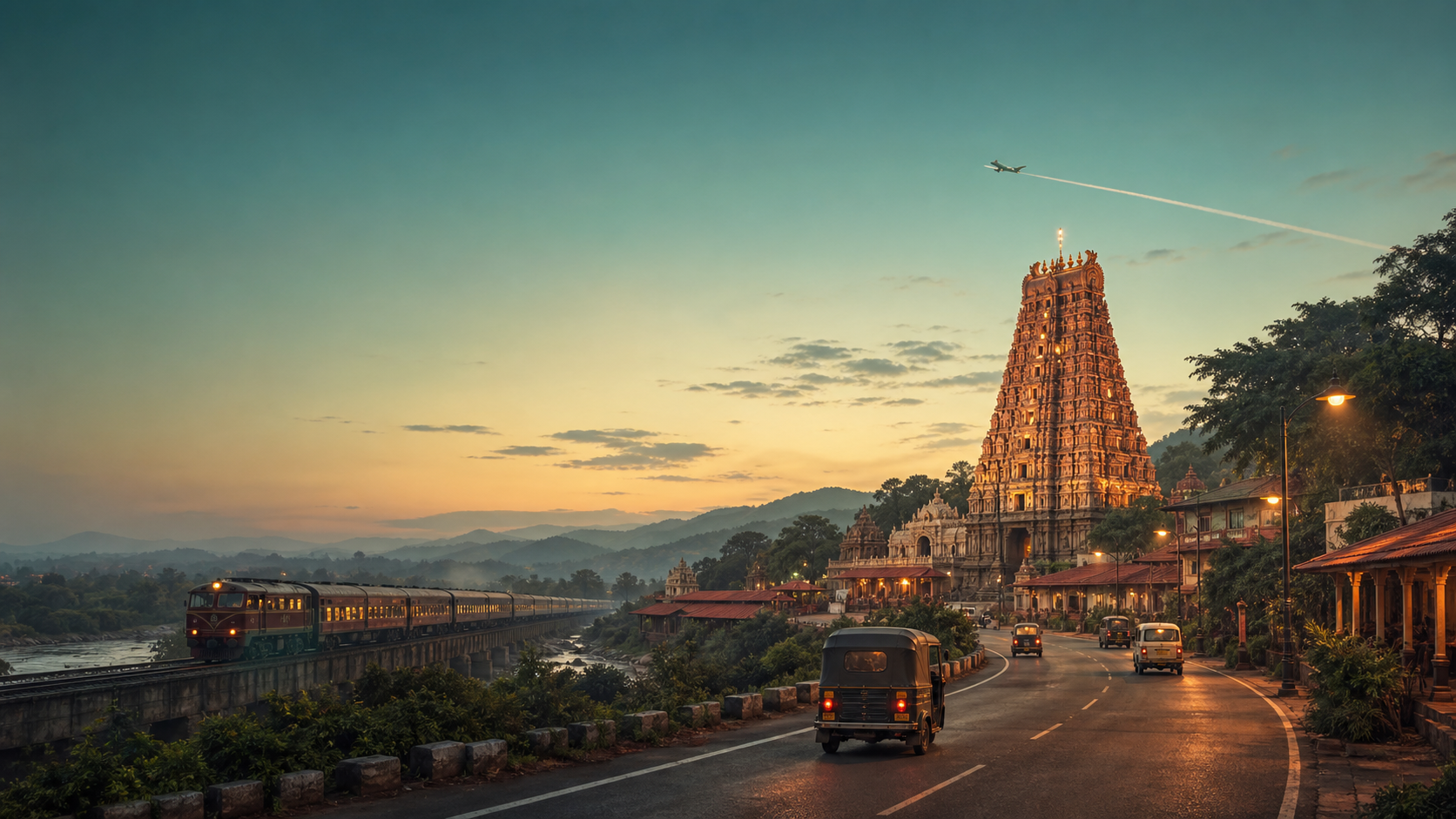
A complete pilgrim record drawn from the existing published article data.
Meenakshi Amman Temple: A Jewel of Dravidian Architecture
The Meenakshi Amman Temple, located in Madurai, Tamil Nadu, stands as a vibrant testament to South Indian spiritual and architectural grandeur. This ancient temple, primarily built in the Dravidian style, draws millions of devotees and tourists annually to its sacred precincts. Its towering gopurams and intricate sculptures embody centuries of artistic tradition and profound devotion. Dedicated to Goddess Meenakshi and Lord Sundareswarar, it represents a living tradition of faith. The complex is a prime example of the rich cultural heritage of the region, showcasing remarkable craftsmanship in granite and stucco.
Architectural Grandeur
The temple complex is a sprawling masterpiece of Dravidian architecture, characterized by its monumental gateways and richly sculpted halls.
Spiritual Significance
As a Paadal Petra Sthalam, the temple holds deep spiritual importance for adherents of Shaiva, Shakta, and Vaishnava traditions, reflecting a syncretic approach to divinity.
Location and Influence
Situated in the heart of Madurai, the temple has been a cultural and religious epicenter, influencing art, literature, and society across Tamil Nadu for centuries.
The Sacred Union: Legends of Meenakshi and Sundareswarar
At the heart of the temple's spiritual essence are the captivating myths and legends surrounding Goddess Meenakshi and Lord Sundareswarar. The story recounts Meenakshi's divine birth from a yajna performed by King Malayadhwaja Pandya, emerging with three breasts. A celestial voice prophesied the third breast would vanish upon meeting her destined husband, Lord Shiva. This sacred union, where Meenakshi recognized Sundareswarar (Shiva), is celebrated annually during the grand Meenakshi Tirukalyanam festival in Chithirai. These narratives underscore the temple's significance as a site of profound divine love and cosmic marriage.
The Divine Birth of Meenakshi
Goddess Meenakshi was born miraculously from a sacred fire ritual, emerging as a three-breasted child, destined to rule Madurai and fulfill a divine purpose.
Meenakshi's Reign and Celestial Marriage
Meenakshi ruled Madurai with valor before her fated encounter with Lord Sundareswarar (Shiva), leading to their celestial marriage, a union of cosmic significance.
Annual Celebrations
The Meenakshi Tirukalyanam festival, held annually in April–May, reenacts the divine wedding of Meenakshi and Sundareswarar, drawing devotees from across the globe.
Experiencing the Sacred: A Visitor's Guide
This guide provides essential information for visitors to navigate the Meenakshi Amman Temple complex and immerse themselves in its vibrant spiritual atmosphere. The temple is easily accessible within Madurai city via local buses and is less than 1 km from Madurai Junction Railway Station. Madurai International Airport is 12 km away. Visitors should note that modest dress is required, with dhoti or saree preferred, and footwear must be removed before entering. The best time to visit is from October to March, allowing for a comfortable and enriching experience of this historic site.
Transportation and Accessibility
The temple is conveniently located within Madurai, well-connected by local buses, and close to Madurai Junction Railway Station and Madurai International Airport.
Visitor Guidelines
Modest dress is mandatory, with traditional attire like dhoti or saree preferred. Footwear must be removed before entering the temple complex, respecting sacred traditions.
Best Time to Visit
The ideal period for visiting is between October and March, offering pleasant weather conditions for exploring the temple's vast complex and participating in its rituals.
| Deity | Meenakshi |
|---|---|
| Form | Meenakshi is depicted as Parvati in a warrior-queen form, uniquely born three-breasted and with fish-shaped eyes (Minakshi). She is portrayed as a crowned sovereign, holding a sceptre and lotus. |
| Consort | Sundareswarar |
| Sampradaya | Shaiva, Shakta, Vaishnava (syncretic) |
| Significance | Meenakshi is revered as the sovereign ruler of Madurai, embodying divine authority and power. Her iconography integrates Shaiva, Shakta, and Vaishnava traditions, with Shiva as her consort and Vishnu as her brother, highlighting a rare theological harmony. |
The Divine Birth and Reign of Meenakshi
In ancient Madurai, King Malayadhwaja Pandya and Queen Kanchanamalai performed a yajna, seeking an heir. From the sacred flames emerged a radiant, three-breasted girl, three years old. A celestial voice prophesied her third breast would vanish upon meeting her destined husband. This extraordinary child, named Meenakshi, grew into a formidable ruler, conquering kingdoms. The prophecy was fulfilled when she encountered Lord Shiva, appearing as Sundareswarar. As their eyes met, her third breast disappeared, revealing her true divine form. Their celestial marriage, a grand event, cemented their eternal bond in Madurai.
In Madurai, Meenakshi reigns, a warrior queen whose fish-eyes gaze upon her devotees with boundless grace and power, uniting traditions in her divine embrace.
From ancient flames she rose, three-breasted and destined to rule, her very presence transforming Madurai into a celestial abode.
Related temples: Aakkoor Thanthondreeswarar Temple | Abhaya Varadeeswarar Temple, Adirampattinam
Centuries of Devotion: The Temple's Enduring Legacy
Tracing its origins to the 6th century CE with first references, the Meenakshi Amman Temple's history is a rich narrative of continuous devotion and architectural evolution. The earliest surviving masonry structures were commissioned by the Pandya dynasty's Sadayavarman Kulasekaran I. Following a period of destruction, the Vijayanagara Empire, under Kumara Kampana, undertook significant rebuilding in the 14th century. Major expansions and additions were then carried out by the Madurai Nayaks in the 16th–17th centuries, shaping the temple into its current magnificent form, an enduring legacy of multiple powerful dynasties.
Ancient Foundations
The temple's roots are traced back to the 6th century CE, marking it as one of the oldest sacred sites in South India, continuously revered and expanded.
Dynastic Patronage
Successive powerful dynasties, including the Pandyas, Vijayanagara rulers, and Madurai Nayaks, contributed significantly to the temple's construction and artistic embellishment.
Continuous Evolution
The temple's history is marked by periods of construction, rebuilding, and extensive expansions, reflecting a dynamic and evolving architectural tradition over a millennium.
Gopurams and Halls: A Symphony in Stone
Renowned for its towering gopurams, intricate sculptures, and the iconic Thousand-Pillared Hall, the Meenakshi Amman Temple exemplifies the pinnacle of Dravidian temple architecture. The complex features fourteen gopurams, each adorned with thousands of stucco figures depicting mythological tales. The Hall of a Thousand Pillars, a marvel of engineering and artistry, presents unique musical pillars and finely carved deities. Constructed primarily from granite, stucco, and lime mortar, the temple's design showcases exceptional craftsmanship and a deep understanding of structural aesthetics, creating a symphony in stone.
Towering Gopurams
The temple is famed for its fourteen multi-tiered gopurams, serving as monumental gateways, each intricately sculpted with vibrant mythological narratives and divine figures.
The Thousand-Pillared Hall
A remarkable architectural feat, the "Ayirakkal Mandapam" features nearly a thousand carved pillars, many of which produce musical notes when tapped.
Sculptural Artistry
Every surface of the temple, from its ceilings to its columns, is adorned with exquisite carvings and paintings, depicting deities, mythical beasts, and scenes from Hindu epics.
Cultural Impact and Regional Identity
The Meenakshi Amman Temple has profoundly shaped Tamil culture, serving as an enduring muse for centuries of artists, poets, and musicians. Its intricate sculptures and vibrant frescoes depict countless mythological narratives, inspiring classical Bharatanatyam dancers and Carnatic vocalists who often perform compositions dedicated to Goddess Meenakshi and Lord Sundareswarar. The temple's architectural grandeur and spiritual aura have been immortalized in Sangam literature, medieval devotional hymns (like the Tevaram and Tiruvachakam), and modern Tamil poetry, reflecting its central role in the spiritual and aesthetic life of the region. This continuous artistic engagement underscores the temple's status not merely as a place of worship, but as a living repository of Tamil artistic heritage, fostering creativity and preserving traditional forms.
Beyond its artistic influence, the Meenakshi Amman Temple is a cornerstone of Madurai's identity and a powerful symbol of Tamil pride. The annual Chithirai Festival, celebrating the divine marriage of Meenakshi and Sundareswarar, transforms the city into a vibrant spectacle, drawing millions of devotees and tourists and showcasing the region's rich cultural traditions. This festival, alongside daily rituals and community gatherings, reinforces social bonds and a shared sense of heritage among the local populace. The temple's economic impact is also significant, supporting countless livelihoods through tourism, crafts, and religious services. It stands as a testament to the enduring power of faith and culture, anchoring the collective memory and aspirations of the Tamil people for generations.
🗺 How to Reach
Hover a card to animate the journey on the map
Route to Madurai
Common Questions
Where is Meenakshi Amman Temple: Madurai's Living Legend located?
Meenakshi Amman Temple: Madurai's Living Legend is documented at Madurai, Tamil Nadu.
Which deity is associated with Meenakshi Amman Temple: Madurai's Living Legend?
Meenakshi Amman Temple: Madurai's Living Legend is associated with Meenakshi.
Related Temples


A Living Covenant