



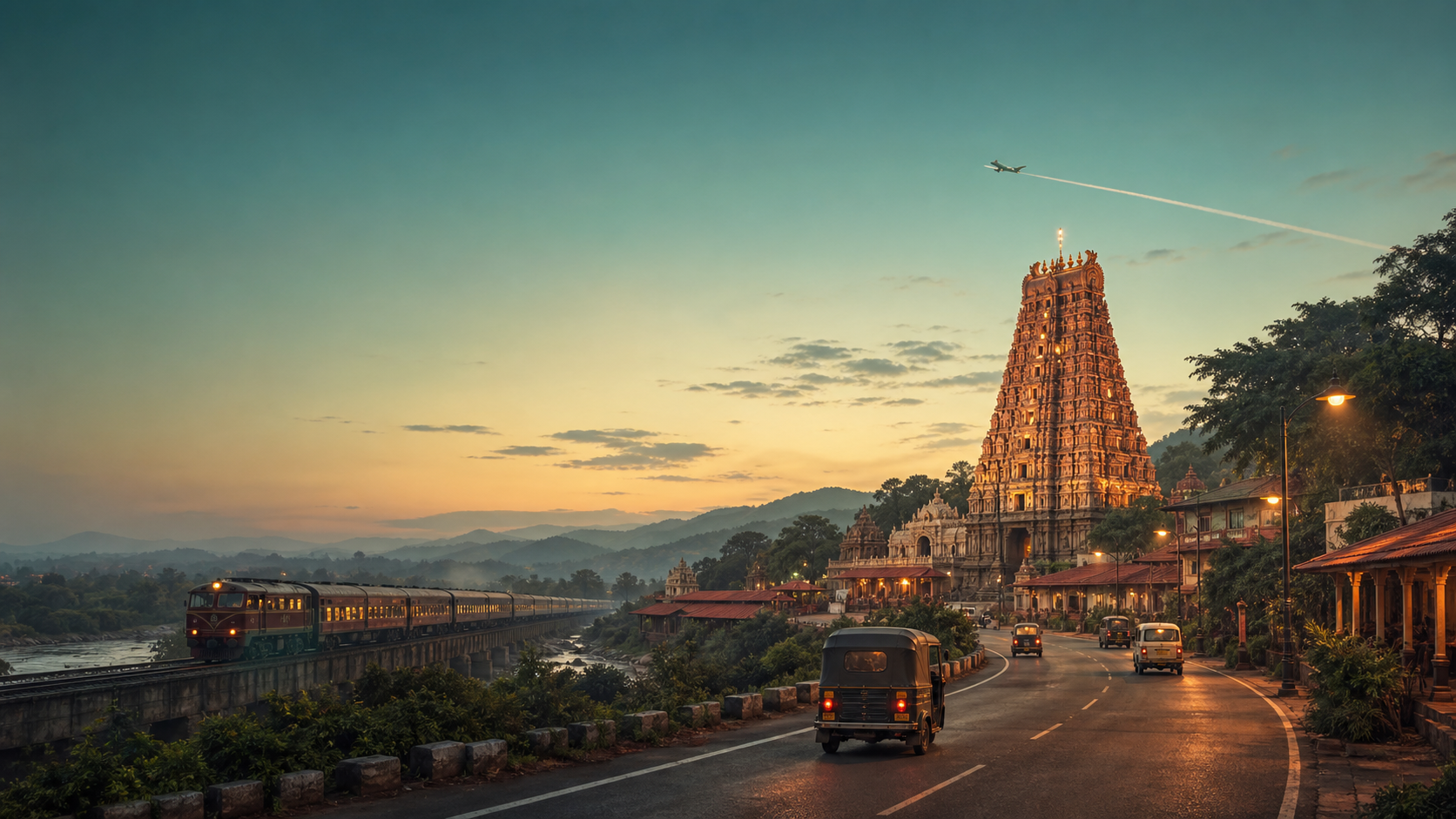
A complete pilgrim record drawn from the existing published article data.
\n
| Built | \nUncertain; referenced since 3rd century CE; major elements 9th–16th centuries | \n
|---|---|
| Deity | \nKallalagar (Vishnu) | \n
| Consort | \nThirumagal (Lakshmi) | \n
| Style | \nDravidian (Tamil Vaishnava) | \n
| Area | \n~2 acres (0.81 hectares) | \n
| Classification | \nOne of 108 Divya Desams | \n
| Major Festivals | \nChithirai Thiruvila, Float Festival, Navaratri, Vaikunta Ekadashi | \n
| Nearest City | \nMadurai (~20 km) | \n
\n
Historical Foundation
Timeline
Origins & Early Mentions
\n
\n
\n
\n
\n
\n
\n
\n
\n\n
Later Patronage & Developments
\n
\n\n\n\n\n\n
Architecture & Craftsmanship
\n
\n\nDravidian Grandeur and Layout
\n
\n\n\n \n
\n The magnificent seven-tiered rajagopuram of Kallalagar Temple, a hallmark of Dravidian architectural style.
\n\n\n
Sculptural Riches & Unique Features
\n
\n\n\n\nWhat is a Divya Desam?
\n
\n\n\n
\n \n
\n One of the powerful Narasimha sculptures, depicting Vishnu's fierce man-lion avatar.
\n\n\n
The Presiding Deity
Deity Profile
Vishnu is the presiding deity worshipped at this temple.
- Main Deity: Vishnu
- Form: Kallalagar (Sundararaja Perumal), standing form
- Consort: Thirumagal (Lakshmi)
- Tradition: Vaishnava
At the heart of Kallalagar Temple lies the divine presence of Lord Vishnu, manifesting in a form beloved by millions.
\n\nKallalagar: The Beautiful Lord
\n
Kallalagar (Sundararaja Perumal)
\n
- \n
- Main Deity: Vishnu \n
- Form: Standing posture, representing majesty and accessibility. \n
- Consorts: Sridevi and Bhudevi, flanking the Lord in the sanctum, symbolizing prosperity and earth. \n
- Significance: The 'Beautiful Lord' who descends to redeem devotees, central to the temple's Sthala Purana. \n
- Unique Aspect: Known for his vibrant blue complexion, believed to be sustained by exclusive Nupura Ganga water for abhishekam. \n
\n
Over 1 Million: The approximate number of devotees who gather for the annual Chithirai Thiruvila festival, emphasizing the temple's immense popularity and cultural impact.
\n\n\n
Pantheon of Divinities
\n
Beyond the primary sanctum, the Kallalagar Temple complex houses several shrines dedicated to other significant deities, creating a rich spiritual ecosystem:
\n- \n
- Thirumagal (Lakshmi): As the consort of Kallalagar, she has a prominent place, ensuring prosperity and well-being. \n
- Sundaravalli Nachiyar: Another form of the Divine Mother, worshipped with devotion. \n
- Andal: The revered Alvar poetess-saint, whose devotion to Vishnu is celebrated. \n
- Sudarshana (Chakrathalvar): The personified divine discus of Vishnu, holds unique significance with its annual procession through the closed Mukya Gopuram. \n
- Yoga Narasimha: Another form of Narasimha, depicting the man-lion avatar in a meditative state, balancing fierce protection with serene spirituality. \n
- Karupana Swami: The guardian deity associated with the unique ritual of the closed main gopuram, revered as Patinettaam padi Karuppan. \n
- Garuda, Hanuman, Pandava: Shrines dedicated to these revered figures, including the mythical eagle mount of Vishnu, Lord Rama's devoted monkey general, and tanks named after the Pandavas. \n
\n
 \n
\n A glimpse into the sacred space, leading to the Garbhagriha where Lord Kallalagar resides.
\n\n\n
Festivals & Living Traditions
\n
\n\nThe Grand Chithirai Thiruvila
\n
\n \n
\n Kallalagar's utsava murti during the grand Chithirai Thiruvila, poised to cross the Vaigai river.
\n\n\n
Other Auspicious Celebrations
\n
Beyond Chithirai Thiruvila, the temple observes several other significant festivals throughout the year:
\n- \n
- Float Festival (Masi, February–March): An annual event where the processional deities are taken out on a beautifully decorated float in the temple tank (Teppakulam), a visually stunning spectacle. \n
- Navaratri (September–October): A nine-night festival dedicated to the Divine Feminine, observed with special pujas, discourses, and musical performances in honour of the temple's consorts. \n
- Vaikunta Ekadashi (Margali, December–January): A highly sacred day for Vaishnavites, marking the symbolic opening of the 'Vaikunta Dvara' or 'Paramapada Vasal' (Gateway to Vaikunta), offering special darshan and rituals believed to grant liberation. \n
\n\n
Daily Rites & Unique Practices
\n
\n\n\n \n
\n The sacred Nupura Ganga, whose waters are exclusively used for the abhishekam of Kallalagar.
\n\n\n
Plan Your Visit
\n
A pilgrimage to Kallalagar Temple offers a profound spiritual and cultural experience. Planning your visit can enhance your journey to this ancient Divya Desam.
\n\nReaching Alagar Kovil
\n
- \n
- Nearest City: Madurai is the nearest major city, approximately 20-30 km away from Alagar Koyil. \n
- Nearest Airport: Madurai International Airport (IXM) is about 35 km from the temple, offering good domestic and limited international connectivity. \n
- Nearest Railway: Madurai Junction Railway Station (MDU) is approximately 30 km away, well-connected to major Indian cities. \n
- Road: The temple is easily accessible by road from Madurai via taxis, buses, and private vehicles. \n
\n\n
\n\n
When to Experience the Divine
\n
- \n
- Best Season to Visit: The months between October and March offer pleasant weather, making it ideal for exploration. \n
- For Festivals: To witness the grandeur of the Chithirai Thiruvila, plan your visit for the Tamil month of Chithirai (April–May). Other festival times like Masi (Feb–Mar) for the Float Festival, Navaratri (Sep–Oct), and Margali (Dec–Jan) for Vaikunta Ekadashi also offer unique experiences. \n
- Suggested Duration: A minimum of half a day is recommended to explore the temple complex thoroughly. A full day would allow for a more leisurely experience, including witnessing some daily rituals and exploring the surrounding Alagar Hills. \n
\n\n
Nearby Temple Circuit
\n
Kallalagar Temple can be part of a larger temple tour in Tamil Nadu:
\n- \n
- Meenakshi Amman Temple, Madurai: A globally renowned temple complex, famous for its towering gopurams and vibrant cultural life, closely linked through the Chithirai festival narrative. \n
- Srivilliputhur Divya Desam: Home to the birthplace of Andal and Periyalvar, another significant Divya Desam known for its beautiful architecture and devotional heritage. \n
- Soundararajaperumal Temple, Thadikombu: An important Vishnu temple featuring similar Vijayanagara sculptural styles, offering a comparative study of regional artistry. \n
\n
" }"Every stone here carries the prayers of generations who came before."
"Kallalagar Temple is not just a temple — it is a living chronicle of faith."
Related temples: Aakkoor Thanthondreeswarar Temple | Abeyadana Temple
Sacred Stories & Mythology
Sthala Purana
Sage Suthapas (Manduka Maharishi) was cursed by Durvasa to become a frog while bathing in Nupura Ganga on Alagar Hill. He performed penance on the banks of the Vaigai river at Thenur. Kallalagar descended from his abode on Alagar Hill to redeem the sage, performing the liberation ritual at Thenur Mandap. Later, during the reign of Thirumalai Nayak in 1653, this ritual was shifted to Vandiyur and performed at Thennur Mandapam built by the king. Another legend states Yama worshipped Vishnu here and, with Vishvakarma’s help, built the temple.
\n
\n\nThe Redemption of Manduka Maharishi
\n
The Curse and the Call of the Frog Sage
\n
\n \n\n\n
Yama's Devotion & Temple's Genesis
\n
\n\n\n\n
Chithirai Festival Narratives
\n
\n\n\n\n
Saints, Poets & Devotees
\n
\n\nAlvar Glorification
\n
\n\nLiterary Echoes
\n
Beyond the Alvars, Kallalagar Temple finds mention in an array of Tamil literary works, underscoring its historical and cultural significance:
\n- \n
- Cilappatikaram (3rd Century CE): This ancient Sangam epic, considered one of the five great epics of Tamil literature, contains references to this site as a Vishnu temple, showcasing its remarkable antiquity. \n
- Naalayira Divya Prabandham (7th–9th Century CE): The collective works of the Alvars, providing rich devotional poetry dedicated to Kallalagar. \n
- 108 Tirupathi Anthathi (18th–19th Century CE): A later devotional work that continues the tradition of glorifying the Divya Desams, including Kallalagar Temple. \n
\n
\n\nRecords, Marvels & Heritage
\n
Kallalagar Temple stands as a repository of historical records, architectural marvels, and unique heritage practices that distinguish it among Indian temples.
\n\nArchitectural & Ritualistic Uniqueness
\n
The temple boasts several one-of-a-kind features:
\n- \n
- Permanently Closed Mukya Gopuram: It is the only Divya Desam where the main gopuram remains permanently closed, except for the annual passage of the Sudarshana Chakra. This unparalleled ritual highlights a deep spiritual reverence. \n
- Sudarshana Chakra Passage: The specific practice of only allowing the celestial discus, and no other deity, through the main gate is a centuries-old tradition found exclusively here. \n
- Rare Vijayanagara Sculptures: The presence of sophisticated and dynamic Vijayanagara-period sculptures, comparable to those in other elite temples, makes it a significant site for art historians and devotees alike. \n
- Gopuram Depicting Cultural Evolution: The Karuppa Swamy shrine gopuram's depiction of local cultural life and even a British police uniform is a rare historical artifact etched in stone, reflecting the temple's integration with societal changes. \n
\n\n
Engineering & Environmental Aspects
\n
The temple demonstrates an ingenious integration of natural resources and structural design:
\n- \n
- Nupura Ganga Water System: The exclusive use of Nupura Ganga water for abhishekam, believed to preserve the icon's color, points to an ancient understanding of water properties and ritualistic purity. \n
- Integrated Fortifications & Waterbodies: The temple's design incorporates a large fort and various water bodies (Pandava, Hanuman, Uttara Narayana, Garuda tanks) within or around its complex, indicating a holistic approach to sacred space planning and resource management. The 2013 excavation of a buried Teppakulam further reveals the extent of these water systems. \n
\n\n
Cited Sources & References
\n
- \n
- Naalayira Divya Prabandham (Alvar hymns) \n
- Cilappatikaram (Sangam-era epic) \n
- 108 Tirupathi Anthathi (18th–19th c. devotional work) \n
- HR&CE official website (alagarkoilkallalagar.hrce.tn.gov.in) \n
- Academic articles and Wikipedia referencing primary Tamil literary and colonial-era texts. \n
\n
Heritage & Conservation
\n
\n\n🗺 How to Reach
Hover a card to animate the journey on the map
Route to Alagarkovil
Common Questions
Where is Kallalagar Temple: An Ancient Vaishnava Divya Desam in Tamil Nadu located?
Kallalagar Temple: An Ancient Vaishnava Divya Desam in Tamil Nadu is documented at Alagarkovil, Tamil Nadu.
Which deity is associated with Kallalagar Temple: An Ancient Vaishnava Divya Desam in Tamil Nadu?
Kallalagar Temple: An Ancient Vaishnava Divya Desam in Tamil Nadu is associated with Vishnu.
Related Temples


A Living Covenant