



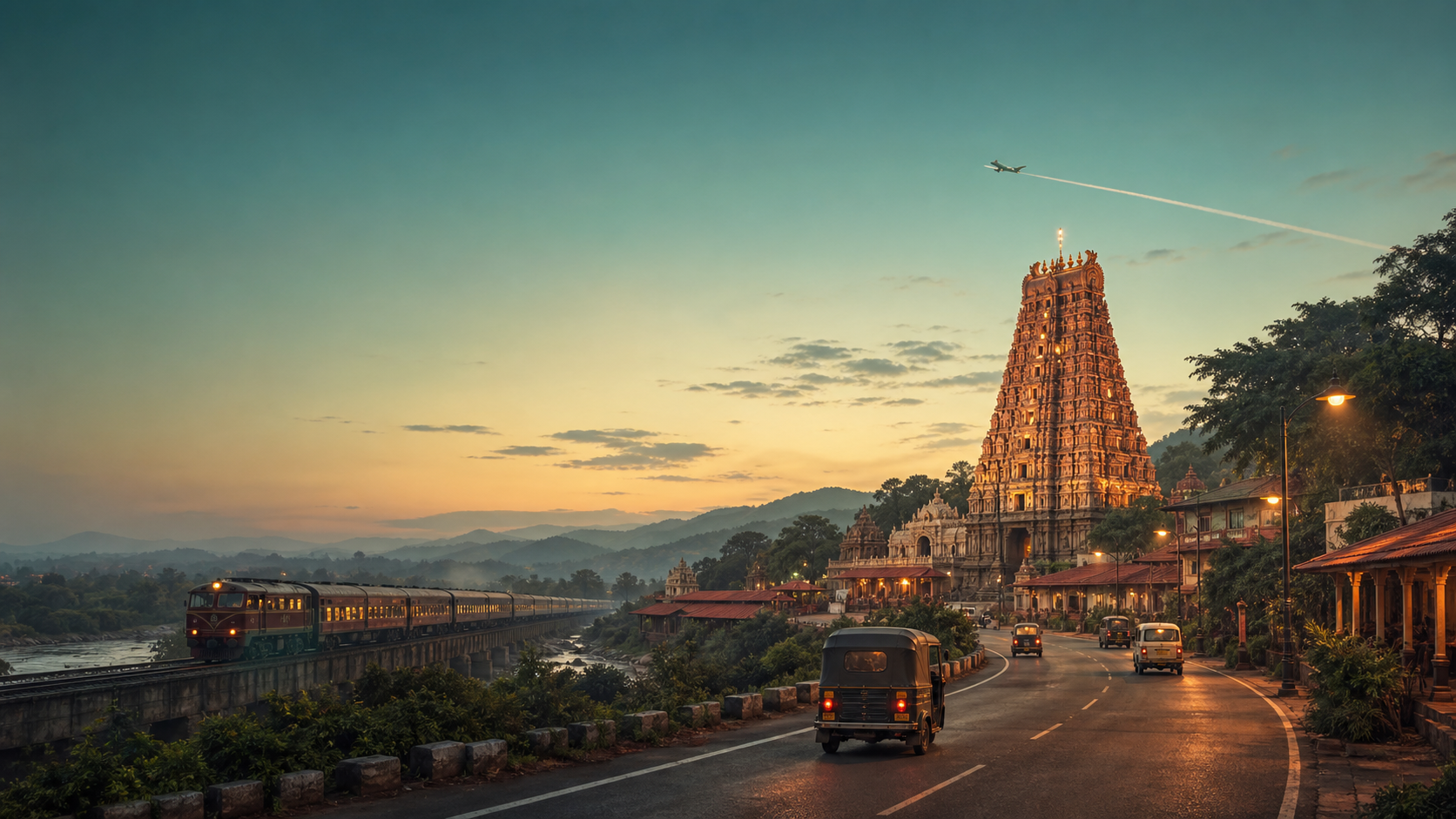
A complete pilgrim record drawn from the existing published article data.
Historical Foundation
A Legacy in Stone: The Pallava Era
Architecture & Craftsmanship
Dravidian Splendor & Pallava Innovation
What is a Vimana?
In South Indian temple architecture, the Vimana refers to the pyramidal superstructure over the garbhagriha (sanctum sanctorum). It typically consists of several diminishing tiers, culminating in a single capstone or finial (stupi).
Sculptural Narratives & Artistic Detail


The Presiding Deity
Lord Kailasanathar: The Cosmic Dweller
Deity Profile: Lord Kailasanathar
- Main Deity: Shiva (Kailasanathar)
- Form: 16-faceted Linga
- Consort: Parvati (Uma Maheshwari)
- Associated Deities: Brahma, Vishnu, Yama
- Tradition: Shaiva (Pancha Bhoota Sthala classification)
- Significance: Represents Shiva as the Lord of Mount Kailash, cosmic creator, preserver, and destroyer.
Forms of the Divine
"The 16-faceted linga of Kailasanathar is a profound symbol, reflecting the multifaceted glory and cosmic presence of Lord Shiva, inviting devotees to ponder the infinite."
Festivals & Living Traditions
Annual Celebrations
The temple observes two major festivals that draw large congregations of devotees:
- Maha Shivaratri (February/March): This is the principal festival at Kailasanathar Temple, celebrated with immense fervor. Special abhishekam (ritual bathing) of the main linga is performed, accompanied by night-long vigils, devotional singing, and processions. It is believed that worshipping Shiva on this night grants immense spiritual merit.
- Aani Thirumanjanam (June/July): This annual ceremonial bath of the main linga is another significant event, symbolizing the purification and rejuvenation of the deity. It is a visually rich ceremony where the linga is adorned and bathed with various auspicious substances.
A Legacy of Worship

Plan Your Visit
Essential Visitor Information
- Location: The temple is situated in Kanchipuram, a historic city in Tamil Nadu.
- Managing Body: Archaeological Survey of India (ASI).
- Nearest Airport: Chennai International Airport (MAA), approximately 75 km away.
- Nearest Railway: Kanchipuram Railway Station (CJ), conveniently located within the city limits.
- Best Season to Visit: October to March, when the weather is pleasant. Visiting during Maha Shivaratri (February/March) offers a unique cultural and spiritual experience.
- Suggested Duration: Allocate 2-3 hours to thoroughly explore the temple complex, its numerous sculptures, and the circumambulatory passage.
- Visit Rules:
- Photography is permitted without flash.
- Modest dress is required, respecting the sanctity of the religious site.
- Footwear must be removed before entering the sanctum sanctorum.
Exploring Kanchipuram's Sacred Landscape
Related temples: Aakkoor Thanthondreeswarar Temple | Aazhimala Shiva Temple
Timeline of Kailasanathar Temple
Enduring Through Ages
"The Kailasanathar Temple is a foundational text in stone, narrating not just mythology but the very evolution of South Indian temple architecture under the Pallavas."
Sacred Stories & Mythology
Legends Carved in Stone
The Lingothbhava Episode
One of the most significant legends depicted is the Lingothbhava episode. This myth describes a time when Brahma and Vishnu, debating their supremacy, encountered an infinite column of light, the Linga, whose beginning and end they could not find. Brahma, soaring upwards as an Annam (swan), and Vishnu, delving downwards as a Varaha (boar), both failed, thereby humbling them and revealing Shiva as the supreme, boundless reality. The Kailasanathar Temple features this narrative with remarkable iconographic precision, showing Brahma and Vishnu in their respective forms searching for the linga's extremities, a powerful testament to Shiva's omnipotence.
Miracles & Devotional Beliefs

Saints, Poets & Devotees
Echoes of Devotion
Patronage and Piety
Key Takeaway: Royal Devotion in Stone
The Kailasanathar Temple is a prime example of how the profound personal devotion of Pallava rulers like Rajasimha Pallaveswaram translated into monumental architectural and artistic achievements, shaping the spiritual and cultural landscape of Tamil Nadu.
Records, Marvels & Heritage
Architectural Prowess & Engineering Feats
The temple holds several distinctions in the annals of Indian architecture:
- It is the earliest structural stone temple in Kanchipuram, setting a precedent for future constructions.
- It is considered the most complete surviving Pallava temple, offering an intact example of the dynasty's architectural style.
- It showcases the earliest known use of sandstone sculpture carved with wooden chisels in South India, a testament to the sophisticated craftsmanship of the Pallava artisans. This technique allowed for intricate detailing that would have been challenging with harder stone.
Preserving the Past
Pro Tip for Heritage Enthusiasts
When visiting, take your time to examine the sculptural details. The temple's reliefs are best appreciated in natural light, revealing the nuanced expressions and intricate stories carved into the sandstone. Look for the unique Garudan depiction and the detailed narrative panels.
🗺 How to Reach
Hover a card to animate the journey on the map
Route to Kanchipuram
Common Questions
Where is Kailasanathar Temple, Kanchipuram: Pallava Marvel located?
Kailasanathar Temple, Kanchipuram: Pallava Marvel is documented at Kanchipuram, Tamil Nadu.
Which deity is associated with Kailasanathar Temple, Kanchipuram: Pallava Marvel?
Kailasanathar Temple, Kanchipuram: Pallava Marvel is associated with Shiva.
Related Temples


A Living Covenant