



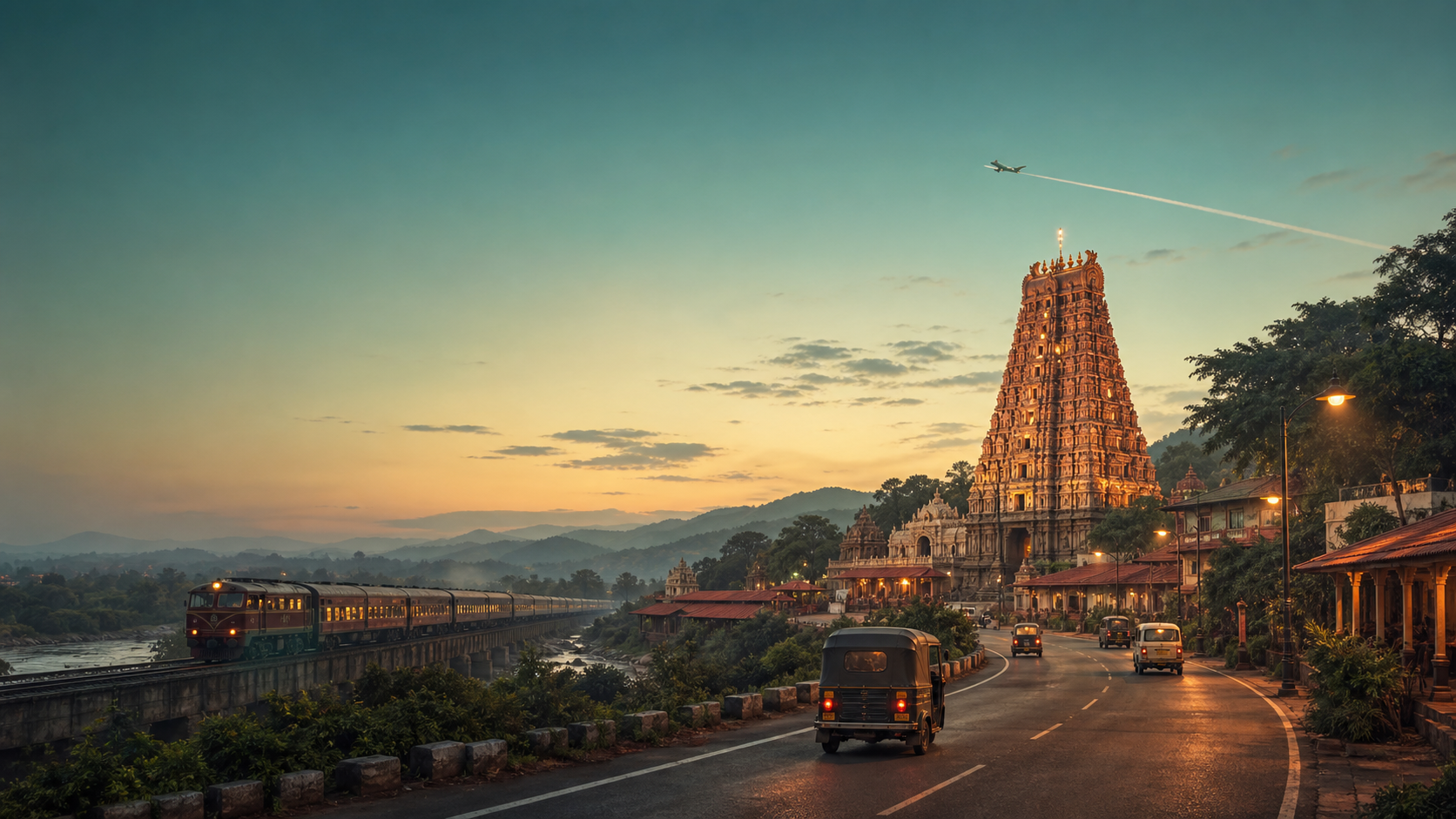
A complete pilgrim record drawn from the existing published article data.
Historical Foundation
The Sangam-Era Genesis: Kochengot Chola and the Spider King
Epigraphic Testimony: Chola and Hoysala Voices in Stone
Colonial Interlude and Modern Stewardship
Architecture & Craftsmanship
The Vibudi Prakara: A 1.6-Kilometre Testament to Devotion
Sanctum Sanctorum: Engineering Humility and Divine Intimacy
Iconographic Mastery: From Ekapada Trimurti to the Aum-Shaped Shrines
What is an Upadesa Sthalam?
An Upadesa Sthalam is a temple where Shiva appears not as cosmic destroyer or benevolent husband, but as Guru—the supreme teacher imparting Siva Gnana (divine knowledge) to a devoted disciple. At Thiruvanaikaval, Shiva faces west in the sanctum; Akilandeswari faces east in her separate shrine—symbolising the Guru-disciple axis. No marriage ritual occurs here, underscoring that their relationship transcends consortship to embody pure transmission of wisdom.
The Presiding Deity
Jambukeswarar: The Water Lingam That Breathes
Name: Jambukeswarar (Lord of the Jambu Forest)
Form: Appu Lingam (Water Lingam)—self-manifested, perpetually wet
Material: Natural black granite, partially submerged in spring water
Unique Trait: Underground stream emerges directly from the base; flow increases 40% during monsoon
Worship Protocol: Annabhishekam (rice ablution) performed daily; no oil or sandalwood paste applied—only water and bilva leaves
Akilandeswari: The Disciple Who Became Divine
Name: Akilandeswari (She who rules the universe)
Origin: Reincarnation of Parvati, sent to earth to perform penance after mocking Shiva’s austerity
Iconography: Four-armed, holding parrot, book, rosary, and gesture of teaching (chinmudra)
Shrine Architecture: Built in exact shape of Tamil ‘Aum’; eastern-facing, with no wedding canopy (mandapam)
Special Ritual: Noon puja conducted by priest dressed as woman, using Karum Pasu (black cow) for symbolic purification
— Dr. R. Balasubramanian, Tamil University, Thanjavur
Festivals & Living Traditions
Margazhi Festival: A Month of Melodic Monsoon
Natyanjali: Bharatanatyam as Ritual Geometry
Plan Your Visit
Logistics & Etiquette
Temple Circuit Integration


Related temples: Aakkoor Thanthondreeswarar Temple | Aazhimala Shiva Temple
Sacred Stories & Mythology
The Spider, the Elephant, and the First Stone
In the primordial age, the sage Jambu meditated beneath a Venn Naaval tree on the banks of the Cauvery. So intense was his tapas that a jambu tree sprouted from his skull. From its roots flowed pure water, coalescing into a lingam—Appu Lingam. Two Shivaganas, Malyavan and Pushpadanta, arrived to worship. Malyavan wove a web over the lingam as offering; Pushpadanta, in devotion, bathed it with river water. One day, Pushpadanta’s trunk brushed the web—destroying it. Enraged, Malyavan cursed him. Their quarrel disturbed Shiva’s meditation. He appeared, dissolved their curses, and declared: “You shall return as kings—one to build this temple, the other to protect its waters.” Thus, Kochengot Chola (Malyavan reborn) laid the first stone with a low doorway; and later, Hoysala Someswara (Pushpadanta reborn) endowed gold for water rituals. The temple’s entire architecture is a stone chronicle of this reconciliation.
Adi Shankara’s Intervention: When Anger Became Auspicious
By the 8th century, Akilandeswari’s shrine had fallen into disrepair. Local legends say her idol wept tears of rage—causing droughts and crop failure. Adi Shankara, travelling south to consolidate Advaita, arrived at Thiruvanaikaval and perceived her fury as unrealised potential. He installed Prasanna Vinayaka—not as remover of obstacles, but as embodiment of prasanna (serenity)—to calm her energy. Then, he crafted two Sri Chakra thaatankas from gold and sapphire, placing them on her ears. The moment they touched her, her expression softened, her posture shifted from fierce to teaching, and the perennial spring surged anew. To this day, priests recite Shankara’s Akilandeswari Ashtakam before noon puja—a sonic key unlocking her grace.
The Silent Marriage: Why No Thiru Kalyanam?
Saints, Poets & Devotees
The Nayanars and the Tevaram Resonance
Muthuswamy Dikshitar: Carnatic Alchemy in Granite Halls
— Prof. K. S. Srinivasan, Central University of Tamil Nadu
Records, Marvels & Heritage
Hydrological Miracles: The Nine Theerthams and Perpetual Spring
Structural Longevity: Granite, Geometry, and Grace
🗺 How to Reach
Hover a card to animate the journey on the map
Route to Temple
Common Questions
Where is Jambukeswarar Temple, Thiruvanaikaval: Tamil Nadu’s Sacred Water located?
Jambukeswarar Temple, Thiruvanaikaval: Tamil Nadu’s Sacred Water is documented at Tamil Nadu.
Which deity is associated with Jambukeswarar Temple, Thiruvanaikaval: Tamil Nadu’s Sacred Water?
Jambukeswarar Temple, Thiruvanaikaval: Tamil Nadu’s Sacred Water is associated with Shiva.
Related Temples


A Living Covenant