




A complete pilgrim record drawn from the existing published article data.
Echoes of the Vijayanagara Empire: The Temple's Rich History
The Prasanna Virupaksha Temple's origins trace back to the 14th-15th century CE, with initial construction commissioned by Lakkan Dandesha, a chieftain under Paruda Deva Raya of the Vijayanagara Empire. Its most significant expansions, including the central pillared hall and gopuram, were undertaken in the early 16th century CE by the revered Emperor Krishnadevaraya. Despite the devastating Battle of Talikota in 1565 CE, the temple remarkably survived, ensuring uninterrupted worship. This continuous patronage by Vijayanagara rulers solidified its status as a pivotal religious and architectural marvel, now celebrated globally as a UNESCO World Heritage site.
Founding and Expansion
The temple's foundational structure was established under Lakkan Dandesha. Later, Emperor Krishnadevaraya significantly enhanced the complex, contributing major architectural elements that define its current grandeur.
Survival and Legacy
The temple's resilience is notable, having withstood the destruction that befell Hampi in 1565 CE. Its continuous operation since then underscores its deep-rooted spiritual importance and historical endurance, preserving the legacy of the Vijayanagara era.
UNESCO Recognition
The temple's historical significance and architectural value are globally acknowledged through its inclusion in the UNESCO World Heritage Site 'Group of Monuments at Hampi'.
Vijayanagara Artistry: Unpacking the Temple's Architectural Marvels
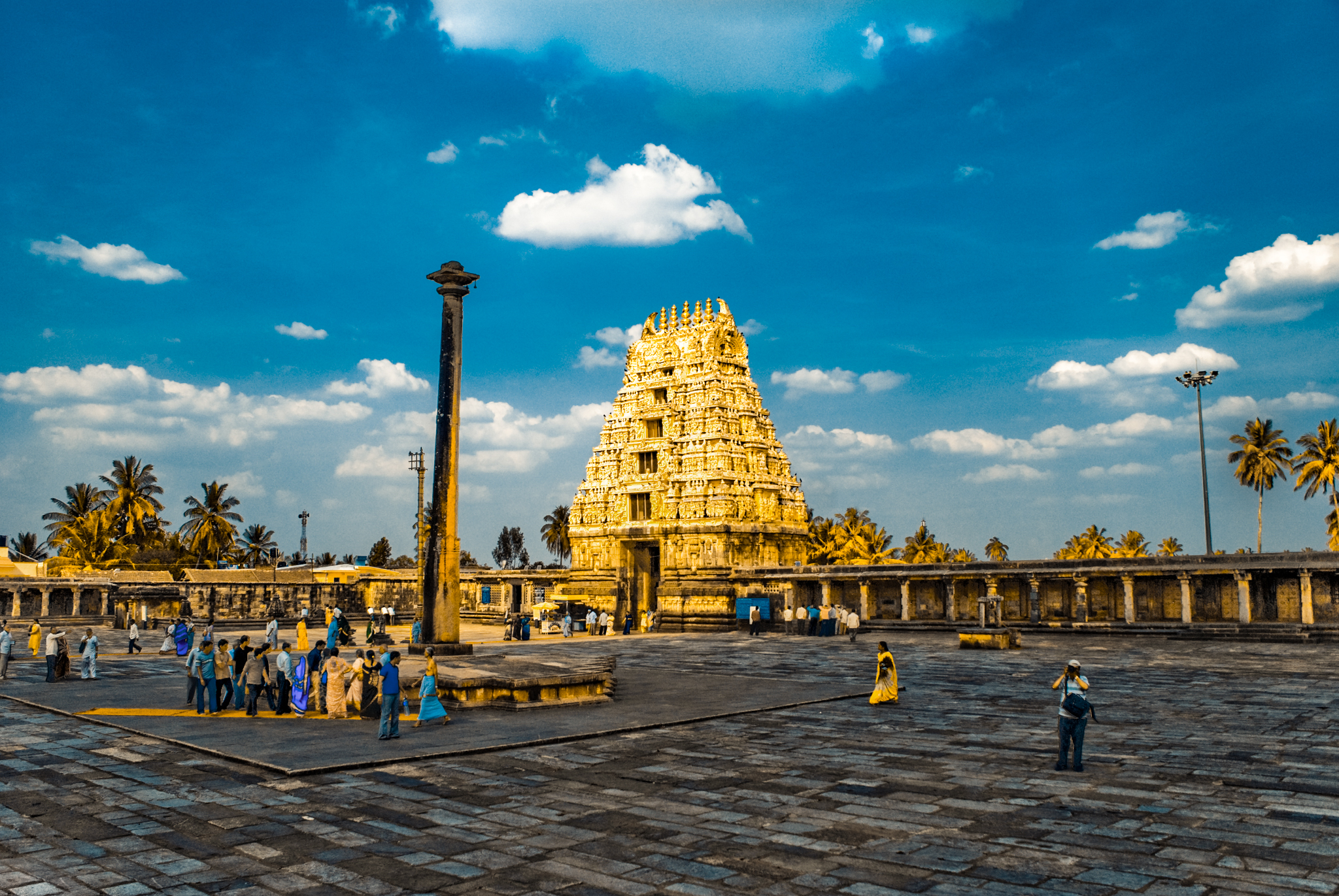
The Prasanna Virupaksha Temple exemplifies the distinctive Dravidian (Vijayanagara Dravidian) architectural style, a hallmark of the Vijayanagara Empire's artistic prowess. Constructed primarily from granite, the temple showcases intricate carvings and sculptural details that adorn its pillars, walls, and gopurams. These elements narrate mythological tales and depict various deities, reflecting the sophisticated craftsmanship of the period. The blend of grandeur and minute detailing in structures like the central pillared hall and the towering gopuram illustrates the architectural mastery achieved during the 14th-16th century CE.
Dravidian Style
The temple's design adheres to the classic Dravidian architectural principles, characterized by its towering gopurams, pillared halls, and intricate sculptural embellishments, all rendered in granite.
Intricate Carvings
Every surface of the temple, from its massive pillars to its delicate friezes, is adorned with finely carved figures and mythological scenes, showcasing the exceptional skill of Vijayanagara artisans.
Granite Construction
The predominant use of granite as a building material allowed for the creation of robust and enduring structures, capable of supporting the elaborate carvings and monumental scale seen throughout the complex.
Lord Virupaksha: Deity and Devotion at Hampi
Lord Virupaksha, a manifestation of Shiva and the presiding deity of the temple, lies at the heart of Hampi's spiritual life. The temple's origin is deeply intertwined with the divine union of Goddess Pampa and Lord Virupaksha on Hemakuta Hill, a narrative celebrated annually during the Pampa-Virupaksha Kalyanotsava. As a site of continuous worship within the Shaiva tradition, the temple observes major festivals like Maha Shivaratri and the Rathotsava (Chariot Festival), drawing thousands of devotees. This enduring devotion highlights Virupaksha's central role as a living Jyotirlinga.
The Divine Union
The temple commemorates the marriage of Goddess Pampa and Lord Virupaksha, a sacred event that consecrated the land and remains central to the temple's spiritual identity and annual festivals.
Continuous Worship
Despite historical upheavals, the temple has maintained an unbroken tradition of worship, with daily rituals and prayers dedicated to Lord Virupaksha, affirming its status as an active spiritual center.
Key Festivals
Annual celebrations such as the Rathotsava, Maha Shivaratri, and the Pampa-Virupaksha Kalyanotsava are integral to the temple's devotional calendar, attracting pilgrims and showcasing vibrant traditions.
Prasanna Virupaksha Temple: A Living Legacy in Hampi
The Prasanna Virupaksha Temple, nestled within the UNESCO World Heritage Site of Hampi, stands as a vibrant testament to enduring faith and historical grandeur. Dating back to the 14th-16th century CE, this Shaiva tradition temple is dedicated to Lord Virupaksha, a form of Shiva. It has maintained continuous worship since its inception, surviving the destruction of Hampi in 1565 CE. Its architectural splendor, crafted in the Dravidian (Vijayanagara Dravidian) style from granite, reflects the artistic pinnacle of the Vijayanagara Empire, making it a cornerstone of Hampi's spiritual and cultural landscape.
Spiritual Significance
The temple is a significant pilgrimage site, preserving the ancient Shaiva tradition. Continuous worship of Lord Virupaksha, considered a Jyotirlinga, has been maintained for centuries, upholding its sanctity and spiritual vibrancy amidst the historic ruins of Hampi.
UNESCO Heritage Status
As part of the 'Group of Monuments at Hampi', the Prasanna Virupaksha Temple is recognized as a UNESCO World Heritage Site. This designation highlights its outstanding universal value, showcasing the architectural and historical brilliance of the Vijayanagara Empire.
Planning Your Visit to Prasanna Virupaksha Temple
To ensure an enriching experience at the Prasanna Virupaksha Temple, plan your visit between October and February, when the weather is most favorable. The temple is open daily from 6:00 AM to 6:00 PM, with free entry for all visitors. Modest dress is required, covering shoulders and knees, and footwear must be removed before entering. Please note that leather items are not permitted inside the sanctum. Allow 1-2 hours to explore the complex. The temple is easily accessible by local buses from Hospet (13 km away), which is well-connected by train.
Timings and Entry
The temple operates from 6:00 AM to 6:00 PM daily. Entry is free for all visitors, allowing ample opportunity to explore the sacred premises.
Dress Code and Etiquette
Visitors are requested to dress modestly, ensuring shoulders and knees are covered. Footwear must be removed, and leather items are prohibited within the sanctum, respecting the temple's sanctity.
Accessibility
The temple is conveniently located near Hampi Bazaar. It is well-connected by road from Hospet, which serves as a major railway junction, offering various transport options for visitors.
| Deity | Virupaksha |
|---|---|
| Form | Virupaksha is worshipped in the aniconic form of a Lingam. |
| Consort | Pampa |
| Sampradaya | Shaiva |
| Significance | He is considered the 'Lord with the unblinking eye' and is revered as the husband of the local goddess Pampa, an incarnation of Parvati, making the site sacred as Pampakshetra. |
The Divine Union of Pampa and Virupaksha
Long ago, on the sacred Hemakuta Hill, the goddess Pampa, a divine incarnation of Parvati herself, undertook a rigorous penance. Her heart yearned for Lord Shiva, and her unwavering devotion was absolute. Day after day, she performed severe austerities, her spirit resolute in its quest to win the hand of the Supreme Lord. Shiva, ever compassionate and moved by such profound love, appeared before her in his glorious form as Virupaksha, the 'Lord with the unblinking eye.' He accepted her devotion, and their celestial marriage took place on this very ground, consecrating the land as Pampakshetra. This divine union is the very soul of this temple, where Virupaksha continues to bless his devotees, his unblinking gaze a testament to his eternal presence, enduring through ages and trials, a living beacon of faith amidst the ruins.
The unblinking eye of Virupaksha watches over Hampi, a timeless guardian of devotion and divine union.
In the heart of Hampi's ruins, the Virupaksha Temple stands as a living testament to enduring faith and continuous worship.
Related temples: Akkana Basadi | Amareshwar Temple
Restoration & Conservation Efforts
The preservation of ancient sites like Prasanna Virupaksha Temple within the Hampi complex presents a formidable challenge, requiring continuous and meticulous effort. Exposed to centuries of natural weathering, including monsoons and temperature fluctuations, as well as the inevitable impact of human activity, the temple's delicate structures demand ongoing attention. The Archaeological Survey of India (ASI), often in collaboration with international bodies like UNESCO, plays a crucial role in safeguarding this World Heritage Site. Conservation initiatives involve a multifaceted approach, encompassing structural stabilization to prevent collapse, careful removal of accumulated debris, and scientific chemical cleaning to combat biological growth and atmospheric pollutants. The primary goal is always to maintain the temple's historical authenticity while ensuring its structural integrity for future generations. Specific conservation efforts at Prasanna Virupaksha and across Hampi adhere to strict archaeological principles, prioritizing minimal intervention and the use of traditional, compatible materials wherever possible. Advanced techniques, including laser scanning and photogrammetry, are employed for detailed documentation and monitoring of deterioration, guiding restoration strategies. Beyond physical repairs, conservation extends to managing visitor flow and educating tourists about responsible practices to mitigate further damage. The long-term sustainability of these efforts also relies heavily on community engagement, fostering local pride and economic benefits that incentivize preservation. By balancing scholarly research, technological application, and local participation, the aim is to ensure that the spiritual and architectural grandeur of Prasanna Virupaksha continues to inspire and educate for centuries to come.🗺 How to Reach
Hover a card to animate the journey on the map
Route to Temple
Related Temples


A Living Covenant