



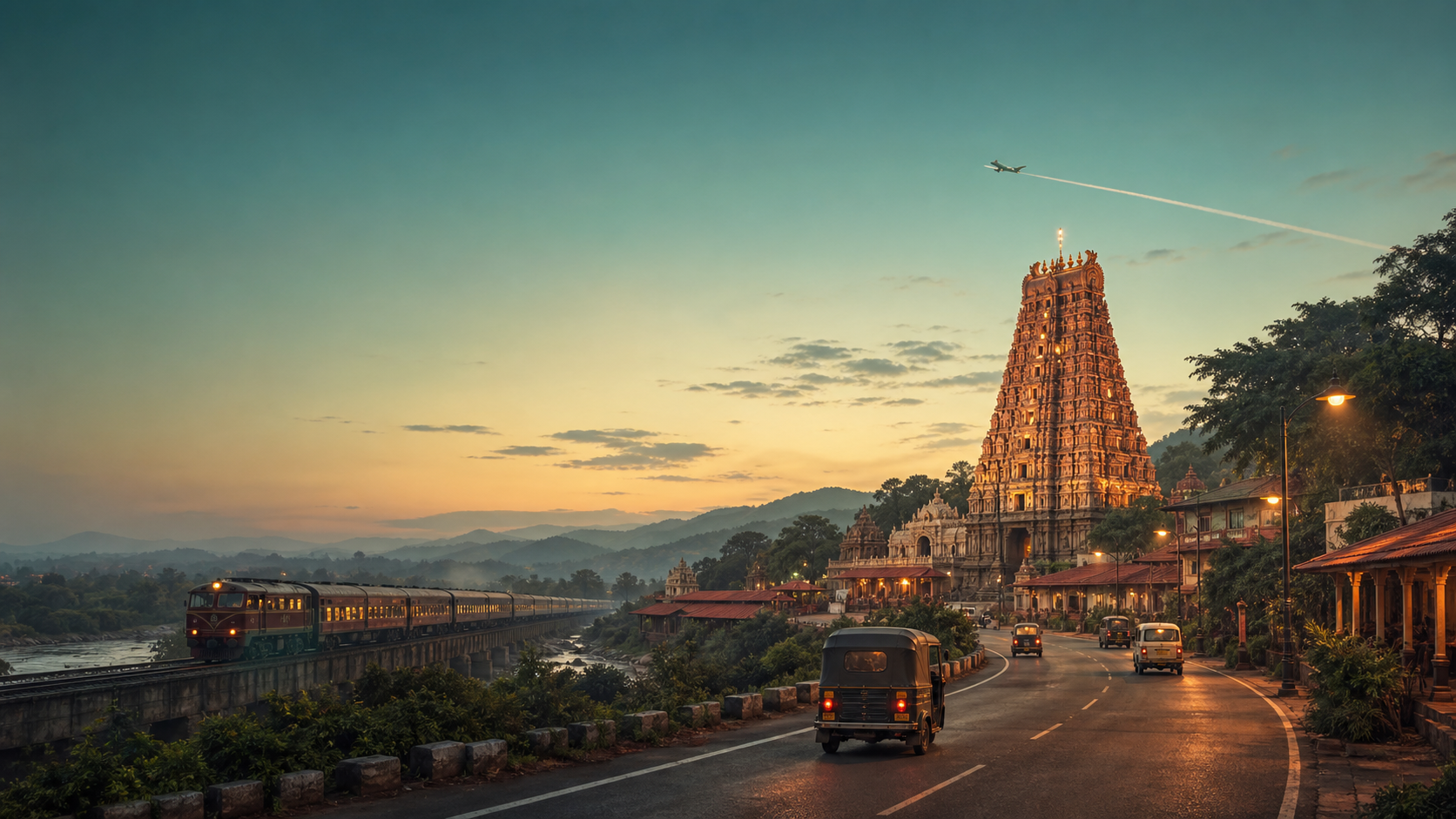
A complete pilgrim record drawn from the existing published article data.

An encompassing view of the Amba Vilas Palace complex, showing the integration of several temples within its grounds.
Historical Foundation
The Wodeyar dynasty's patronage of these temples spanned an incredible 454 years, from the consecration of Lakshmiramana Swamy in 1499 to the completion of Gayatri Temple in 1953.
Early Foundations: Lakshmiramana Swamy and Dynastic Legitimacy
"The consecration of Lakshmiramana Swamy in 1499 laid the spiritual cornerstone for the Wodeyar dynasty within their royal seat, establishing a legacy that would flourish over centuries."
Expansion, Hoysala Revival, and Wartime Devotion

The facade of Kille Venkataramana Swamy Temple, a testament to resilience and restored sovereignty.
What is Spolia?
Spolia refers to repurposed building materials or decorative fragments from older structures, often used in new constructions. In the case of the Shveta Varahaswamy Temple, authentic Hoysala spolia was used, providing a unique historical and architectural link to a prior era.
Dynastic Continuity and Final Additions
"From the earliest royal shrine to the latest, the temples within Amba Vilas Palace are a continuous narrative of Wodeyar piety, art, and the very spirit of Mysore."
Key Takeaway: A Dynasty's Devotion
The Group of Temples at Amba Vilas Palace stands as an unparalleled example of a single ruling dynasty, the Wodeyars, constructing and maintaining a complete sacred complex within their royal residence over five centuries. This enduring patronage highlights the deep spiritual connection that underpinned their rule and cultural identity.
Architecture & Craftsmanship

Intricately carved pillars within the mantapa of the Shveta Varahaswamy Temple, showcasing Hoysala influences.
Dravidian Majesty and Hoysala Echoes
Sculptural Grandeur and Mural Art

Vibrant 19th-century murals adorning the walls of the Prasanna Krishanswamy Temple, depicting epic tales.
The Presiding Deity
The Vaishnava Pantheon within the Palace
The primary deity in several key temples is Vishnu, revered in distinct forms:
- Lakshmiramana Swamy: The ancient shrine features Vishnu accompanied by his consort, Lakshmi, embodying prosperity and divine grace.
- Shveta Varahaswamy: This temple is dedicated to Vishnu in his rare Shveta Varaha (white boar) avatar. This particular iconographic form is not commonly found in South Indian temples, making the shrine unique.
- Kille Venkataramana Swamy: A form of Venkateshwara, a widely revered manifestation of Vishnu, especially significant for its association with the Wodeyar dynasty's restoration.
- Prasanna Krishanswamy: Here, Vishnu is worshipped as infant Krishna, particularly in a distinctive crawling posture (Bala Krishna), a charming and regionally unique representation.
Iconographic Rarities and Secondary Deities
Shveta Varahaswamy (White Boar Avatar)
Lord Vishnu's Varaha avatar is widely known, but the 'Shveta' (white) Varaha form is exceptionally rare. In this manifestation, Vishnu assumes the form of a wild boar to rescue the Earth (Bhūmi) from the cosmic waters. The presence of this unique iconography in the Mysore Palace highlights a distinct aspect of Wodeyar devotion and perhaps a specific regional or philosophical emphasis within their Vaishnava tradition.
Prasanna Krishanswamy (Crawling Infant Krishna)
The Prasanna Krishanswamy Temple is famous for its crawling image of child Krishna (Bala Krishna). This depiction, often referred to as 'Bala Krishna in a prone posture,' is a distinctive regional representation, evoking tenderness and playfulness. Devotees often believe this form of Krishna blesses children with health and mobility, making it a particularly beloved icon for families seeking blessings for their offspring.

A revered crawling Bala Krishna idol, unique to the Prasanna Krishanswamy Temple.
Festivals & Living Traditions
Mysuru Dasara: The Grand Spectacle
Pro Tip for Visitors during Dasara
If you plan to visit during Mysuru Dasara (Sept-Oct), be prepared for large crowds and heightened security. Book accommodations well in advance. While access to the palace temples may be restricted during certain royal rituals, the festive atmosphere and cultural displays are an unforgettable experience.
Other Significant Observances
Beyond Dasara, the temples observe other important Vaishnava festivals with great devotion:
- Krishna Janmashtami: Celebrated with fervor during the Bhadrapada month (August-September) at the Prasanna Krishanswamy and Trinayaneshvara Swamy temples, commemorating the birth of Lord Krishna. Special rituals and offerings, including butter and jaggery, are made, especially for the crawling Krishna idol.
- Vaikuntha Ekadashi: This major observance, falling in the Margashirsha month (December-January), sees thousands of devotees visiting the Lakshmiramana Swamy and Kille Venkataramana Swamy temples to pass through the 'Vaikuntha Dwara' (Gate to Vaikuntha), believed to grant liberation.

The iconic Mysuru Dasara procession, with the palace and its temples as a backdrop, symbolizing royal tradition.
Daily Rituals and Cultural Significance
Plan Your Visit
Getting There
- Nearest City: Mysuru (Mysore), Karnataka.
- Nearest Airport: Mysuru Airport (MYQ), approximately 12 km away. Bangalore International Airport (BLR) is a larger international hub, about 180 km away.
- Nearest Railway: Mysuru Junction Railway Station, just 2 km from the palace. Well-connected to major cities across India.
- Nearest Bus Stand: Mysore City Bus Stand is very close, with frequent local buses and auto-rickshaws available to reach the palace.
Best Time to Visit
Nearby Temple Circuit
Consider extending your spiritual journey by visiting other significant temples in the vicinity:
- Chamundeshwari Temple (Chamundi Hills): A famous hilltop temple dedicated to the fierce form of Goddess Durga, located just a short drive from the palace.
- Srikanteshwara Temple (Nanjangud): A large and ancient Shiva temple often referred to as 'Dakshina Kashi' (Kashi of the South), located about 23 km from Mysuru.
- Ranganathaswamy Temple (Srirangapatna): An important Vaishnava temple dedicated to Lord Ranganatha (Vishnu), situated on an island in the Kaveri River, approximately 20 km from Mysuru.
Related temples: Abeyadana Temple | Adi Kesava Perumal temple
Sacred Stories & Mythology
The Yadu Lineage and Divine Patronage
Queen Lakshmammanni's Prophetic Dream
During the tumultuous period when the Wodeyar rulers were effectively stripped of power by Hyder Ali and Tipu Sultan, a powerful divine intervention occurred. Queen Lakshmammanni, wife of Krishnaraja Wodeyar II, had a vivid dream in the 1760s. In this dream, Lord Venkataramana appeared to her, instructing her to bring his idol from a temple in Balmuri and enshrine it within the palace grounds. He promised that if this was done, the Wodeyar family would regain their rightful sovereignty over Mysore. True to the prophecy, after Tipu Sultan's defeat and death in 1799, the British reinstated the Wodeyar dynasty to the Mysore throne, cementing the Kille Venkataramana Swamy Temple as a symbol of divine blessing and restored power.
"The temples of the Amba Vilas Palace stand as enduring monuments to a dynasty's faith, where legend and history converge to narrate tales of divine intervention and royal destiny."
Coronation and Miraculous Blessings
For more on Vaishnava traditions and divine lineages, explore our article on the Sri Ranganathaswamy Temple in Srirangam, a principal Divya Desam.
Saints, Poets & Devotees
Key Takeaway: The Wodeyars as Royal Devotees
The Wodeyar kings, far from being mere political figures, were devout Vaishnavites and ardent patrons of art and culture. Their commissioning of temples, their participation in rituals, and their deep veneration of deities like Krishna and Varaha embody a royal devotion that shaped the spiritual landscape of Mysore.
Royal Patronage of Arts and Devotion
Records, Marvels & Heritage
Unique Distinctions and Archaeological Significance
The Amba Vilas Palace, including its temples, attracts over 3 million visitors annually, making it one of Karnataka's most popular heritage destinations.
Heritage Status and Conservation Efforts
Learn more about the work of the Archaeological Survey of India (ASI) in Karnataka in preserving the state's rich heritage.

The majestic Mysore Palace, a protective guardian to its sacred temples, illuminated during a festive night.
🗺 How to Reach
Hover a card to animate the journey on the map
Route to Mysore
Common Questions
Where is Temples of Amba Vilas Palace: Mysore's Royal Sacred Heart located?
Temples of Amba Vilas Palace: Mysore's Royal Sacred Heart is documented at Mysore, Karnataka.
Which deity is associated with Temples of Amba Vilas Palace: Mysore's Royal Sacred Heart?
Temples of Amba Vilas Palace: Mysore's Royal Sacred Heart is associated with Vishnu.
Related Temples


A Living Covenant