



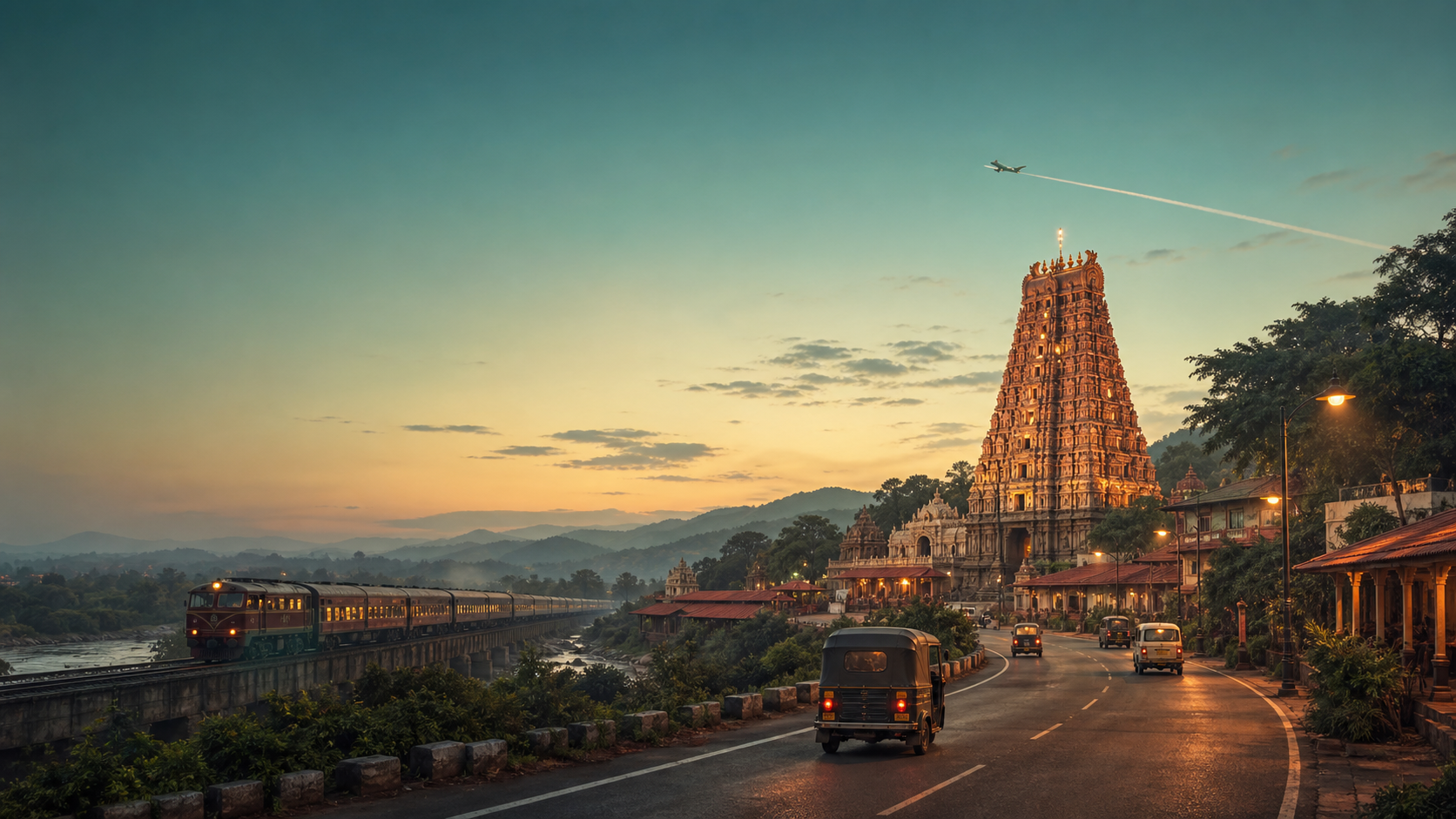
A complete pilgrim record drawn from the existing published article data.
Historical Foundation
Architectural Eras & Key Events
Chola Era Contributions
Vijayanagara & Nayak Patronage
Key Takeaway: Dynastic Legacy
The Bhu Varaha Swamy Temple is a rare example of continuous royal patronage spanning from the Cholas to the Nayaks, each dynasty leaving an indelible mark on its architecture and endowments, showcasing its enduring spiritual and cultural importance.
Architecture & Craftsmanship
The magnificent seven-tiered rajagopuram stands as a majestic gateway.
Dravidian Grandeur & Structural Elements
Definition: Gopuram & Vimana
A Gopuram is a monumental entrance tower, usually ornamented with sculptures, found at the entrance of South Indian temples. A Vimana is the tower above the sanctum sanctorum, often pyramidal or conical in shape, containing the main deity.
Nayak Artistry & Unique Features
The pillars of the Purushasuktha Mandapa showcase intricate Nayak artistry.
The Presiding Deity
Bhu Varaha Swamy
Main Deity: Varaha (Bhu Varaha Swamy)
Deity Form: A striking boar-faced icon, standing gracefully with his hands on his waist. The central icon is a 2 ft (0.61 m) shaligrama stone, a sacred fossilized ammonite revered as a natural representation of Vishnu.
Iconographic Uniqueness: The deity possesses a profoundly unique posture: his human body faces west, towards the devotees, symbolizing his benevolent gaze upon his worshippers. However, his head is distinctly turned southward, towards the direction of the slain asura Hiranyaksha, fulfilling a dying wish as per the Sthala Purana.
Consort Deity: Ambujavalli Thayar (Goddess Lakshmi), who stands majestically alongside the Lord.
Secondary Deities: The temple complex also houses shrines for various other deities and revered figures, including Srinivasa Perumal, Garuda, Nammalvar, Andal, Ramanuja, Venugopala, Vishvaksena, Vedanta Desika, Thirumangai Alvar, Manavala Mamunigal, Kulanthai Amman, Tirukachi Nambi, Rama, and the Saptha Kannigaigal.
Lord Varaha's Unique Form
Definition: Swayambu Kshetra
A Swayambu Kshetra refers to a holy place where the presiding deity is believed to be self-manifested, not carved or installed by human hands. These sites are considered exceptionally sacred and powerful.
A Pantheon of Deities
The unique Varaha icon, with its human body facing west and head turned south.
Festivals & Living Traditions
Celebrations of Unity: Chariot Festival & Masi Maham
The Chariot Festival, a vibrant display of devotion and interfaith unity.
Daily Devotion and Sacred Arts
Key Takeaway: A Living Heritage
The festivals and daily rituals at Bhu Varaha Swamy Temple are not mere reenactments; they are a living heritage, actively fostering spiritual growth, cultural preservation, and a unique model of interfaith harmony that enriches the entire region.
Plan Your Visit
Visitor Information
- Nearest City: Cuddalore (approx. 25 km)
- Nearest Airport: Pondicherry Airport (100 km), Tiruchirappalli International Airport (180 km)
- Nearest Railway: Srimushnam Railway Station (within town), Cuddalore Junction (25 km)
- Best Season to Visit: October to March offers pleasant weather. For a truly immersive experience, plan your visit during the Masi Maham festival (February–March) or the Vaikasi Brahmotsavam (April–May) to witness the grandeur and unique interfaith rituals.
- Suggested Duration: Allow 3–4 hours to explore the temple complex, participate in rituals, and soak in the spiritual atmosphere.
Pilgrimage Circuit & Visit Rules
To ensure a respectful visit, please adhere to the following rules:
- Photography: Prohibited inside the sanctum sanctorum.
- Dress Code: Modest attire is required. Traditional Indian wear is preferred.
- Access: While the temple is exceptionally inclusive, allowing Muslim devotees up to the Ardha Mandapam, other internal areas may have specific access restrictions during certain rituals or for non-Hindus, though typically it is open to all.
 Bhu Varaha Swamy temple figure 7" loading="lazy" style="width:100%;border-radius:8px;" />

Related temples: Aakkoor Thanthondreeswarar Temple | Abimukeswarar Temple
"Every stone here carries the prayers of generations who came before."
Sacred Stories & Mythology
The Rescue of Bhudevi and the Slaying of Hiranyaksha
The foundational legend of Srimushnam revolves around a terrifying cosmic event. The formidable asura, Hiranyaksha, plunged Bhudevi (Mother Earth) into the netherworld, causing chaos and despair across the universe. In her desperate plea, Bhudevi turned to Lord Vishnu for salvation. Responding to her earnest prayers, Vishnu assumed the magnificent form of Varaha, the divine boar.
Varaha descended into the primordial waters, engaged in a fierce and prolonged battle with Hiranyaksha. Ultimately, the Lord triumphed, slaying the asura and triumphantly lifting Bhudevi on his tusks, restoring her to her rightful place. As Hiranyaksha lay dying, he made a final request: that Lord Vishnu's gaze be fixed upon him even in his defeat. Compassionate, Lord Varaha granted this wish. Thus, at Srimushnam, the central icon of Bhu Varaha Swamy embodies this promise, with his body facing west towards devotees and his head respectfully turned southwards, towards where the asura was slain. This unique posture is a constant reminder of divine justice tempered with compassion.
Sacred Origins of Nithya Pushkarani
The Miraculous Dhanda Teertha
Key Takeaway: Myths as Markers
The sacred stories of Bhu Varaha Swamy Temple are not mere tales; they are the spiritual markers that explain the deity's unique form, the sanctity of its water bodies, and the divine interventions that define its identity, connecting devotees directly to the Puranic age.
Saints, Poets & Devotees
The Legacy of Madhvacharya and Dvaita Philosophy
The temple has been a spiritual haven for many revered saints and philosophers.
Alvars and Acharyas
Definition: Abhimana Kshethram
An Abhimana Kshethram is a revered temple where devotees, particularly the great Acharyas and Alvars, have shown immense affection and devotion, considering it a special abode of the Lord, making it exceptionally dear to them.
Records, Marvels & Heritage
Unique Distinctions and Spiritual Significance
8 Swayambu Kshetras: Bhu Varaha Swamy Temple is one of only eight sites where Lord Vishnu is believed to have self-manifested.
Interfaith Harmony & Miracles
The interiors showcase intricate craftsmanship and a serene spiritual ambiance.
🗺 How to Reach
Hover a card to animate the journey on the map
Route to Srimushnam
Common Questions
Where is Bhu Varaha Swamy Temple: A Legacy of Devotion and Harmony located?
Bhu Varaha Swamy Temple: A Legacy of Devotion and Harmony is documented at Srimushnam, Tamil Nadu.
Which deity is associated with Bhu Varaha Swamy Temple: A Legacy of Devotion and Harmony?
Bhu Varaha Swamy Temple: A Legacy of Devotion and Harmony is associated with Varaha (Bhu Varaha Swamy).
Related Temples


A Living Covenant