A complete pilgrim record drawn from the existing published article data.
They are celebrated for their intricate sculptures, diverse iconography, and historical significance as some of the earliest surviving examples of temple architecture in the region.

History & Foundation
Chalukyan Legacy
These temples mark the first major example of Chalukyan temple architecture, showcasing their innovative approach to rock-cut construction. They represent a foundational period for South Indian temple building.
Key Historical Milestones
- c. 535-566 CE: Pulakeshin I establishes Badami as capital, initiates temple construction.
- 578 CE: Inscription of Mangalesha found in Cave 3, providing crucial dating evidence.
- 7th century CE: Jain inscriptions added to Cave 4, indicating continued religious patronage.
- c. 540-650 CE: Primary period of construction and artistic activity across the four caves.

Early Inscriptions
Historical inscriptions within the caves provide vital clues to their dating and patronage. Cave 3, dedicated to Vishnu, contains a significant inscription from 578 CE, attributed to King Mangalesha. This record helps firmly establish the timeline of the complex.
Furthermore, Cave 4, the Jain cave, features inscriptions dating to the 7th century CE. These epigraphic records confirm the multi-faith patronage and the continuous development of the site over several decades.
Architecture & Deity
Rock-Cut Engineering
The Badami Cave Temples are a marvel of rock-cut architecture, excavated directly into massive sandstone cliffs. This method involved carving out temples from solid rock, rather than building them up. The complex spans approximately 200 meters along the cliff face.
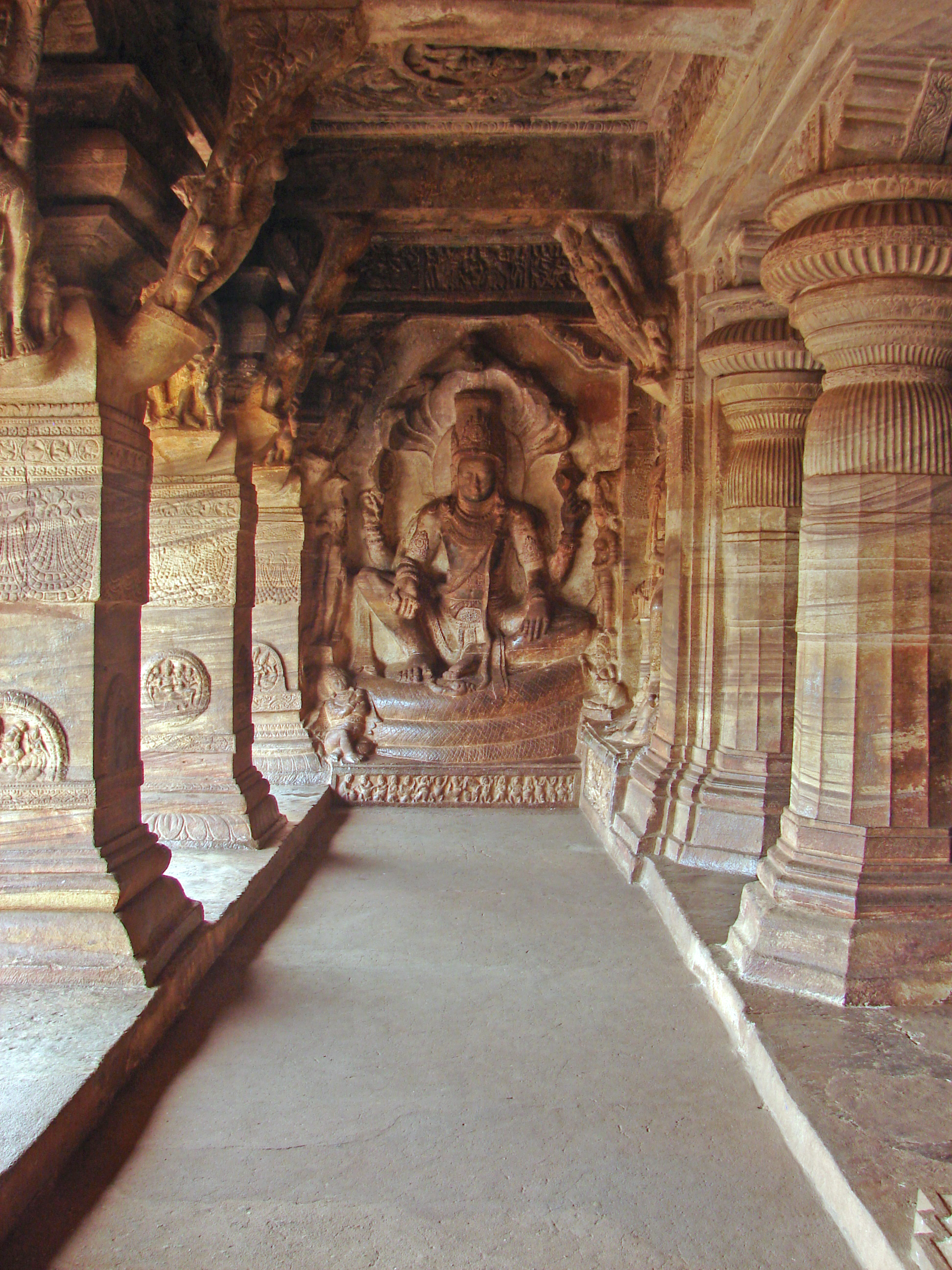
Each cave features a pillared verandah, a spacious mandapa (hall), and a small garbhagriha (sanctum sanctorum). Cave 3 is the largest, boasting a 15-meter-deep mandapa and a 9-meter-high ceiling, demonstrating remarkable precision without modern tools.
What is Rock-Cut Architecture?
Rock-cut architecture involves creating structures by excavating into natural rock formations. This subtractive method contrasts with additive construction, where materials are built up. It requires immense skill in planning and execution.

Diverse Iconography
Caves 2 and 3 are Vaishnava, dedicated to Vishnu. Cave 2 showcases a magnificent Trivikrama Vishnu, while Cave 3 features Mahishasuramardini Durga alongside Vishnu's avatars. Cave 4 is a Jain temple, housing sculptures of Tirthankara Rishabhanatha and other Jain figures.
Iconic Deities of Badami
- Cave 1 (Shaiva): Shiva as Nataraja, Harihara
- Cave 2 (Vaishnava): Vishnu as Trivikrama, Vishnu reclining on Shesha
- Cave 3 (Vaishnava): Vishnu's avatars, Mahishasuramardini Durga
- Cave 4 (Jain): Tirthankara Rishabhanatha, Mahavira

Festivals & Traditions
Chalukya Utsava
The festival features classical music and dance performances, including Bharatanatyam, alongside exhibitions showcasing local crafts and history. It offers a vibrant opportunity to experience the living traditions connected to these ancient sites.

Pilgrimage and Beliefs
While not a primary pilgrimage center in the traditional sense, the Badami Cave Temples hold spiritual significance for many. The diverse deities within the caves attract devotees from Shaiva, Vaishnava, and Jain traditions.
Local folk beliefs persist, linking the site to protective energies and ancient legends. Visitors often engage in quiet contemplation, appreciating the spiritual ambiance of these rock-cut sanctuaries. The temples serve as a testament to India's enduring multi-religious harmony.
Key Takeaway: The Badami Cave Temples are a rare example of contemporaneous, multi-faith rock-cut temples built under a single dynastic patronage, showcasing religious tolerance and artistic brilliance.
Visiting the Temple
Planning Your Trip
Badami is easily accessible. Badami Railway Station (BDM) is less than 1 km away, and Belagavi Airport (IXG) is 150 km distant. Consider combining your visit with nearby Aihole and Pattadakal for a comprehensive Chalukyan heritage circuit.

Visitor Guidelines
The site attracts approximately 200,000–300,000 visitors annually. This highlights its enduring appeal and importance as a heritage destination.
Pro Tip: Explore Early Morning!
Visit the caves early in the morning to avoid crowds and experience the tranquil beauty of the site as the sun illuminates the red sandstone. This also provides better light for photography.

"Every stone here carries the prayers of generations who came before."
Related temples: Aakkoor Thanthondreeswarar Temple | Aazhimala Shiva Temple
Sacred Stories
The Legend of Vatapi
Sage Agastya's Triumph
The legend of Sage Agastya defeating the demon brothers Vatapi and Ilvala is central to Badami's mythological identity. Agastya's wisdom and spiritual power allowed him to overcome a seemingly invincible threat, bringing peace to the region.
"Agastya's digestion of Vatapi symbolizes the triumph of spiritual wisdom over demonic deception."

Puranic Connections
The presence of Vishnu and Shiva deities within the caves further connects them to the broader Puranic narratives, celebrating divine interventions and cosmic order. The stories enhance the visitor's experience, offering a deeper understanding of the site's cultural context.
Restoration & Conservation
🗺 How to Reach
Hover a card to animate the journey on the map
Route to Badami
Common Questions
Where is Badami Cave Temples: Chalukyan Rock-Cut Marvels located?
Badami Cave Temples: Chalukyan Rock-Cut Marvels is documented at Badami, Karnataka , India.
Which deity is associated with Badami Cave Temples: Chalukyan Rock-Cut Marvels?
Badami Cave Temples: Chalukyan Rock-Cut Marvels is associated with Shiva.
Related Temples


A Living Covenant