



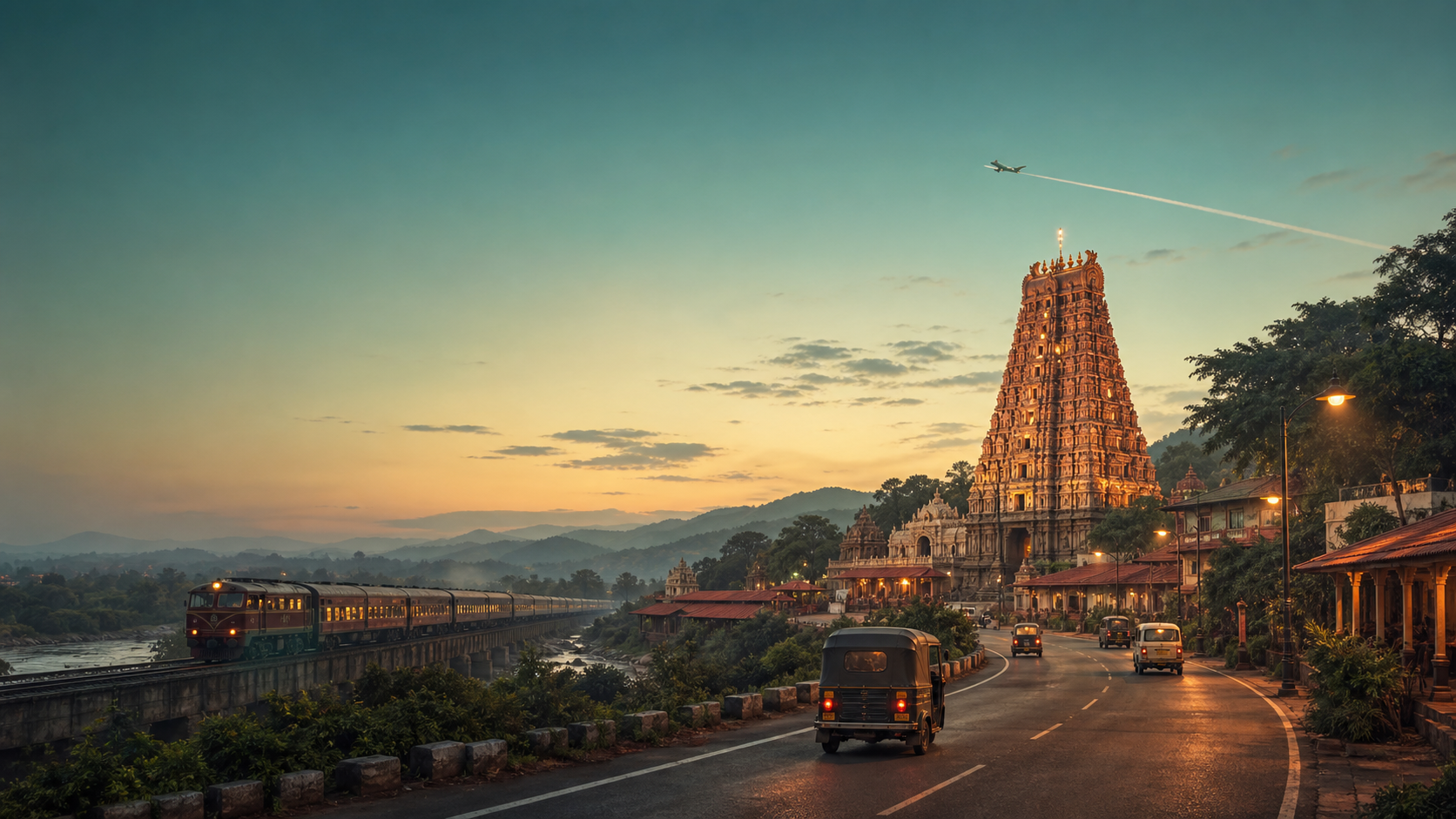
A complete pilgrim record drawn from the existing published article data.
Tracing the Ancient Legacy: Chola Patronage and Paadal Petra Sthalam Status
The Ardhanareeswarar Temple's profound legacy is rooted in Chola dynasty patronage, evident in its Dravidian architecture. Revered as a Paadal Petra Sthalam by Nayanmar saints like Sambandar, it remains a significant heritage site, meticulously maintained today.
Chola Dynasty's Architectural Imprint
The temple's Dravidian architecture distinctly showcases Chola patronage, with their significant structural contributions shaping its artistic grandeur.
Paadal Petra Sthalam Recognition
Recognized among the 275 Paadal Petra Sthalams, its sanctity was immortalized by Nayanmar Sambandar's 5th-century Tevaram hymns.
Preserved Heritage Status
An ASI-recognized site, the HR&CE Department diligently preserves its historical and spiritual integrity for future generations.
The Hilltop Sanctuary: A Blend of Dravidian Architecture and Natural Splendor
Perched atop a hill, the Ardhanareeswarar Temple exemplifies classic Dravidian architecture, harmoniously integrated with its natural surroundings. The challenging ascent defines this sacred site, offering a unique pilgrimage experience.
The Ascent
Devotees and visitors ascend 1156 stone steps to reach the temple complex. This climb provides panoramic vistas of the surrounding landscape, culminating in the serene sanctuary.
Dravidian Architectural Elements
The temple showcases typical Dravidian features, including a multi-tiered gopuram and various mandapams. Stone carvings adorn its structures, reflecting the artistry prevalent during the Chola dynasty, which contributed significantly to its architectural evolution.
Ardhanareeswarar Temple: A Unique Abode of Divine Duality
The Ardhanareeswarar Temple in Tamil Nadu is a revered Hindu shrine dedicated to Ardhanarishvara, the composite form of Shiva and Parvati. This ancient site is recognized as a Paadal Petra Sthalam, highlighting its deep spiritual and historical importance.
The Divine Form of Ardhanarishvara
The presiding deity, Ardhanarishvara, is depicted as half-male (Shiva) and half-female (Parvati). This iconography symbolizes the cosmic unity, interdependence, and synthesis of masculine and feminine principles.
Paadal Petra Sthalam Recognition
As a Paadal Petra Sthalam, the temple holds immense spiritual significance, celebrated in Tevaram hymns by Nayanar saints like Sambandar, affirming its ancient heritage.
Ardhanarishvara: Embodiment of Cosmic Union and Unique Margatha Linga Darshan
The Ardhanareeswarar Temple's presiding deity is Ardhanarishvara, a composite form of Shiva and Parvati. This iconography symbolizes the inseparable union of masculine and feminine principles, representing cosmic duality and wholeness.
Mythological Origins
Legends describe Parvati's desire to share Shiva's being, leading to their merger. This form emphasizes the equality and interdependence of Shiva and Shakti, signifying divine masculine and feminine as integral aspects of ultimate reality.
Margatha Linga and Ucchi Kala Poojai
A unique feature is the darshan of the Margatha Linga, an emerald lingam. Revealed only during the Ucchi Kala Poojai (midday ritual), this rare event offers devotees an auspicious opportunity to witness its spiritual energy.
Pilgrim's Path: Navigating the Sacred Hill and Experiencing the Temple
The Ardhanareeswarar Temple, atop Thiruchengode hill, offers a profound pilgrim experience. Visitors navigate sacred paths to reach the revered Ardhanarishvara deity.
Hill Ascent and Girivalam
Access to the temple is via over 1200 steps, offering expansive views. The 7-kilometer Girivalam (circumambulation) path around the hill's base is also a significant spiritual practice, particularly on full moon days.
Darshan Timings and Etiquette
Darshan is typically available from morning to noon and late afternoon. Confirm current timings locally. Modest attire and respectful conduct are essential within the sacred premises for a fulfilling visit.
| Deity | Ardhanarishvara |
|---|---|
| Form | Composite form of Shiva and Parvati |
| Consort | Parvati |
| Sampradaya | Shaivism |
| Significance | Ardhanarishvara represents the synthesis of masculine and feminine energies, symbolizing that the Divine Being is both male and female. This temple is one of the oldest Ardhanarishvara temples in India, a revered Paadal Petra Sthalam, and uniquely offers Margatha Linga darshan exclusively in Margali month mornings and Ucchi Kala Poojai. |
The Sage's Stubborn Devotion and Divine Union
Long ago, the sage Bhringi worshipped only Lord Shiva, meticulously circumambulating him while pointedly ignoring Goddess Parvati. Parvati, feeling disregarded, complained to Shiva. To illustrate their inseparable essence, Shiva merged with Parvati, manifesting as Ardhanarishvara – half male, half female. Yet, Bhringi, in his stubborn devotion, transformed into a beetle, attempting to bore a hole between them to circumambulate only Shiva. Offended, Parvati cursed him, draining his flesh and blood, leaving him a skeletal figure. Shiva, witnessing his plight, granted Bhringi a third leg for support, but the divine couple's union forever taught the world the profound truth of the equal and essential nature of the masculine and feminine in creation.
Where Shiva and Parvati merge as one, the ancient Ardhanareeswarar Temple stands, a testament to divine unity and timeless devotion, a spiritual ascent to grace.
Where Shiva and Parvati merge as one, this ancient Paadal Petra Sthalam stands, a testament to divine harmony, reached by a sacred ascent.
Related temples: Aakkoor Thanthondreeswarar Temple | Abhaya Varadeeswarar Temple, Adirampattinam
Modern Pilgrimage and Tourism
The Ardhanareeswarar Temple continues to be a vibrant center for Shaivite and Shakta devotees, drawing pilgrims from across Tamil Nadu and beyond. Its unique representation of Shiva and Parvati as Ardhanareeswarar holds profound spiritual significance, attracting those seeking blessings for marital harmony, fertility, and the dissolution of duality. Modern pilgrimage to the temple is facilitated by improved road networks and public transport, making it accessible to a wider demographic, including families and elderly devotees. Many pilgrims undertake the journey as part of a larger circuit of temples in the Kongu Nadu region, often coinciding their visits with auspicious days like Mahashivaratri, Karthigai Deepam, or the annual Brahmotsavam festival, when the temple premises buzz with heightened spiritual energy, devotional music, and ritualistic fervor.
Beyond its religious importance, the Ardhanareeswarar Temple also serves as a significant cultural and heritage tourism destination, attracting visitors interested in its ancient architecture, intricate sculptures, and historical narratives. The influx of pilgrims and tourists has fostered a local economy centered around the temple, with numerous shops selling religious paraphernalia, flowers, prasadam, and local handicrafts. Guesthouses, small hotels, and eateries have emerged to cater to the needs of visitors, providing a glimpse into the local lifestyle and cuisine of Tiruchengode. Efforts are often made by local authorities and temple management to enhance visitor facilities, including amenities like parking, restrooms, and information centers, ensuring a comfortable and enriching experience for all who come to witness the divine unity enshrined within its sacred walls.
🗺 How to Reach
Hover a card to animate the journey on the map
Route to Valnaickenpalayam
Common Questions
Where is Ardhanareeswarar Temple: Divine Union of Shiva-Parvati located?
Ardhanareeswarar Temple: Divine Union of Shiva-Parvati is documented at Tamil Nadu.
Which deity is associated with Ardhanareeswarar Temple: Divine Union of Shiva-Parvati?
Ardhanareeswarar Temple: Divine Union of Shiva-Parvati is associated with Ardhanarishvara.
Related Temples


A Living Covenant