



A complete pilgrim record drawn from the existing published article data.
Centuries of Devotion: Tracing Tirumala's Ancient Past
The Venkateswara Temple boasts a rich and ancient history, believed to have commenced construction around 300 CE. Its enduring legacy is marked by continuous patronage and development across millennia. The earliest recorded endowment dates back to 966 CE by Pallava queen Samavai, signifying its importance even then. Dynasties such as the Pallavas, Cholas, and Pandyas, followed by the Reddi kingdom and the mighty Vijayanagara Empire, significantly contributed to its architectural grandeur and spiritual prominence. The temple's foundational builder is attributed to the Thondaman king, whose vision laid the groundwork for this revered shrine.
Early Origins and Builders
Construction is believed to have begun around 300 CE, with the Thondaman king credited as the initial builder. This early period established the temple's sacred foundation.
Dynastic Patronage
From the 10th to 16th centuries, powerful dynasties like the Pallavas, Cholas, Pandyas, and the Vijayanagara Empire made extensive contributions, funding renovations and expansions that shaped the temple's current form.
Historical Endowments
The temple's antiquity is underscored by the earliest recorded land and jewel endowment in 966 CE by Pallava queen Samavai, highlighting its long-standing significance and continuous support.
A Marvel in Stone: The Dravidian Architecture of Tirumala
The Venkateswara Temple is a magnificent example of Dravidian architecture, characterized by its intricate carvings, towering gopurams, and grand mandapams. Constructed primarily from granite, with embellishments of gold and precious stones, the temple complex showcases centuries of artistic devotion. The Vimanam, or the golden roof over the sanctum, is a prominent feature, reflecting the opulence and reverence bestowed upon the deity. Each dynasty, from the Cholas to the Vijayanagara rulers, added distinct architectural elements, collectively creating a breathtaking symphony in stone that continues to awe pilgrims and art enthusiasts alike.
Dravidian Style
The temple exemplifies the classic Dravidian architectural style, known for its pyramidal towers (gopurams), pillared halls (mandapams), and intricate sculptural details.
Materials and Craftsmanship
Built predominantly from durable granite, the temple features exquisite craftsmanship, including fine carvings, and is adorned with gold and precious stones, notably the golden Vimanam.
Architectural Evolution
Over centuries, various dynasties contributed to the temple's architectural development, adding new structures and renovating existing ones, resulting in a rich tapestry of historical styles.
The Lord of Seven Hills: Mythology and Significance of Sri Venkateswara
The captivating mythology of Lord Venkateswara, also known as Srinivasa, is central to the temple's profound spiritual draw. In the Kali Yuga, Lord Vishnu descended as Srinivasa after his consort Lakshmi departed Vaikuntha. He sought solace on the serene Tirumala hills, where he eventually reunited with Lakshmi, reborn as Padmavati. Their celestial wedding at Narayanavanam culminated in their decision to remain eternally as stone icons on Venkatadri hill. This act of immense grace established Lord Venkateswara as the 'Kaliyuga Varada,' the granter of boons in the current age, offering salvation and solace to countless devotees who seek his divine blessings.
The Descent of Srinivasa
Lord Vishnu incarnated as Srinivasa in Kali Yuga, embarking on a quest that led him to the Tirumala hills after Lakshmi's departure from Vaikuntha.
Divine Union
Srinivasa's story culminates in his marriage to Padmavati, Lakshmi's earthly incarnation, a celestial event celebrated as a key part of the Tirumala mythology.
Kaliyuga Varada
By choosing to reside eternally on Venkatadri, Lord Venkateswara became known as the 'Kaliyuga Varada,' signifying his role as the benevolent deity who blesses and guides devotees through the challenges of the current age.
Planning Your Pilgrimage: A Guide to Tirumala
Planning a pilgrimage to the Venkateswara Temple requires careful consideration to ensure a fulfilling spiritual experience. The best time to visit is typically between October and March, offering pleasant weather. A strict dress code is enforced: men must wear dhoti or veshti, and women must wear saree or salwar kameez. While entry is free, various special darshans are available for a fee. It is recommended to allocate a minimum of two days for darshan, rituals, and visiting associated shrines. Tirumala is well-connected, with Tirupati serving as the main hub for bus, train, and flight services.
Visitor Information
The temple has specific timings, and while entry is free, special darshans may incur fees. The optimal period for a visit is between October and March for comfortable weather.
Dress Code and Duration
A strict dress code is mandatory, requiring traditional attire. Pilgrims should plan for at least two days to fully experience the darshan, rituals, and surrounding holy sites.
Transportation
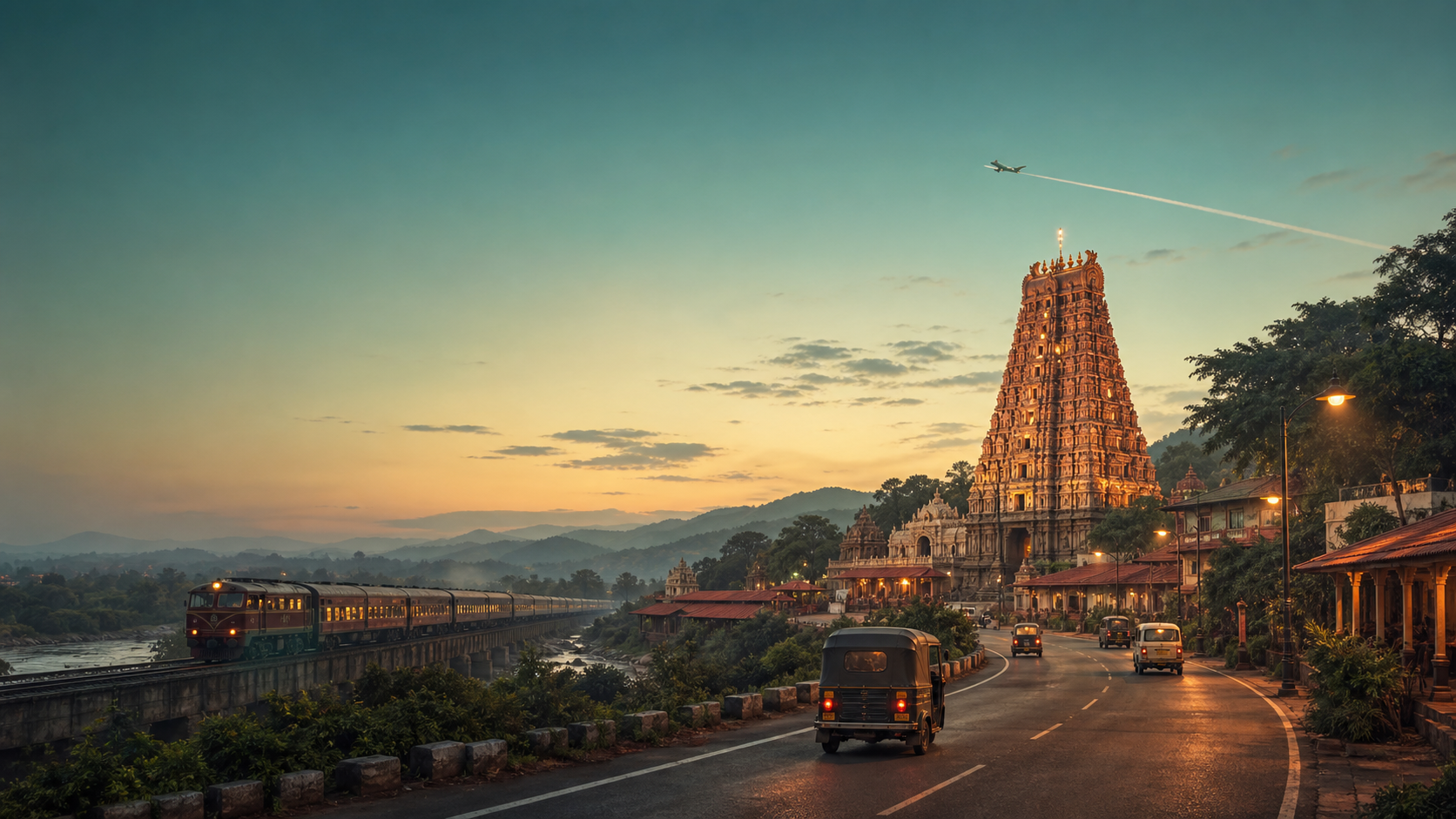
Tirumala is easily accessible via Tirupati, which is well-served by a railway station (TPTY, 35 km), an airport (TIR, 15 km), and frequent bus services to the hill temple.
| Deity | Venkateswara |
|---|---|
| Form | Venkateswara appears in a standing form facing east, holding Sudarshana Chakra and Panchajanya Shankha, adorned with a garland of tender flowers and golden ornaments. |
| Consort | Padmavati |
| Sampradaya | Vaishnava |
| Significance | He is revered as Kaliyuga Prathyaksha Daivam, the visible deity for the Kali Yuga, and is considered a self-manifested (Swayambhu) form of Vishnu. Venkateswara remains eternally on Venkatachala to liberate devotees from the trials of this age. |
The Descent of Srinivasa and the Eternal Abode
In the profound age of Kali Yuga, Lord Vishnu, in His infinite compassion, descended to Earth as Srinivasa. This incarnation was necessitated by the departure of His beloved consort, Lakshmi, who had left Vaikuntha in sorrow after Sage Bhrigu's audacious kick to Vishnu's chest. Srinivasa, heartbroken, embarked on a quest, eventually choosing the serene heights of the Tirumala hills for intense meditation. Meanwhile, Lakshmi herself reappeared on Earth, born as the beautiful Padmavati in the nearby town of Tiruchanur. Their divine paths converged, leading to a celestial wedding at Narayanavanam. Following their sacred union, the divine couple, in an act of immense grace, chose to remain eternally on the sacred Venkatadri hill as stone icons, thus offering salvation and solace to countless devotees navigating the trials and tribulations of Kali Yuga.
Venkateswara, the visible deity for the Kali Yuga, remains eternally on Venkatachala to liberate devotees from the trials of this age.
The divine couple, Srinivasa and Padmavati, chose to remain eternally on Venkatadri hill, offering salvation and solace to countless devotees.
Related temples: Akkanna Madanna Caves | Bairagimadam Temple
The Abode of Lord Venkateswara: A Global Pilgrimage Hub
The Venkateswara Temple in Tirumala stands as an unparalleled beacon of faith, drawing millions of devotees annually from across the globe. Revered as a Vishnu Swayambhu Kshetra and the 75th Divya Desam, it embodies profound spiritual and cultural significance within the Vaishnava tradition. Pilgrims undertake arduous journeys to seek the blessings of Lord Venkateswara, believing in his power to grant boons and alleviate suffering in the Kali Yuga. Its immense popularity and continuous influx of devotees underscore its status as one of the world's busiest pilgrimage centers, fostering a unique spiritual atmosphere.
Spiritual Significance
The temple is central to the Vaishnava tradition, housing Lord Venkateswara, an incarnation of Vishnu, believed to be self-manifested. It is considered a site where the Lord remains eternally present to bless humanity.
Global Devotion
Attracting pilgrims from all corners of the world, Tirumala transcends geographical and cultural boundaries, uniting devotees in their shared reverence for the presiding deity.
Cultural Heritage
Beyond its religious importance, the temple is a custodian of rich cultural heritage, reflecting centuries of artistic, architectural, and devotional contributions from various dynasties and saints.
Cultural Impact
The Venkateswara Temple at Tirumala transcends its role as a mere place of worship, deeply embedding itself into the cultural fabric of Andhra Pradesh and beyond. Its iconography, particularly the serene yet powerful image of Lord Venkateswara, has inspired countless artists, sculptors, and painters over centuries, leading to a distinct school of religious art that is recognized for its unique blend of devotion and aesthetic beauty. Traditional Carnatic music compositions, known as Annamacharya kritis, are dedicated almost exclusively to the deity, forming a significant portion of the South Indian classical music repertoire and being performed daily within the temple precincts. The temple's narratives and legends are woven into local folklore, literature, and performing arts, shaping regional identity and providing a continuous source of inspiration for spiritual and creative expression. This pervasive influence ensures the temple's stories and devotional fervor resonate far beyond its physical boundaries. Beyond its artistic and spiritual contributions, the Tirumala temple exerts a profound social and economic impact on the region and its devotees. It serves as a powerful unifying force, drawing pilgrims from diverse backgrounds and fostering a sense of shared devotion and community, often transcending caste and social barriers during the pilgrimage. The temple administration, Tirumala Tirupati Devasthanams (TTD), is one of the largest charitable organizations globally, managing numerous educational institutions, hospitals, orphanages, and social welfare programs funded by pilgrim donations. This philanthropic outreach significantly contributes to societal development, providing essential services and opportunities to underprivileged sections. Furthermore, the temple's immense popularity sustains a vast local economy, creating employment and driving development in the surrounding areas, making it a pivotal institution not just religiously, but also socio-economically.🗺 How to Reach
Hover a card to animate the journey on the map
Route to Temple
Common Questions
Where is Venkateswara Temple: Lord of Seven Hills, Darshan Guide located?
Venkateswara Temple: Lord of Seven Hills, Darshan Guide is documented at Tirumala, Andhra Pradesh.
Which deity is associated with Venkateswara Temple: Lord of Seven Hills, Darshan Guide?
Venkateswara Temple: Lord of Seven Hills, Darshan Guide is associated with Vishnu.
Related Temples
A Living Covenant