



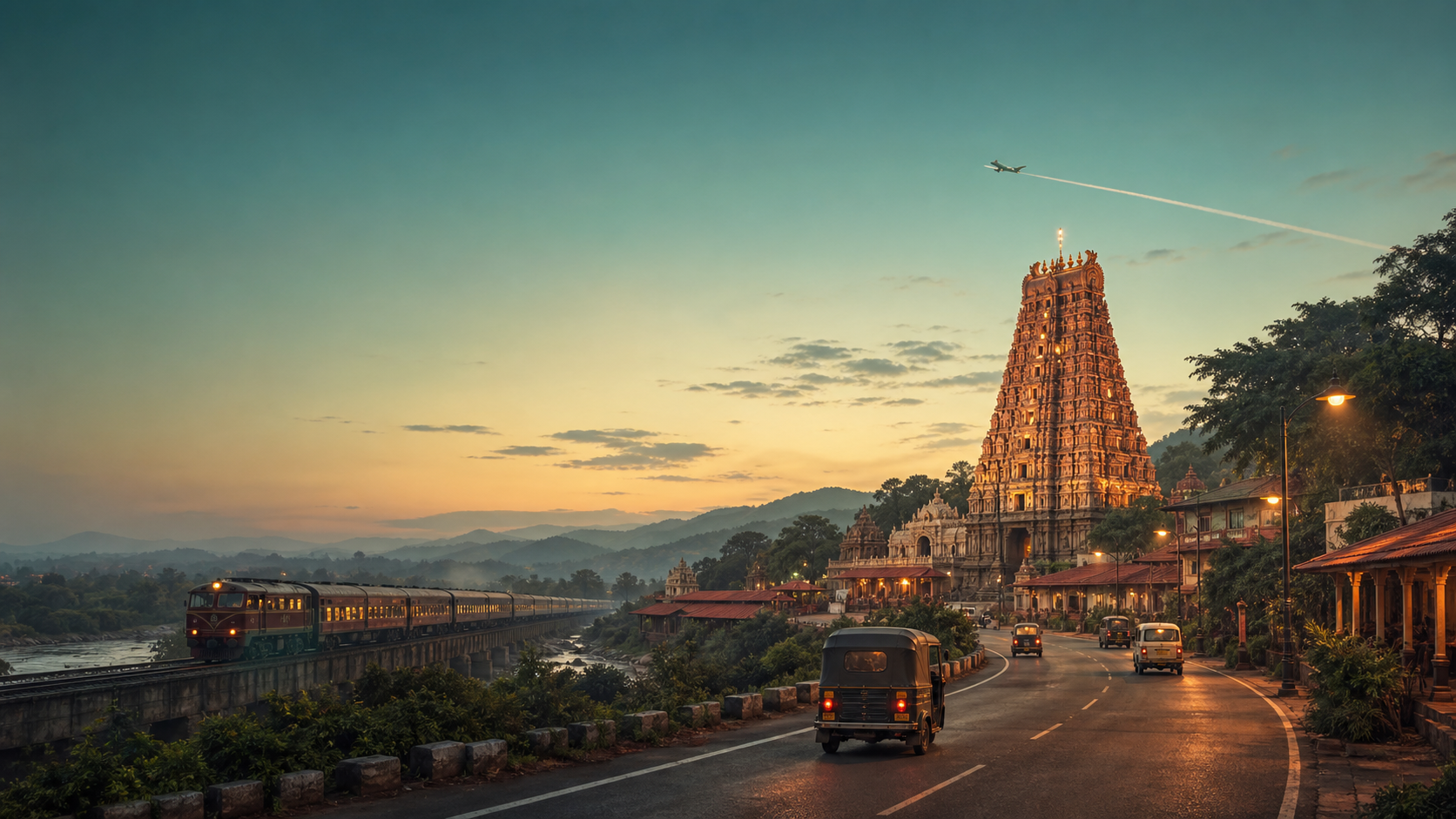
A complete pilgrim record drawn from the existing published article data.
Historical Foundation
The Pallava Anchor: Samavai Perindevi’s Enduring Legacy
Vijayanagara Expansion: From Hill Shrine to Imperial Sanctuary
Modern Stewardship: TTD and the Digital Darshan Revolution
Architecture & Craftsmanship
Dravidian Geometry Meets Vaikhanasa Cosmology
The Acoustic Sanctum: Engineering Divine Audibility
Sculptural Syntax: Posture, Gesture, and Narrative Precision
The Presiding Deity
Venkateswara Dhruva Beram
Form: Standing stone moolavirat (8 ft / 2.4 m tall)
Attributes: Four arms holding sankha (conch), chakra (discus), gada (mace), and shankha (lotus); crowned with makara kundala earrings and adorned with vanamala (wild-flower garland)
Orientation: Faces east, eyes slightly downward—symbolising compassionate vigilance over devotees
Unique Feature: Crown embedded with 1,008 diamonds; waistband inscribed with 108 names of Vishnu in Grantha script
Energy Role: The dhruva (fixed, pole-star) source—unchanging, eternal, the axis around which all other deities revolve
Why Dhruva Beram Is Never Moved: The Physics of Divine Stability
The Vanamala Mystery: Botanical Authenticity and Symbolic Weight
Consorts: Sridevi & Bhudevi—Present in Absence
Festivals & Living Traditions
Brahmotsavam: The Cosmic Procession Cycle
Kaishika Dwadasi: The One-Day Manifestation of Wrath
Vaikunta Ekadasi: The Opening of Liberation’s Gate
Plan Your Visit
Strategic Timing: When to Align with Divine Rhythms
Logistics Mastery: From Airport to Ananda Nilayam
Accommodation: Book TTD guesthouses (Srivari Mettu, Vaikuntam Q-Camp) 180 days in advance. Private hotels may require a ₹5,000 refundable deposit.
Internal Links: Related Temple: Tirumala Temple Architecture Guide | Related Temple: Vaikhanasa Agama: Ritual Foundations
Cultural Etiquette: Codes That Consecrate Conduct
Dress Code: Men must wear dhoti/veshti (rentals available at TTD counters); women must wear saree/salwar-kameez. Trousers, shorts, or sleeveless tops are not permitted.
Head Covering: Mandatory for men in the inner prakara; cloth is provided free at entrances.
Photography: Strictly prohibited inside the sanctum sanctorum and all inner prakaras. Violators face a ₹5,000 fine and ejection.
The Pancha Beramulu (“Five Deities”) is Tirumala’s unique theological framework, comprising: (1) Dhruva Beram—the eternal moolavirat; (2) Bhoga Srinivasa—the enjoying, energized silver form; (3) Ugra Srinivasa—the purificatory wrath form; (4) Malayappa Swami—the accessible utsava form with consorts; and (5) Koluvu Srinivasa—the financial guardian deity. Together, they represent the complete spectrum of divine function: existence, experience, purification, relationship, and stewardship.


Sacred Stories & Mythology
The Kali Yuga Covenant: Venkateswara’s Oath on Tirumala
According to the Tirumala Sthala Purana, as Kali Yuga intensified, sages gathered at Mount Meru and prayed to Vishnu to descend and alleviate human suffering. Vishnu agreed, stipulating conditions: He would appear only where devotees collectively invited Him, reside only on a hill mirroring Meru’s sanctity, and remain until Kali Yuga’s end. The sages then meditated on the Seshachalam hills, and Venkateswara manifested as a self-born (swayambhu) form.
When Goddess Padmavati (an incarnation of Lakshmi) arrived to marry Him, a dispute over dowry arose. To resolve it, Venkateswara declared He would remain on the hill until the debt was repaid, thus binding Himself to Tirumala eternally. The hill’s geological formation—granite peaks resembling serpent hoods—fulfills the Meru requirement, while the Swami Pushkarini tank mirrors the celestial river Ganga. This narrative represents a geosacral contract, where landscape becomes a divine covenant.
The Cave Revelation: Discovery of Malayappa Swami
For centuries, Ugra Srinivasa served as the utsava murti. However, his processions mysteriously ignited spontaneous fires, burning palanquins, damaging idols, and injuring devotees. In desperation, priests performed 48-day satyanarayana homams. On the final night, Lord Venkateswara appeared in dreams to three priests, instructing them: “Seek My youthful form in the cave called Malayappan Konai, where the southern rock bears a natural footprint.”
At dawn, they discovered the cave and, within it, three idols: Malayappa Swami (youthful Venkateswara), Sridevi, and Bhudevi—all carved from a single piece of black granite. Installed in 1330 CE, these deities instantly ended the fires. Geological surveys confirm the cave’s natural ventilation shafts prevent heat buildup, demonstrating that divine instruction aligned with empirical physics. Today, Malayappa Swami’s processional route intentionally avoids all enclosed spaces, honoring this ancient calibration of faith and function.
The Celestial Accountant: Koluvu Srinivasa’s Daily Audit
Every morning at 5:30 AM, before any devotee enters the temple, the Koluvu Seva commences. Koluvu Srinivasa—a small silver murti seated on a golden throne—receives yesterday’s financial accounts: cash receipts, gold donations, grain stocks, and expenditure ledgers. The dharmakarta (chief administrator) reads aloud while the archaka rings a silver bell.
If the accounts balance, the bell tone is clear; discrepancies cause the tone to waver, prompting immediate reconciliation. Folk belief holds that Koluvu Srinivasa inspects festival preparations nightly during Brahmotsavam, appearing as a luminous figure checking lamp wicks and flower arrangements. This is the world’s only known temple where a deity performs daily financial auditing, transforming accounting into sacrament. TTD’s 2022 annual report noted zero financial irregularities in 89 consecutive years—a testament to the ritual’s psychological and ethical efficacy.
Saints, Poets & Devotees
Ramanuja and the Divya Kalyana: Ritualising Theology
Annamacharya: The Temple’s Eternal Musician
The Alvars’ Hymnic Cartography
“Bhoga Srinivasa is not a replica—he is Venkateswara in leisure, enjoying what the Dhruva Beram ordains. Their connection is not mechanical—it is metabolic.”
—Dr. K. S. Raghavan, Iconographic Scholar, Sri Venkateswara University
Records, Marvels & Heritage
The Sambandha Kroocha: India’s Oldest Energetic Conduit
Statistical Sovereignty: A Temple That Defies Metrics
Conservation Challenges: Balancing Devotion and Durability
“When Koluvu Srinivasa hears the accounts, He doesn’t judge the numbers—He measures the sincerity behind them. That is the temple’s true audit.”
—Sri R. S. Sharma, Former Dharmakarta, TTD
🗺 How to Reach
Hover a card to animate the journey on the map
Route to Tirupati
Common Questions
Where is Deities in Tirumala Venkateswara Temple: The Sacred Pancha Beramu located?
Deities in Tirumala Venkateswara Temple: The Sacred Pancha Beramu is documented at Andhra Pradesh.
Which deity is associated with Deities in Tirumala Venkateswara Temple: The Sacred Pancha Beramu?
Deities in Tirumala Venkateswara Temple: The Sacred Pancha Beramu is associated with Vishnu.
Related Temples
A Living Covenant