



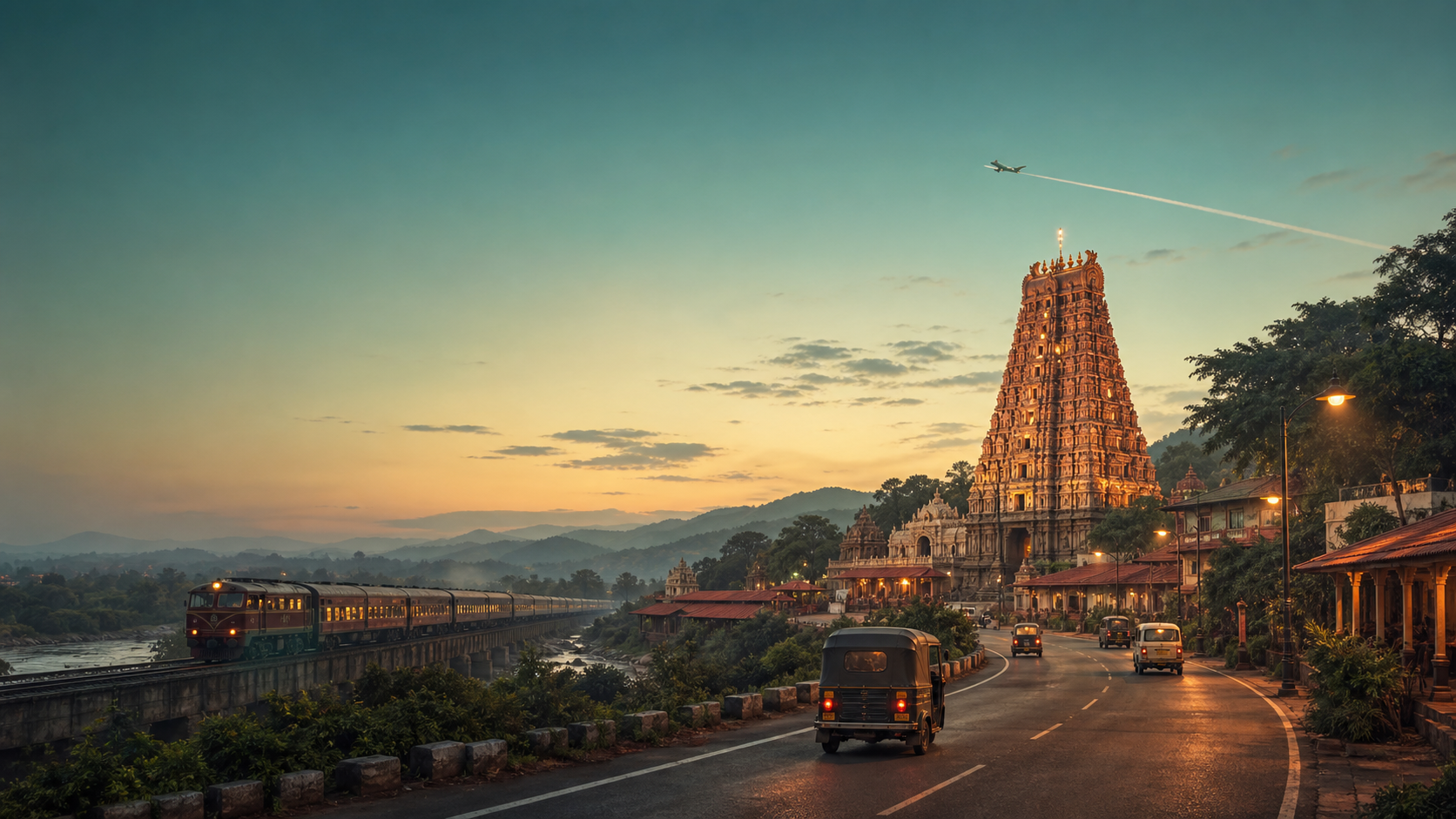
A complete pilgrim record drawn from the existing published article data.
Discovering Sadras: A Glimpse into Coastal History
Sadras, historically known as Sadurangapattinam, is a significant coastal town nestled in Tamil Nadu's Chengalpattu district. This ancient settlement, situated on the Coromandel Coast, boasts a rich past marked by its strategic maritime location and cultural evolution. At its heart lies an ancient Vishnu temple, a testament to its enduring spiritual heritage. The town's historical narrative is intricately woven with its various names, each reflecting a distinct era and influence. Its position made it a crucial point for trade and defense throughout different periods.
Coastal Significance
Located strategically on India's southeastern coast, Sadras served as a vital port and trading hub, connecting various civilizations through sea routes for centuries.
Ancient Vishnu Temple
The town is home to an ancient temple dedicated to Vishnu, which has played a pivotal role in its historical identity and nomenclature.
Evolving Identity
Sadras has undergone several name changes over time, each reflecting the dominant political or religious influences of its respective era.
From Rajanarayanan to Sadurangapattinam: The Evolution of a Name
The historical nomenclature of Sadras reveals a fascinating journey through time. Originally, during the reign of the Sambuvaraya dynasty, the town was known as Rajanarayanan Pattinam. Later, it acquired the name Sadiravasagan Pattinam, a designation believed to be linked directly to the ancient Vishnu temple and its presiding deity. Over centuries, this evolved into Sadurangapattinam, the name often referenced in historical records, and eventually shortened to the modern-day Sadras. These name changes underscore the town's shifting political landscapes and its deep connection to its religious institutions.
Sambuvaraya Origins
The earliest recorded name, Rajanarayanan Pattinam, dates back to the Sambuvaraya chieftaincy, highlighting its ancient roots.
Temple's Influence
The name Sadiravasagan Pattinam is historically associated with the Vishnu temple, indicating its significant cultural and religious impact on the town's identity.
Modern Adaptation
The transition to Sadurangapattinam and subsequently Sadras reflects linguistic and historical shifts, yet preserves the town's rich heritage.
The Ancient Vishnu Temple: Heart of Sadras's Identity
The ancient Vishnu temple stands as a central pillar of Sadras's historical and cultural identity. Dedicated to Lord Vishnu, the temple's presence is not merely spiritual but deeply intertwined with the town's very naming conventions. During the Sambuvaraya dynasty, this sacred site likely inspired the name Sadiravasagan Pattinam, signifying its profound influence on the local populace and rulers. As a prominent Hindu tradition site, it has served as a focal point for devotion and community life for centuries, reflecting the enduring faith of the region. Its architecture, though ancient, speaks volumes of the craftsmanship of its era.
Deity and Dynasty
The temple is dedicated to Vishnu, aligning with the Hindu tradition, and its establishment is historically linked to the Sambuvaraya dynasty.
Naming Significance
The name Sadiravasagan Pattinam, an earlier designation for Sadras, is believed to derive from or be strongly associated with this Vishnu temple.
Enduring Spiritual Hub
For generations, the temple has been a vital spiritual center, shaping the cultural landscape and providing a continuous thread of identity for the town.
Sadras: A Strategic Fortress on the Coromandel Coast
Sadras's location on the Coromandel Coast endowed it with significant strategic importance throughout history. Its position made it a coveted port and a natural fortress, attracting various powers seeking to control trade routes and exert influence over the region. While specific fortifications may have varied over time, the town inherently served as a defensive outpost due to its coastal access and natural geography. This strategic value led to its involvement in numerous historical events and conflicts, particularly during colonial periods when European powers vied for control of India's lucrative maritime trade.
Coastal Vantage Point
The town's direct access to the Bay of Bengal made it an invaluable asset for maritime trade and naval operations.
Trade and Defense
Sadras functioned as both a bustling trade center and a defensive stronghold, crucial for protecting economic interests along the coast.
Historical Conflicts
Its strategic significance positioned Sadras at the forefront of historical power struggles, influencing its development and political landscape.
Visiting Sadras: A Journey Through Time
For those interested in exploring history and ancient spirituality, Sadras offers a compelling destination in Tamil Nadu. Located in the Chengalpattu district, visitors can reach this historic town by various means. Chennai, a major hub, is approximately 71 km away by road, with bus services taking about 1.5 hours. For train travelers, Chengalpattu station (CGL) is about 27 km distant. Air travelers can fly into Chennai Airport (MAA), roughly 52 km from Sadras, and continue by road. Exploring Sadras provides a unique opportunity to witness the remnants of a rich past, including its ancient Vishnu temple.
Reaching Sadras
Sadras is accessible by road from Chennai, with regular bus services. The nearest train station is Chengalpattu, and Chennai Airport serves air travelers.
Exploring the Town
Visitors can immerse themselves in the town's historical ambiance, discovering its ancient structures and the significant Vishnu temple.
Travel Logistics
Planning a trip involves considering travel time from Chennai (about 2 hours by car) and arranging local transport from arrival points like Chengalpattu or Chennai Airport.
| Deity | Vishnu |
|---|---|
| Form | Appears in various avatars (e.g., Rama, Krishna) to restore balance and uphold righteousness. |
| Consort | Lakshmi |
| Sampradaya | Vaishnavism |
| Significance | The Preserver of the Universe, maintaining cosmic order and dharma. He protects the good and destroys evil. |
The Cosmic Sleep and Creation
In the vast cosmic ocean, Lord Vishnu reclines on the serpent Adishesha, in a state of yogic slumber known as Yoga Nidra. From his navel sprouts a lotus, upon which Lord Brahma, the creator, emerges. Brahma then begins the creation of the universe, guided by Vishnu's divine will. This eternal cycle of preservation and creation underscores Vishnu's supreme role as the sustainer of all existence, a profound mystery celebrated in temples dedicated to Him.
Whenever dharma declines and adharma rises, I manifest myself to protect the good and destroy the wicked.
The divine presence of Vishnu ensures the cosmic balance, guiding the universe through cycles of creation and preservation.
🗺 How to Reach
Hover a card to animate the journey on the map
Verified routes to Sadras
Common Questions
Where is Sadras Vishnu Temple: A Coastal Fortress Shrine located?
Sadras Vishnu Temple: A Coastal Fortress Shrine is documented at Tiruklalikundram, Tamil Nadu.
Which deity is associated with Sadras Vishnu Temple: A Coastal Fortress Shrine?
Sadras Vishnu Temple: A Coastal Fortress Shrine is associated with Vishnu.
