



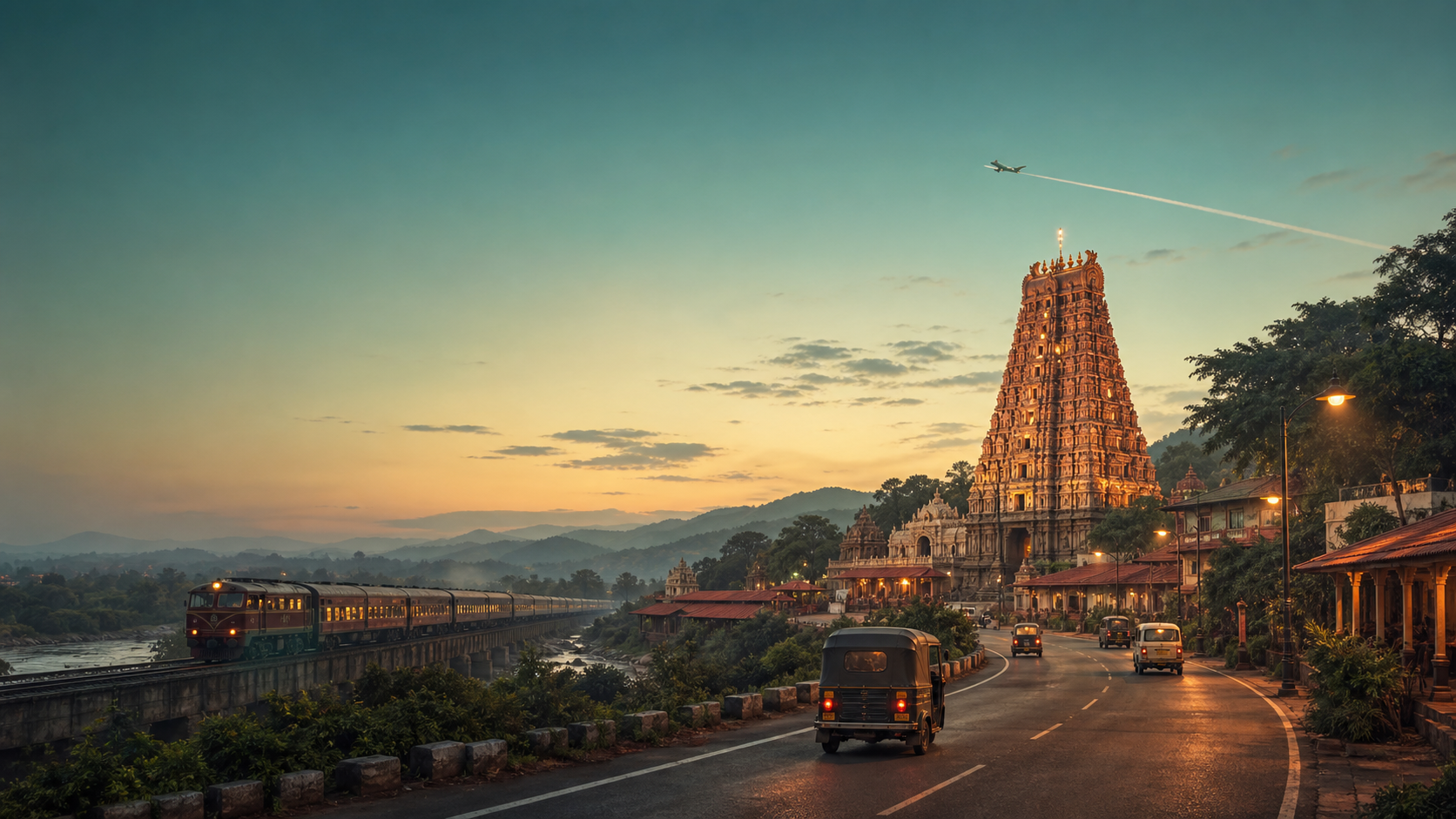
A complete pilgrim record drawn from the existing published article data.
Key Takeaway: The Pallikondeswara Temple is uniquely significant as the only known Shiva temple where the primary deity, Pallikondeswara, is depicted in a full reclining posture on his consort Parvati's lap, a rare iconography that distinguishes it from all other Shiva shrines globally.
Historical Foundation
Origins and Royal Patronage
Renovations and Modern Revival
Key Historical Milestones

The three-tiered gopuram, a hallmark of Dravidian architecture, welcomes devotees to the sacred precincts.
Architecture & Craftsmanship
Vijayanagara Grandeur
What is a Gopuram?
A Gopuram is a monumental entrance tower, usually ornamented with carvings and sculptures, that forms the gateway to a Hindu temple complex, especially in South Indian architecture. It is typically pyramidal and rises in tiers to a considerable height.
Unique Iconography & Sculptural Richness
"The absence of a primary lingam and the central icon of an anthropomorphic reclining Shiva make Pallikondeswara Temple an iconographic marvel, a deviation that profoundly enriches Shaiva tradition."

The central icon: Lord Shiva in the rare Bhoga Sayana posture, reclining on the lap of Goddess Parvati.
The Presiding Deity
Bhoga Sayana Shiva: A Unique Icon
Pallikondeswara (Shiva) & Sarva Mangalambika (Parvati)
Main Deity: Shiva (Pallikondeswara, Bhoga sayana Siva)
Deity Form: Reclining on the lap of his consort, Parvati, after consuming the Halahala poison.
Consort Deity: Sarva Mangalambika (Parvati)
Iconographic Uniqueness: The only known temple where Shiva is depicted in a full reclining posture on Parvati's lap, mirroring Vishnu's Ranganatha form. No primary Lingam in the garbhagriha.
Significance: Represents Shiva's divine rest and recovery, symbolizing compassion and the cosmic balance maintained by Parvati.
A Pantheon of Deities
"Surutupalle is a sacred haven where the cosmic exhaustion of Shiva transforms into a divine tableau, offering solace and unique spiritual contemplation to all who visit."
Festivals & Living Traditions
Annual Grand Celebrations
Daily Rituals & Pradosham Observances
Pro-Tip for Pradosham:
If you plan to visit during Pradosham, arrive early to secure a good spot, as the temple can get very crowded with around 15,000 devotees. The atmosphere during these biweekly observances is incredibly vibrant and spiritually charged.

Devotees gather in large numbers for major festivals like Maha Shivaratri and Pradosham.
Plan Your Visit
Location & Accessibility
- Nearest Airport: Tirupati International Airport (120 km)
- Nearest Railway: Tirupati Railway Station (110 km)
- Road: Well-connected by road networks from major cities in Andhra Pradesh and Tamil Nadu.
Best Time & Duration for Visit
- Aipassi Annabishekam: October–November (Tamil month of Aippasi) for special rituals.
- Thiruvadhirai: December–January (Tamil month of Margazhi) for Nataraja worship.
- Pradosham: Any fortnight's 13th lunar day for auspicious Shiva worship.
A suggested duration of 3–4 hours is adequate to explore the temple complex, participate in rituals, and appreciate its architectural and sculptural marvels.
Visitor Guidelines & Nearby Attractions
To ensure a respectful and enriching visit, please observe the following guidelines:
- Dress Code: Modest attire is enforced – dhoti/veshti for men and saree/salwar for women are recommended.
- Photography: Permitted in the outer prakarams (precincts) but strictly restricted inside the garbhagriha (sanctum sanctorum).
The temple can also be part of a larger pilgrimage circuit. Nearby notable temples include:
- Sri Venkateswara Temple, Tirupati (approx. 110 km)
- Sri Kalahasti Temple (approx. 70 km)
- Sri Varahaswamy Temple, Tirumala
These nearby sites offer a comprehensive spiritual journey through the sacred landscape of Andhra Pradesh.
Related temples: Abimukeswarar Temple | Aisanyesvara Siva Temple
Sacred Stories & Mythology
The Halahala Incident & Shiva's Divine Rest
The Samudra Manthan & Shiva's Compassion
When the deadly Halahala poison emerged during the churning of the cosmic ocean, threatening all life, Lord Shiva, out of immense compassion, drank it. Goddess Parvati, ever watchful, held his throat to prevent the poison from descending further, thus saving the world. Exhausted from this act, Shiva rested his head on Parvati's lap at Surutupalle, giving rise to the temple's unique reclining form. This selfless act of Shiva is a cornerstone of his divinity and devotion.

Intricate carvings often depict mythological episodes like the Samudra Manthan, central to Shiva's legend.
Echoes of the Ramayana
Saints, Poets & Devotees
Ancient Hymns & Bhakti Movement
Modern Spiritual Luminaries
Records, Marvels & Heritage
An Iconographic Marvel
What is a Pradosha Kshetram?
A Pradosha Kshetram is a temple or sacred site particularly auspicious for observing Pradosham, a biweekly three-hour period around sunset on the 13th day of each lunar fortnight. It is believed to be the time when Lord Shiva is in a state of supreme bliss and performs the cosmic dance (Ananda Tandavam), making worship during this time highly potent.
Architectural and Mythological Distinctions
Heritage Status & Conservation
Over 30,000 devotees visit Pallikondeswara Temple during Maha Shivaratri, while
~15,000 attend the biweekly Pradosham observances, highlighting its significant pilgrimage status.
🗺 How to Reach
Hover a card to animate the journey on the map
Route to Chennai Corporation
Common Questions
Where is Pallikondeswara Temple: Reclining Shiva Shrine located?
Pallikondeswara Temple: Reclining Shiva Shrine is documented at Chennai Corporation, Andhra Pradesh.
Which deity is associated with Pallikondeswara Temple: Reclining Shiva Shrine?
Pallikondeswara Temple: Reclining Shiva Shrine is associated with Shiva.
Related Temples
A Living Covenant