A complete pilgrim record drawn from the existing published article data.
Tracing the Ancient Roots of Kedarnath
The history of Kedarnath is deeply intertwined with ancient Hindu scriptures and legends. According to the Mahabharata, the Pandavas sought Lord Shiva's forgiveness here for their sins committed during the Kurukshetra War. Shiva, disguised as a bull, dived into the ground, leaving his hump at Kedarnath. The temple's revival is often attributed to the 8th-century philosopher-saint Adi Shankara, who established several monastic centers across India. Historical records indicate the temple has stood for over a thousand years, enduring natural calamities and periods of reconstruction, testament to its enduring spiritual significance.
The Pandava Legend
Legend states that the Pandavas built the original temple to atone for their sins after the Kurukshetra War, with Shiva appearing as a bull.
Adi Shankara's Revival
The 8th-century saint Adi Shankara is credited with revitalizing the Kedarnath shrine and establishing its spiritual prominence.
Historical Endurance
Despite its ancient origins and challenging environment, the temple has a long history of resilience and reconstruction.
The Enduring Architecture of Kedarnath Temple
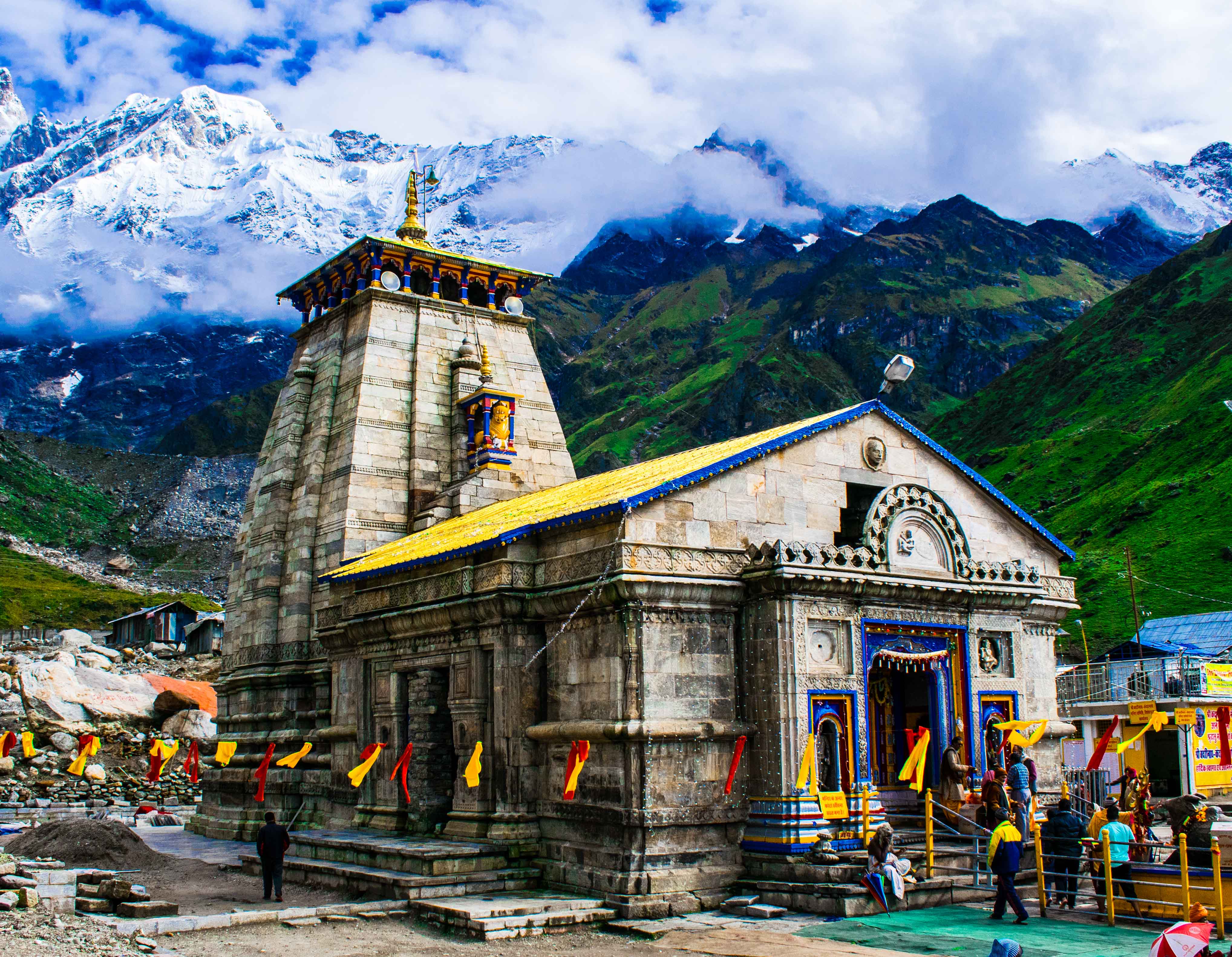
Built with massive, irregularly shaped grey stone slabs, the Kedarnath Temple showcases remarkable ancient Indian architecture, designed to withstand the harsh Himalayan climate. The temple's construction involves interlocking stones without the use of mortar, a technique demonstrating advanced engineering skills of its era. Its sturdy structure has famously endured several natural disasters, including floods and earthquakes, preserving its original form. The _garbhagriha_ (sanctum sanctorum) houses the conical rock formation representing Lord Shiva, while the _mandapa_ (assembly hall) features images of deities and mythological scenes carved into the stone.
Stone Construction
The temple is built from large, grey stone slabs, precisely interlocked without mortar, a testament to ancient craftsmanship.
Resilience to Climate
Its robust architecture is specifically designed to withstand extreme weather conditions, including heavy snowfall and natural calamities.
Architectural Features
Key elements include the _garbhagriha_ housing the sacred lingam and the _mandapa_ adorned with intricate carvings.
Lord Shiva: The Presiding Deity of Kedarnath
Kedarnath is one of the twelve Jyotirlingas, the most sacred abodes of Lord Shiva, where he is worshipped in his unique bull-backed form. This distinctive conical rock formation inside the sanctum sanctorum is revered as the hind part of Shiva, who took the form of a bull (Nandi) to evade the Pandavas. The deity here is known as Kedarnath, signifying 'Lord of the Field' or 'Lord of Kedar Khand,' an ancient name for this region. Devotees believe that a visit to Kedarnath grants moksha (salvation) and purifies the soul, making it a profoundly significant pilgrimage for followers of Shaivism.
Jyotirlinga Status
Kedarnath is recognized as one of the twelve sacred Jyotirlingas, representing a radiant manifestation of Lord Shiva.
Bull-Backed Form
The main deity is a unique conical rock, believed to be the hump of Lord Shiva in his bull form.
Spiritual Significance
Worship at Kedarnath is believed to bestow moksha and cleanse sins, holding deep spiritual value for devotees.
Planning Your Sacred Journey to Kedarnath
A pilgrimage to Kedarnath is a challenging yet profoundly rewarding spiritual experience, requiring careful planning and preparation. The temple is accessible primarily by a 16-kilometer trek from Gaurikund, following a motorable road to Sonprayag. Due to heavy snowfall, the temple remains closed for approximately six months during winter, typically from November to April. The best time to visit is from May to October, when the weather is relatively mild. Pilgrims are advised to carry warm clothing, essential medicines, and maintain physical fitness for the demanding trek at high altitudes.
Best Time to Visit
The ideal period for pilgrimage is May to October, avoiding the harsh winter closure due to heavy snowfall.
Trekking and Accessibility
The journey involves a significant 16-kilometer trek from Gaurikund, accessible from Sonprayag by road.
Essential Preparations
Pilgrims should prepare for high altitude, carry warm clothes, medicines, and ensure physical fitness for the trek.
| Deity | Shiva |
|---|---|
| Form | Shiva is commonly depicted in various forms, including a meditating ascetic with a third eye, crescent moon, and snake, or as Nataraja, the cosmic dancer. His iconography often includes a trident (Trishula) and a damaru drum. |
| Consort | Parvati |
| Sampradaya | Shaivism |
| Significance | As one of the principal deities of Hinduism, Shiva is known as the Destroyer or Transformer within the Trimurti, embodying both creation and destruction. He is revered as the supreme being in Shaivism, representing the ultimate reality and liberation. |
The Bull's Retreat: Origin of Kedarnath
After the Kurukshetra War, the Pandavas sought Lord Shiva to atone for their sins. Shiva, unwilling to meet them, disguised himself as a bull and hid among a herd in the Garhwal Himalayas. Bhima, one of the Pandavas, recognized him. As Bhima tried to catch the bull, Shiva submerged himself into the ground. Bhima managed to grasp his hump. The bull's body parts emerged in different places, forming the Panch Kedar. The hump appeared at Kedarnath, establishing it as a sacred site where Shiva is worshipped in his bull-backed form.
In the Himalayas, Lord Shiva resides, a beacon of ultimate truth and liberation for all seekers on their spiritual journey.
The arduous journey to Kedarnath purifies the soul, revealing the divine presence amidst majestic peaks and ancient devotion.
Related temples: Aakkoor Thanthondreeswarar Temple | Abhaya Varadeeswarar Temple, Adirampattinam
Kedarnath: A Sacred Abode in the Himalayas
Kedarnath Temple stands as one of the most revered pilgrimage sites in Hinduism, nestled amidst the majestic Garhwal Himalayas in the Indian state of Uttarakhand. It is a vital part of the Char Dham Yatra and the Panch Kedar pilgrimages, drawing devotees seeking spiritual solace and divine blessings. Perched at an altitude of approximately 3,583 meters (11,755 feet) near the Mandakini River, the temple's remote location adds to its mystique and challenging yet rewarding spiritual journey. The pristine, snow-capped peaks surrounding it create a breathtaking backdrop for this ancient shrine dedicated to Lord Shiva.
Himalayan Location
The temple is situated at a high altitude in the Garhwal Himalayas, offering panoramic views of snow-clad mountains.
Pilgrimage Significance
Kedarnath is a key destination in both the Char Dham and Panch Kedar circuits, holding immense spiritual importance for Hindus.
Natural Grandeur
Surrounded by majestic peaks and the Mandakini River, the temple's setting is renowned for its natural beauty.
Modern Pilgrimage and Accessibility
Kedarnath (Tamil Nadu) continues to be a vibrant center for spiritual devotion, attracting pilgrims from across Tamil Nadu and beyond, albeit on a smaller, more localized scale compared to its Himalayan namesake. Modern pilgrimage to this ancient Shiva temple is characterized by a blend of traditional rituals and contemporary conveniences. Devotees often undertake the journey as part of a larger circuit of temples in the region, seeking blessings for health, prosperity, and spiritual solace. The temple's serene ambiance and historical gravitas offer a profound spiritual experience, drawing families, elderly devotees, and younger generations alike who wish to connect with their cultural and religious heritage. The annual festivals, particularly Maha Shivaratri, witness a significant surge in visitors, transforming the quiet village into a bustling hub of faith and celebration.
Accessibility to Kedarnath (Tamil Nadu) has significantly improved over the years, making the pilgrimage more comfortable for a wider array of devotees. The temple is well-connected by road, with regular bus services and private transport options available from nearby towns and cities. While the immediate vicinity retains its rustic charm, basic amenities such as guesthouses, small eateries, and shops catering to pilgrims' needs have developed around the temple complex. Local authorities and temple trusts have also made efforts to enhance visitor facilities, including improved sanitation, drinking water provisions, and designated parking areas. These infrastructural developments ensure that the spiritual journey remains accessible and enjoyable for all, allowing pilgrims to focus on their devotion without undue hardship.
🗺 How to Reach
Hover a card to animate the journey on the map
Verified routes to Kedarnath
Common Questions
Where is Kedarnath: Shiva's Sacred Abode in Tamil Nadu located?
Kedarnath: Shiva's Sacred Abode in Tamil Nadu is documented at Kanchipuram, Tamil Nadu.
Which deity is associated with Kedarnath: Shiva's Sacred Abode in Tamil Nadu?
Kedarnath: Shiva's Sacred Abode in Tamil Nadu is associated with Shiva.