A complete pilgrim record drawn from the existing published article data.
Historical Foundation
Early Jain Presence and Maurya Legacy
Definition: Tirthankara
In Jainism, a Tirthankara is a saviour and spiritual teacher of the Dharma (righteous path). The term 'Tirthankara' means 'ford-maker,' one who has conquered the saṃsāra (cycle of death and rebirth) on their own and made a path for others to follow. There are 24 Tirthankaras in each half-cycle of time, with Mahavira being the last of the current half-cycle.
The Achalgacch Origin: A Divine Commission
The Appearance of Mahakali
According to legend, as Acharya Aryarakshitsuri prepared for Sallekhana, the demi-goddess Mahakali appeared before him. She implored him to abandon his self-sacrifice, declaring that he was the destined one to propagate the true teachings of the Agamas. Mahakali instructed him to establish a new monastic order founded on pristine Agamic truth, promising her divine protection and prosperity for the lay-followers (Śrāvakas) of this new gaccha. Following this divine commission, Acharya Aryarakshitsuri founded the Achalgacch (also known as Viddhipaksh) at Pavagadh in 1112 CE, and in a remarkable act of institutionalized worship, installed Mahakali as the adhishthayika (protecting deity) of the order. The founding Śrāvakas also installed an idol of Mahakali on the hill to symbolize their reverence, an idol and shrine that have been the subject of modern historical and legal disputes due to encroachments.
Definition: Sallekhana & Gaccha
Sallekhana: A Jain vow of fasting to death, undertaken voluntarily by a layperson or ascetic at the end of their life, through gradual reduction of food and liquid intake, with the aim of purifying the soul and attaining a peaceful end.
Gaccha: A monastic lineage or sub-sect within Jainism, often tracing its origins to a specific founder or unique set of practices. The Achalgacch is a prominent Śvetāmbara gaccha.
Later Patronage & Renovations
Over 2000 Years of History: Initial Jain presence dates back to 3rd century BCE, making Pavagadh one of India's oldest continuously significant Jain pilgrimage sites.
Architecture & Craftsmanship

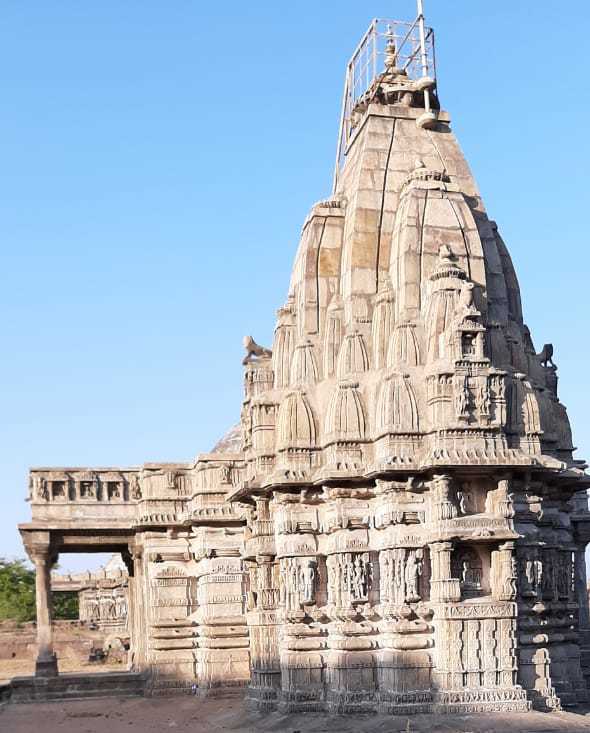
Maru-Gurjara Grandeur and Structural Elements
"The Maru-Gurjara style at Pavagadh is a symphony of stone, where every pillar and shrine narrates a timeless saga of devotion and artistic mastery."
Sculptural Narratives and Iconographic Uniqueness

Definition: Adhishthayika
In Jainism, an adhishthayika (or adhishthayaka for male) refers to a protecting deity or guardian spirit associated with a Tirthankara, a temple, or a monastic order (gaccha). These figures are often demi-gods or goddesses who assist in the propagation and protection of Jain Dharma.
The Presiding Deity
Jirawala Parshvanath
Main Deity: The revered 23rd Tirthankara, Parshvanatha, is venerated here in his unique form known as Jirawala Parshvanath. The name 'Jirawala' designates a specific tirtha (pilgrimage site) and form exclusively associated with Pavagadh. This idol is a focal point for pilgrims, symbolizing liberation and spiritual guidance.
Iconography: As a Śvetāmbara Tirthankara, Jirawala Parshvanath is depicted with a waistband and draped cloth, characteristic features distinguishing Śvetāmbara idols. The presence of a snake canopy above his head, a common attribute of Parshvanath, signifies protection.
A Pantheon of Tirthankaras

Mahakali: The Adhishthayika of Achalgacch
Festivals & Living Traditions
Major Annual Celebrations
Navaratri at Pavagadh: A Confluence of Faiths

Ongoing Devotion and Modern Significance
Plan Your Visit
Getting There and Local Connectivity
Best Time to Visit and Suggested Duration
Essential Tips for Pilgrims
- Dress Code: Modest attire is expected, covering shoulders and knees, reflecting respect for the sacred space.
- Footwear: Footwear must be removed before entering the shrines.
- Photography: While general photography of the complex is usually allowed, restrictions may apply inside the sanctum areas of specific shrines. It's always advisable to look for signs or inquire.
- Access and Facilities: Be aware that due to historical and ongoing access disputes, particularly around certain shrines, access might be subject to change. Facilities like clean drinking water and restrooms are available but may be basic.
- Nearby Circuits: Pavagadh can be part of a larger Jain pilgrimage circuit in Gujarat, including the renowned Palitana Jain Temples and Girnar Jain Temples, offering a comprehensive spiritual journey.
Related temples: Baba Balak Nath | Bahrot Caves
Sacred Stories & Mythology
The Birth of the Achalgacch
Mahakali's Mandate to Acharya Aryarakshitsuri
The most profound origin legend associated with Pavagadh recounts the transformative experience of Acharya Aryarakshitsuri. Disturbed by the moral decline among contemporary Jain monks (yatis), he ascended the sacred hill in 1112 CE, intending to undertake Sallekhana. It was here that the powerful demi-goddess Mahakali appeared before him. She intervened, dissuading him from his vow and instead commissioning him with a divine task: to establish a new monastic order founded on the pure, unadulterated truth of the Agamas. Mahakali pledged to protect the lay-followers of this new gaccha, ensuring their prosperity. Following her mandate, Acharya Aryarakshitsuri founded the Achalgacch, also known as Viddhipaksh, right on Pavagadh Hill, installing Mahakali as its designated protecting deity. This event solidified Pavagadh's place as a cornerstone of Jain spiritual reform and a site of miraculous intervention.
Ancient Consecrations and Renewals

Pavagadh: A Moksha-Stahla of Jainism
Definition: Moksha-Stahla
In Jainism, a Moksha-Stahla is a sacred place or tirtha where, according to tradition, certain individuals have attained moksha (liberation or salvation). Such sites are considered exceptionally holy and are destinations for pilgrims seeking spiritual merit and the blessings for their own path to liberation.
Saints, Poets & Devotees
Prolific Acharyas and Spiritual Guides
Literary Contributions and Historical Records
Lay Patronage and Community Support
Records, Marvels & Heritage
UNESCO Recognition and Global Heritage
Sacred Moksha-Sthala: A Unique Jain Claim
Unique Jain Legacy and Ongoing Challenges
🗺 How to Reach
Hover a card to animate the journey on the map
Route to Manchi Haveli, Pavagadh
Common Questions
Where is Jain Temples, Pavagadh: A Sacred Summit of Faith located?
Jain Temples, Pavagadh: A Sacred Summit of Faith is documented at Manchi Haveli, Pavagadh, Gujarat.
Which deity is associated with Jain Temples, Pavagadh: A Sacred Summit of Faith?
Jain Temples, Pavagadh: A Sacred Summit of Faith is associated with Jirawala Parshvanath.
Related Temples

A Living Covenant