



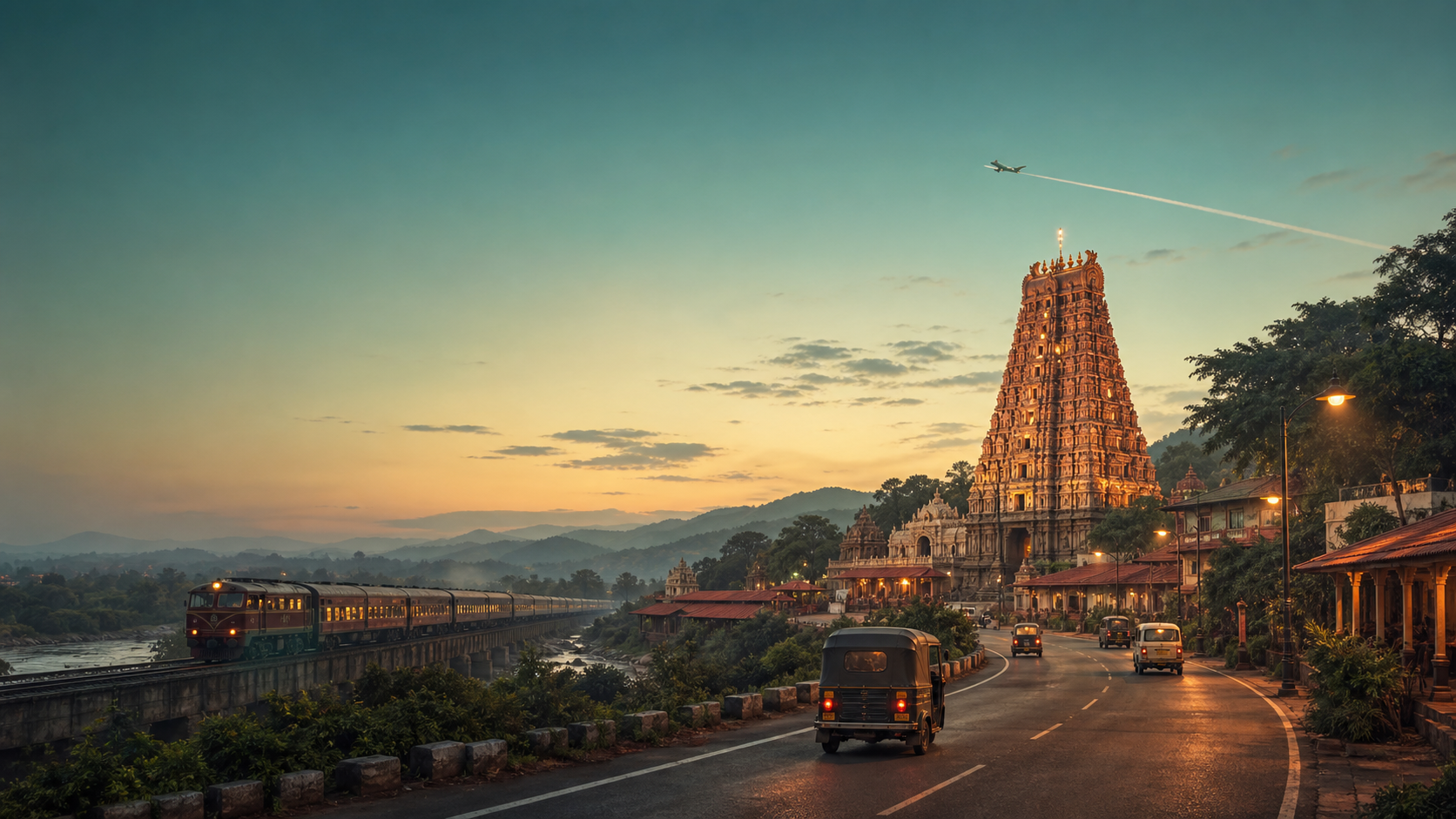
A complete pilgrim record drawn from the existing published article data.
Discovering the Grandeur of Chennakesava Swamy Temple, Markapur
The Chennakesava Swamy Temple in Markapur, Andhra Pradesh, stands as a magnificent testament to Vijayanagara architectural prowess and spiritual devotion. This revered Vaishnava temple, dedicated to Lord Vishnu, invites visitors to explore its rich heritage as a State Protected Monument. Constructed primarily during the Vijayanagara era, it showcases the intricate craftsmanship and profound cultural significance of the period. Its granite structure and Dravidian style offer a glimpse into a glorious past, making it a pivotal site for historical and religious exploration in the region.
Location and Significance
Situated in Markapur, Andhra Pradesh, the temple is a significant pilgrimage destination. It is recognized as a State Protected Monument, underscoring its historical and architectural importance within the region.
Architectural Overview
The temple exemplifies the Dravidian architectural style, characteristic of the Vijayanagara Empire. Built using durable granite, its design reflects the aesthetic and engineering sophistication of its builders.
The Divine Presence: Lord Chennakesava Swamy and Local Lore
Dedicated to Lord Chennakesava Swamy, a benevolent form of Vishnu, the temple serves as a vibrant center for Vaishnavite worship, steeped in local legends and profound spiritual significance. According to lore, Lord Vishnu manifested here as Chennakesava in response to Rishi Markandeya's prayers, after vanquishing the asura Kesi. Another tale attributes the temple's origin to the devotion of a milkmaid named Marika, whose selfless act of building a shrine laid the foundation for this magnificent temple. These narratives underscore the deep spiritual connection of the site to divine blessings and local faith.
The Main Deity
The temple is primarily dedicated to Lord Chennakesava, a form of Vishnu, making it a significant center for Vaishnava tradition and worship.
Legend of Kesi and Markandeya
One legend recounts that Lord Vishnu, in response to Rishi Markandeya's plea, manifested as Chennakesava after Adisesha vanquished the demon Kesi, sanctifying the land.
Marika's Devotion
The temple's origin is also linked to the devotion of a milkmaid named Marika, who built the original shrine after receiving a divine boon, giving rise to the name 'Markapuram'.
Modern Pilgrimage and Annual Festivals
Today, the Chennakesava Swamy Temple in Markapur continues to be a vibrant center of devotion, attracting a steady stream of pilgrims from across Andhra Pradesh and neighboring regions. Devotees visit seeking the blessings of Lord Vishnu in his Chennakesava form, often to fulfill vows, perform special pujas, or simply to experience the spiritual tranquility offered by this ancient shrine. The temple management has made efforts to accommodate the growing number of visitors, ensuring orderly darshan and providing basic amenities, including guesthouses and prasadam distribution. Its enduring popularity underscores its significant place in the spiritual landscape of the Rayalaseema region, serving as a beacon of faith for generations of Vaishnavites who uphold its traditions and participate in its daily rituals, maintaining a living connection to its rich past. The temple truly comes alive during its annual festivals, which are celebrated with immense fervor and draw thousands of devotees. The most prominent among these is the Brahmotsavam, a grand nine-day festival typically held in March or April, featuring elaborate rituals, ceremonial processions of the deity on various vahanas (vehicles), and cultural performances. Other significant celebrations include Vaikuntha Ekadashi, when the 'Swarga Vasal' (Gateway to Heaven) is opened, and Srirama Navami, commemorating the birth of Lord Rama. These festivals are not merely religious observances but also significant community events, fostering a sense of unity and cultural pride among the local populace, as they actively participate in the preparations and festivities, contributing to the temple's vibrant spiritual atmosphere.Planning Your Pilgrimage: Essential Tips for Temple Visitors
This guide provides practical information for visitors, ensuring a fulfilling and insightful experience at the Chennakesava Swamy Temple, a revered State Protected Monument in Markapur. The best time to visit is from October to March, coinciding with pleasant weather. The temple is particularly significant during the Brahmotsavams festival in Chaitra (March–April) and the solar alignment period from December 23 to January 3. Modest attire is required for entry. Visitors typically spend 2–3 hours exploring the complex. Markapur Road Railway Station is a convenient train access point.
Best Time to Visit
The ideal time to visit is between October and March. Special periods include the Brahmotsavams in Chaitra (March–April) and the solar alignment event from December 23 to January 3.
Dress Code and Duration
Modest attire is required for all visitors. A typical visit to explore the temple complex thoroughly usually lasts between 2 to 3 hours.
Transportation
The temple is accessible by train via Markapur Road Railway Station, located on the Guntakal–Vijayawada line. For other transport details, contacting the temple office is recommended.
| Deity | Chennakesava |
|---|---|
| Form | Chennakesava is a form of Vishnu, depicted as 'beautifully adorned Keshava', reflecting his Alankara Priya (lover of adornment) aspect. |
| Consort | Mahalakshmi |
| Sampradaya | Vaishnava |
| Significance | The dual presence of Vishnu (Chennakesava) and consort Mahalakshmi signifies divine beauty and prosperity. He manifested to protect rishis from the asura Kesi, establishing his spiritual role as a protector. |
The Slaying of Kesi and Markandeya's Boon
Along the sacred banks of the Gundlakamma river, rishis sought tranquility in meditation, but their peace was shattered by the malevolent asura Kesi. Disturbed by his torment, the revered Rishi Markandeya turned to Lord Vishnu for succor. Responding to his fervent prayers, Vishnu dispatched the mighty Adisesha, whose potent, poisonous fumes quickly vanquished the demon. In profound gratitude, Markandeya implored Vishnu to forever grace this hallowed ground with His divine presence. Lord Vishnu, assenting, manifested here as Chennakesava, eternally accompanied by Goddess Mahalakshmi, thus sanctifying the land for all time.
Witness the divine beauty of Chennakesava, where Vishnu's grace vanquished evil and brought eternal sanctity to this hallowed ground.
A marvel of Vijayanagara artistry, the temple's sanctum is illuminated by the sun's first rays, a testament to ancient architectural brilliance.
Related temples: Akkanna Madanna Caves | Balaji Temple, Ketkawla
A Legacy Etched in Stone: The Temple's Vijayanagara Origins
Built during the illustrious Vijayanagara Empire, the Chennakesava Swamy Temple's construction reflects the era's artistic zenith and the profound patronage of powerful rulers. Its primary construction began in the early 15th Century CE, circa 1405 CE, with significant walls constructed in 1452 CE. This period saw 18 inscriptions detailing contemporary life and culture. The temple is notably associated with the patronage of Krishna Deva Raya, who also initiated the grand Brahmotsavams festival. Later Vijayanagara rulers also undertook renovations, ensuring the temple's enduring legacy.
Founding and Early Construction
Construction of the temple began in the early 15th century CE, around 1405 CE, during the Vijayanagara era. The temple walls were substantially completed by 1452 CE, evidenced by numerous inscriptions.
Royal Patronage
The temple's development is closely linked to the Vijayanagara Empire, with its builder often cited as Krishna Deva Raya. His influence is also seen in the initiation of the annual Brahmotsavams festival during his reign.
Beyond Grandeur: Unraveling the Temple's Unique Architectural Innovations
The Chennakesava Swamy Temple showcases remarkable structural and acoustic ingenuity, extending beyond its visible grandeur. A towering 135-ft Gaaligopuram (main entrance tower) welcomes devotees. Within, the sanctum is precisely engineered for solar alignment, where sunlight illuminates the deity between December 23 and January 3. The Kalyana Mandapam is famed for its 6 musical pillars, carved from granite, which produce distinct musical notes when tapped. These features highlight the advanced architectural and scientific knowledge possessed by the Vijayanagara artisans, making the temple a marvel of ancient Indian engineering.
The Gaaligopuram
A prominent feature is the impressive 135-foot Gaaligopuram, serving as the temple's main entrance. Its height and intricate detailing are characteristic of Vijayanagara monumental architecture.
Solar Alignment
The temple's sanctum exhibits precise solar alignment, a testament to ancient astronomical knowledge. Sunlight directly illuminates the main deity between December 23 and January 3 each year.
Musical Pillars
Within the Kalyana Mandapam, six unique granite pillars are renowned for producing distinct musical notes when gently struck. This acoustic phenomenon demonstrates exceptional craftsmanship and material understanding.
🗺 How to Reach
Hover a card to animate the journey on the map
Route to Temple
Common Questions
Where is Chennakesava Temple Markapur: Grand Gopuram & History located?
Chennakesava Temple Markapur: Grand Gopuram & History is documented at Markapur, Andhra Pradesh.
Which deity is associated with Chennakesava Temple Markapur: Grand Gopuram & History?
Chennakesava Temple Markapur: Grand Gopuram & History is associated with Vishnu.
Related Temples
A Living Covenant