



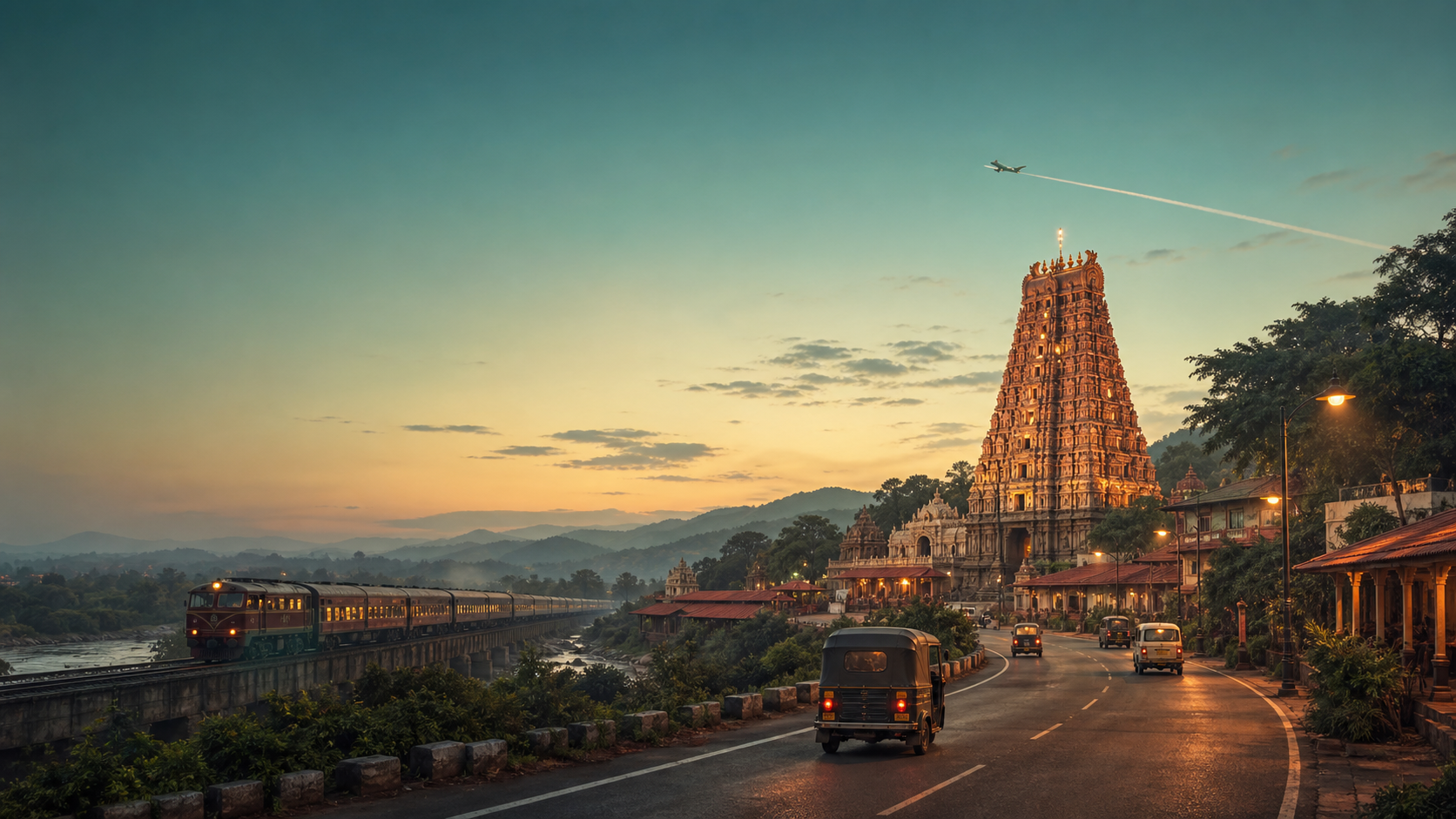
A complete pilgrim record drawn from the existing published article data.
Echoes of Eternity: The History of Trimbakeshwar
The current magnificent structure of the Trimbakeshwar Shiva Temple, primarily built in the 18th century CE, is a testament to the architectural prowess of the Maratha Empire during the Peshwa era. Following its destruction by Aurangzeb's forces in the late 17th or early 18th century, the temple was meticulously rebuilt around the 1750s under the patronage of Peshwa Balaji Baji Rao, also known as Nanasaheb. This reconstruction re-established a site whose spiritual lineage extends back through ancient legends and continuous worship, preserving centuries of devotion.
Peshwa Era Reconstruction
The temple's rebuilding in the 18th century CE was a significant undertaking, spearheaded by Peshwa Balaji Baji Rao (Nanasaheb) of the Maratha Empire, establishing the current structure.
Destruction and Revival
The original temple structure faced destruction by Aurangzeb's forces in the late 17th or early 18th century, leading to its subsequent grand reconstruction in the 1750s.
Ancient Roots
While the current edifice is 18th-century, the site's spiritual importance dates back to ancient times, with legends involving Sage Gautama and the origin of the Godavari.
Stone and Spirit: The Architecture of Trimbakeshwar
The Trimbakeshwar Shiva Temple showcases the distinctive Hemadpanthi style, a regional variant of the Nagara architectural tradition. Constructed primarily from black basalt, the temple's intricate carvings and robust structure are characteristic of Maratha craftsmanship from the Peshwa era. Its most unique architectural feature is the Trideva linga, a three-faced representation within the sanctum, embodying Brahma, Vishnu, and Shiva. This blend of artistic mastery and profound theological symbolism is evident throughout the temple, from its curvilinear shikhara to its detailed sculptural elements, reflecting a rich cultural heritage.
Hemadpanthi Style
The temple exemplifies the Hemadpanthi architectural style, known for its use of local black stone (basalt) without mortar, featuring intricate carvings and pyramidal roofs.
The Trideva Linga
Within the sanctum, the unique Trideva linga represents the three principal deities: Brahma, Vishnu, and Shiva, a rare manifestation not commonly found in other Jyotirlinga temples.
Maratha Craftsmanship
The 18th-century construction reflects the high level of craftsmanship during the Maratha Empire's Peshwa era, evident in the temple's durable basalt material and detailed sculptures.
A Pilgrim's Path: Visiting Trimbakeshwar and Its Legacy
Visiting Trimbakeshwar offers pilgrims a profound spiritual journey, extending beyond mere darshan of the Jyotirlinga. The best time to experience this sacred site is from October to March, ensuring pleasant weather for exploration. Devotees often engage in rituals and prayers, seeking blessings from Lord Shiva. A unique aspect of the pilgrimage is the opportunity to consult the Purohit families, who maintain ancient Hindu genealogy registers. These meticulously preserved records, some dating back centuries, allow pilgrims to trace their ancestral lineage, connecting them to a rich historical and spiritual past, making the visit a deeply personal and meaningful experience.
Pilgrimage Experience
Pilgrims visit Trimbakeshwar for blessings, performing rituals like abhishekam and taking holy dips in the Kusavarta Kunda, especially during festivals like Maha Shivaratri.
Optimal Visit Time and Logistics
The period from October to March is considered ideal for visiting due to favorable weather. The temple is well-connected by bus, train, and flight to Nashik, with local transport available.
Hindu Genealogy Registers
A unique tradition involves consulting the Purohits who maintain ancestral records, allowing pilgrims to trace their family lineage, a practice deeply cherished by devotees.
| Deity | Shiva |
|---|---|
| Form | Unique three-faced Jyotirlinga, representing Brahma, Vishnu, and Shiva |
| Consort | Unknown |
| Sampradaya | Shaiva |
| Significance | This form signifies Shiva's role as the supreme being, encompassing creation, preservation, and destruction, and is a site of immense spiritual power and pilgrimage. |
The Sacred Origin of Godavari and the Trideva Linga
During a severe drought, Sage Gautama performed intense penance on Brahmagiri Hill. Pleased, Lord Shiva granted his wish, causing the sacred Ganges to descend as the Godavari River. Gautama also purified himself here after an accidental act. This sacred land, marked by his penance and the Godavari's origin, was blessed with the unique Trideva linga, embodying the divine trinity of Brahma, Vishnu, and Shiva, signifying its profound spiritual importance and the divine revelation of Shiva's presence.
Here, Shiva manifests as the infinite light, humbling even the gods, revealing his boundless might.
From Sage Gautama's penance, the sacred Godavari flows, sanctifying this divine land of revelation.
Related temples: Abeyadana Temple | Ajanta Caves
Trimbakeshwar Shiva Temple: A Sacred Confluence
The Trimbakeshwar Shiva Temple in Maharashtra stands as a paramount pilgrimage site, revered as one of the twelve sacred Jyotirlingas dedicated to Lord Shiva. Its spiritual significance is further amplified as it marks the sacred source of the Godavari River, one of India's holiest rivers. This confluence of divine presence and natural sanctity makes Trimbakeshwar a profoundly important destination for Hindu devotees seeking blessings and spiritual purification. The temple embodies a deep connection between cosmic divinity and earthly existence, drawing countless pilgrims annually.
Jyotirlinga Status
Trimbakeshwar is one of the twelve Jyotirlingas, considered the most sacred abodes of Lord Shiva. Devotees believe that visiting these sites grants spiritual merit and liberation.
Source of the Godavari
The temple is uniquely situated at the origin of the Godavari River, also known as Dakshin Ganga. This river is believed to have descended to earth through the penance of Sage Gautama.
Pilgrimage Significance
For millions of Hindus, Trimbakeshwar is a vital pilgrimage, offering opportunities for ancestral rites, purification baths in the Kusavarta Kunda, and profound spiritual experiences.
The Sacred Narrative: Deities and Myths of Trimbakeshwar
At the heart of Trimbakeshwar lies the unique three-faced Jyotirlinga, a rare manifestation embodying the divine trinity of Shiva, Vishnu, and Brahma. This sacred form is intricately linked with the mythological origin of the revered Godavari River. According to legend, Sage Gautama's penance brought the Ganges, which manifested as Godavari, to this very spot, purifying the land. Another foundational myth, the infinite pillar of light from the Shiva Purana, recounts how Lord Shiva manifested as a boundless Jyotirlinga, humbling Brahma and Vishnu and establishing his supremacy. These narratives add profound layers of divine sanctity to Trimbakeshwar.
The Trideva Jyotirlinga
The presiding deity is a unique three-faced lingam, representing Lord Brahma, Lord Vishnu, and Lord Shiva, symbolizing the cosmic functions of creation, preservation, and destruction.
Origin of the Godavari
The legend of Sage Gautama performing penance at Brahmagiri Hill resulted in the descent of the Ganges, which manifested as the Godavari River, making Trimbakeshwar its sacred source.
The Infinite Pillar Myth
As one of the twelve Jyotirlingas, Trimbakeshwar is associated with the myth of Shiva manifesting as an infinite pillar of light to resolve a dispute between Brahma and Vishnu.
Restoration & Conservation
The Trimbakeshwar Shiva Temple, like many ancient architectural marvels, has undergone various phases of restoration and conservation to preserve its structural integrity and intricate artistry. Over centuries, exposure to the elements, seismic activity, and the sheer passage of time have necessitated careful interventions. Efforts have focused on maintaining the temple's original Maratha-style architecture, utilizing traditional building materials and techniques where possible. This includes reinforcing the stone foundations, repairing weathered sculptures, and preserving the unique black basalt rock construction that defines its aesthetic. The challenges are significant, balancing the need for structural stability with the imperative to retain the historical and spiritual authenticity of this sacred site, ensuring its survival for future generations of devotees and admirers. Ongoing conservation initiatives at Trimbakeshwar are a collaborative endeavor, often involving the Archaeological Survey of India (ASI), the temple trust, and local government bodies. These projects are crucial not only for physical preservation but also for documenting the temple's architectural evolution and historical significance. Funding for such extensive work often comes from a combination of government grants, pilgrim donations, and philanthropic contributions, highlighting the community's deep commitment to its heritage. A key aspect of modern conservation also involves managing the impact of millions of annual pilgrims, ensuring that necessary infrastructure improvements do not compromise the temple's ancient fabric. The goal is to safeguard Trimbakeshwar as a living heritage site, where spiritual traditions continue uninterrupted within a meticulously preserved historical setting.🗺 How to Reach
Hover a card to animate the journey on the map
Route to Trimbak
Common Questions
Where is Trimbakeshwar Temple: Gateway to Moksha in Maharashtra located?
Trimbakeshwar Temple: Gateway to Moksha in Maharashtra is documented at Trimbak, Maharashtra.
Which deity is associated with Trimbakeshwar Temple: Gateway to Moksha in Maharashtra?
Trimbakeshwar Temple: Gateway to Moksha in Maharashtra is associated with Shiva.
Related Temples


A Living Covenant