



A complete pilgrim record drawn from the existing published article data.
Genesis and Grandeur: The History of Akshardham
The genesis of Swaminarayan Akshardham began with a profound vision in 1968, when Yogiji Maharaj conceived a grand temple on the Yamuna banks. This aspiration, representing decades of devotion and meticulous craftsmanship, was brought to fruition by the BAPS Swaminarayan Sanstha under the leadership of Pramukh Swami Maharaj. Construction commenced on November 8, 2000, involving thousands of artisans and volunteers. The monumental complex, built from Rajasthani pink sandstone and Italian Carrara marble, culminated in its grand inauguration on November 6, 2005. This modern theological mandir stands as a testament to the unwavering faith and collective effort to manifest the eternal abode of God on earth.
The Visionary's Dream
The idea for Akshardham was first articulated by Yogiji Maharaj in 1968, envisioning a spiritual haven on the banks of the Yamuna River in Delhi.
Construction and Inauguration
Construction began in 2000 under Pramukh Swami Maharaj's guidance, with the temple officially inaugurated on November 6, 2005, after five years of dedicated work.
Dedicated Craftsmanship
The project involved immense dedication from countless volunteers and skilled artisans, who meticulously carved and assembled the temple using traditional techniques and materials.
Swaminarayan Akshardham: A Spiritual and Cultural Marvel in Delhi
Swaminarayan Akshardham in Delhi stands as a monumental tribute to Indian culture, spirituality, and architecture. Inaugurated in 2005, this grand complex offers visitors a profound journey through ancient traditions and modern marvels, reflecting the teachings of Swaminarayan. Built by the BAPS Swaminarayan Sanstha, it showcases intricate craftsmanship and serves as a vibrant center for devotion and cultural preservation. Its design, primarily Māru-Gurjara, utilizes Rajasthani pink sandstone and Italian Carrara marble, creating an awe-inspiring spiritual sanctuary on the banks of the Yamuna.
Cultural Heritage Display
The temple complex meticulously preserves and presents India's rich cultural heritage through various exhibitions and artistic displays, celebrating millennia of traditions and values.
Profound Spiritual Significance
Akshardham is a modern theological mandir representing 'Akshardham' as the eternal abode of God on earth, offering a space for spiritual reflection and devotion to Swaminarayan's principles.
Planning Your Visit to Akshardham
To fully experience the spiritual and cultural richness of Swaminarayan Akshardham, visitors should plan their trip carefully. The best time to visit is from October to March, avoiding the summer heat. Expect to spend 6-8 hours exploring the various attractions, including the main monument, exhibitions, and boat ride. Modest clothing is required, and footwear must be removed before entering the sanctum. While specific timings and entry details should be confirmed with the temple office, the complex offers a comprehensive experience, easily accessible from New Delhi Railway Station (12 km) and Indira Gandhi International Airport (20 km).
Optimal Visiting Period
The ideal time to visit Akshardham is between October and March, when the weather in Delhi is most pleasant for outdoor exploration and enjoying the vast complex.
Essential Guidelines
Visitors must adhere to a modest dress code and remove footwear before entering the inner sanctum. It is advisable to allocate 6-8 hours for a complete experience of all attractions.
Accessibility and Transport
The temple is approximately 12 km from New Delhi Railway Station and 20 km from Indira Gandhi International Airport, making it accessible via various transport options.
| Deity | Swaminarayan |
|---|---|
| Form | Seated in abhayamudra, as Purushottam (Supreme Being) — distinct from classical avatara forms |
| Consort | Unknown |
| Sampradaya | Vaishnava (Akshar-Purushottam Darshan, a distinct Swaminarayan theological school) |
| Significance | Swaminarayan is revered as Purushottam, the Supreme Being, depicted in abhayamudra. The temple uniquely enshrines him alongside five divine pairs and his lineage gurus, symbolizing Akshardham as the eternal abode of God. |
The Divine Vision of Akshardham
In the mid-20th century, a profound vision stirred the heart of Yogiji Maharaj: to bring Akshardham, the eternal divine abode, down to Earth on the sacred banks of the Yamuna. This was no ordinary temple, but a spiritual sanctuary reflecting the very essence of Swaminarayan’s teachings—dharma, devotion, and social harmony. Decades later, under the unwavering leadership of Pramukh Swami Maharaj, this divine aspiration began to take physical form. Through the dedicated efforts of countless volunteers from across the globe, what was once a dream became a glorious reality. Akshardham stands today as a testament to faith, a temporal manifestation of the divine, inviting all to experience its profound peace and spiritual upliftment, echoing the eternal wisdom of its founder.
Akshardham is not just a temple; it is a spiritual sanctuary, a testament to faith, and a temporal manifestation of the divine on Earth.
Through selfless dedication and divine vision, a dream became a glorious reality, inviting all to experience profound peace and spiritual upliftment.
Related temples: Achalpuram Shivalokathyagar Temple | Bade Baba Temple
Architectural Splendor and Innovative Design
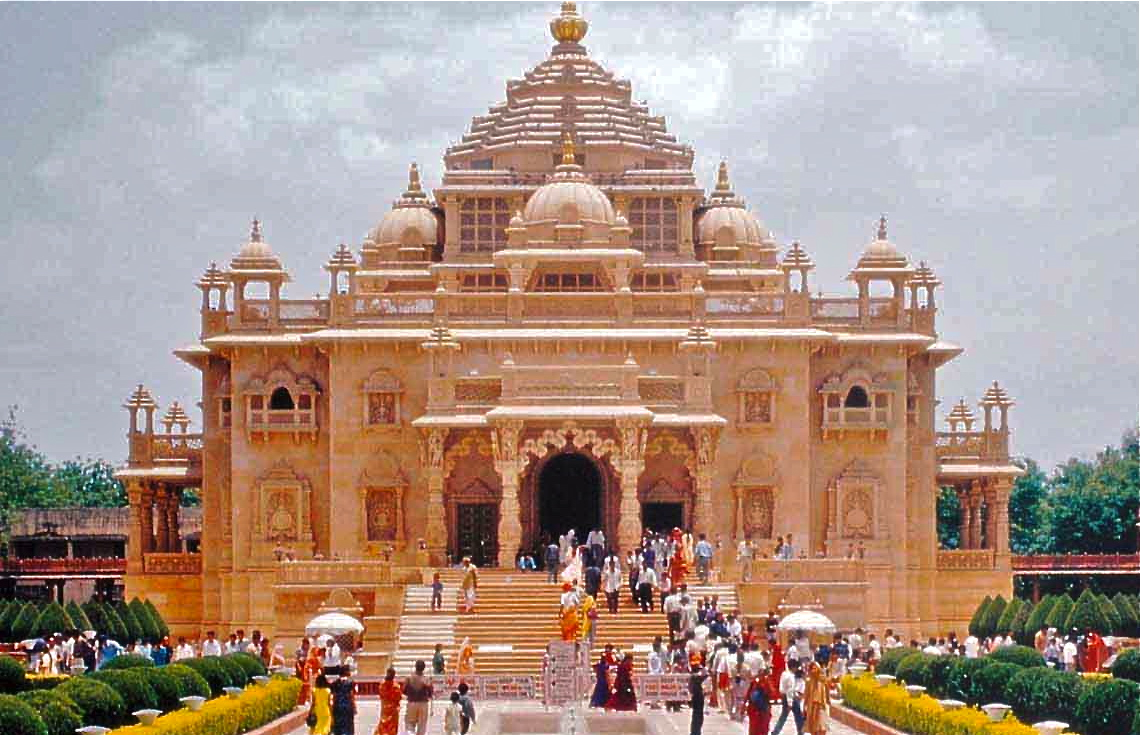
Swaminarayan Akshardham exemplifies a breathtaking fusion of traditional Hindu temple design and modern engineering. Its primary architectural style is Māru-Gurjara, characterized by intricate carvings and detailed sculptures. Constructed entirely without steel, the temple utilizes 6,000 tons of Rajasthani pink sandstone and Italian Carrara marble. The central monument, standing 141 feet high, features 234 ornate pillars and over 20,000 deities and sages. Beyond the main temple, the complex includes a unique stepwell, the Yagnapurush Kund, and groundbreaking technological exhibits that narrate stories from Indian history and the life of Swaminarayan. These elements combine to create a visually stunning and spiritually enriching experience, showcasing the pinnacle of contemporary temple construction.
Māru-Gurjara Style
The temple's architecture follows the ancient Māru-Gurjara style, known for its elaborate carvings and intricate details, reflecting centuries of Indian craftsmanship.
Materials and Construction
Built from Rajasthani pink sandstone and Italian Carrara marble without the use of steel, the temple showcases the skill of thousands of artisans who hand-carved its surfaces.
Unique Features and Exhibits
The complex features a traditional stepwell, the Yagnapurush Kund, and boat rides depicting ancient Indian culture, blending historical design with modern narrative techniques.
The Teachings and Legacy of Swaminarayan
At the heart of Akshardham lies the spiritual philosophy and life of Bhagwan Swaminarayan, the central deity. His teachings, rooted in the Vaishnava tradition (specifically the Akshar-Purushottam Darshan), emphasize devotion (_bhakti_), morality (_dharma_), and selfless service (_seva_). Swaminarayan's legacy, carried forward by the BAPS Sanstha, inspires millions worldwide to lead virtuous lives. The temple itself represents 'Akshardham' as the eternal abode of God, a concept central to his theological school. Exhibitions within the complex vividly portray his life, including the sacred journey of Nilkanth Varni, reinforcing his message of spiritual quest and universal welfare.
Core Principles
Swaminarayan's teachings center on _dharma_ (righteousness), _bhakti_ (devotion), _gnana_ (knowledge), and _vairagya_ (detachment), guiding followers towards spiritual enlightenment.
The Akshar-Purushottam Darshan
This distinct theological school within Vaishnavism posits Akshar as the eternal divine abode and the ideal devotee, and Purushottam as the supreme God, Swaminarayan.
Nilkanth Varni's Journey
The epic seven-year pilgrimage of Nilkanth Varni, Swaminarayan's youthful form, is a foundational narrative promoting renunciation and the search for truth, depicted through various exhibits.
Cultural Impact
Swaminarayan Akshardham has profoundly influenced India's cultural landscape, serving as a monumental testament to traditional Indian art, architecture, and spirituality in the modern era. Its intricate carvings, depicting deities, philosophers, and historical figures, showcase millennia of Indian heritage and craftsmanship, inspiring a renewed appreciation for indigenous artistic forms. The complex's design, blending ancient Vastu Shastra principles with contemporary engineering, has set a new benchmark for religious architecture, demonstrating how traditional aesthetics can be scaled to monumental proportions. Beyond its spiritual significance, Akshardham functions as a vast cultural museum, attracting millions of visitors annually who come to marvel at its beauty and learn about India's rich past, thereby fostering a sense of national pride and cultural continuity.
The cultural impact of Akshardham extends to its role in disseminating moral and spiritual values through its various exhibitions and presentations. The "Sanskruti Darshan" boat ride and the "Neelkanth Darshan" film, for instance, narrate stories of ancient sages and the life of Bhagwan Swaminarayan, imparting lessons on dharma, devotion, and selfless service to a diverse audience. This pedagogical approach makes complex spiritual concepts accessible, particularly to younger generations. Furthermore, as a major tourist attraction, Akshardham significantly contributes to Delhi's tourism economy, drawing international visitors and positioning India as a global hub for spiritual tourism. It stands as a vibrant symbol of contemporary Hinduism, demonstrating its dynamism and capacity to engage with the modern world while preserving its ancient roots.
🗺 How to Reach
Hover a card to animate the journey on the map
Route to Temple
Common Questions
Where is Swaminarayan Akshardham Delhi: A Modern Marvel of Hindu Devotion located?
Swaminarayan Akshardham Delhi: A Modern Marvel of Hindu Devotion is documented at Delhi.
Which deity is associated with Swaminarayan Akshardham Delhi: A Modern Marvel of Hindu Devotion?
Swaminarayan Akshardham Delhi: A Modern Marvel of Hindu Devotion is associated with Swaminarayan.
Related Temples


A Living Covenant