



Temple No. 5828KeralaAyyappan

Sabarimala Temple

Sabarimala Temple: Kerala’s Sacred Vanaprastha Shrine of Ayyappan Perched atop the mist-wrapped Sabarimala hill in the heart of the Periyar Tiger Reserve,.

Direct answer: Sabarimala Temple: Kerala’s Sacred Vanaprastha Shrine of Ayyappan is a Hindu temple guide on Hindu Mandir Yatra covering the temple's location in Kerala and its association with Ayyappan.

KeralaAyyappanKerala

01 / Temple Snapshot

Sabarimala Temple at a glance

  • Temple location: Pamba, Kerala
  • Primary worship: Ayyappan
  • Comfortable season: Mandala-Makaravilakku season (Nov–Jan)—cool weather, clear skies, full ritual calendar

02 / Hours and Darshan

Check darshan before you go

  • Entry details may vary by queue and ritual
  • Located in Pamba, Kerala
  • Confirm current opening hours before travel
  • Keep extra time for security and queues

03 / When To Go

Best time: Mandala-Makaravilakku season (Nov–Jan)—cool...

  • Best time: Mandala-Makaravilakku season (Nov–Jan)—cool weather, clear skies, full ritual calendar
  • Early morning visits are usually calmer
  • Festival days are memorable but crowded
  • Weather and crowds follow the Pamba, Kerala season

04 / Dress and Etiquette

Dress modestly and move with the ritual flow

  • Remove footwear before entering shrine areas
  • Offer prayers to Ayyappan with local customs in mind
  • Photography rules can change by temple zone
  • Carry a small bag for phones, offerings, and receipts

05 / Getting There

Getting there: Pamba, Kerala

  • Nearest airport: Cochin International Airport (COK, 110 km) Trek Options: Traditional 64-km forest trek (Erumely–Sabarimala), helicopter service (Pamba–Sannidhanam), or shared jeep (Pamba–Kochu Pamba)
  • Nearest railway: Chengannur (60 km) or Kottayam (85 km) Nearest Airport: Cochin International Airport (COK, 110 km) Trek Options: Traditional 64-km forest trek (Erumely–Sabarimala), helicopter service (Pamba–Sannidhanam), or shared jeep (Pamba–Kochu Pamba)
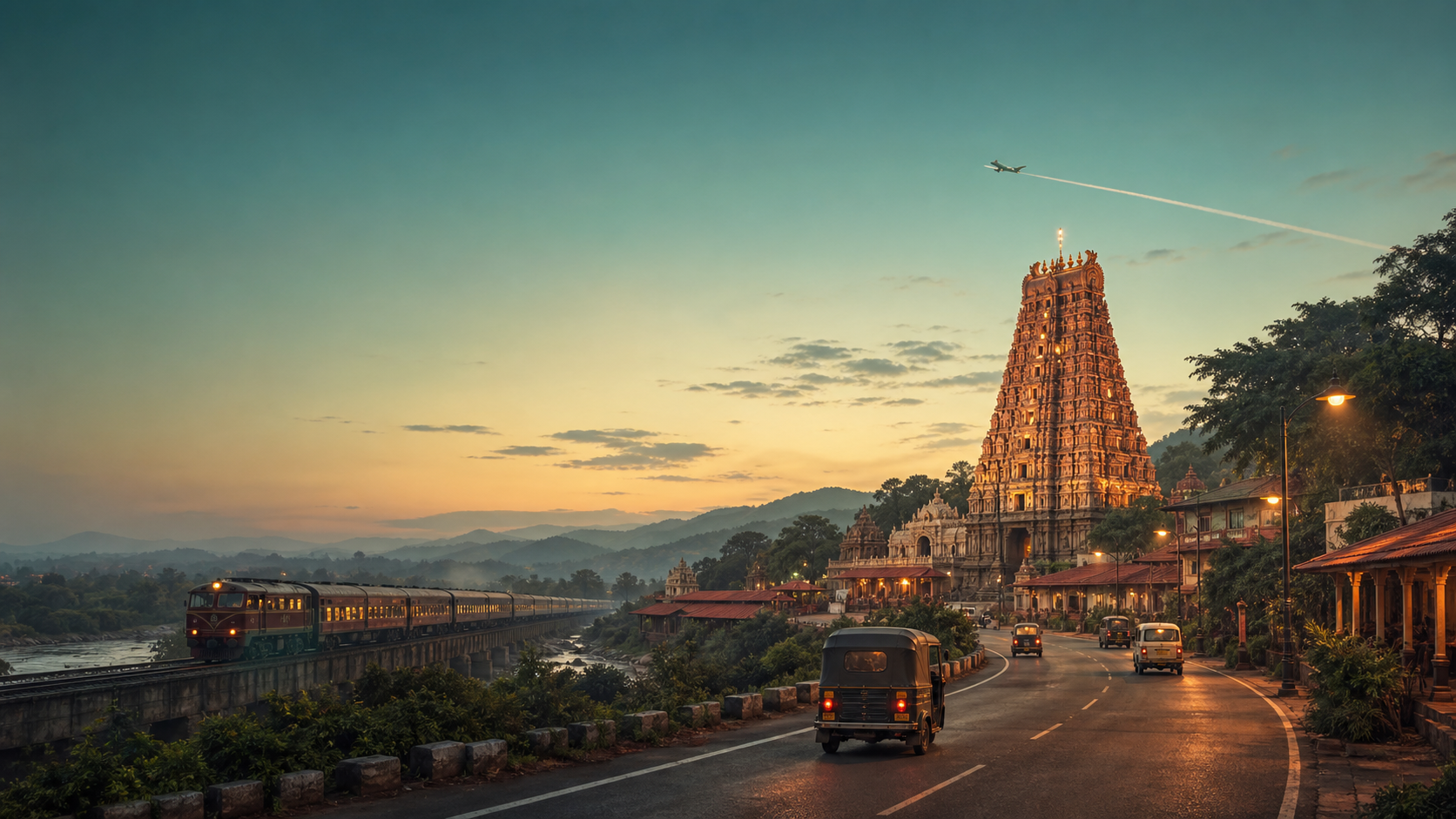
A visual visitor summary generated from this temple's article data.

A complete pilgrim record drawn from the existing published article data.

Historical Foundation

1793Mortgage document executed by Pandalam royal family, pledging Sabarimala temple revenue to Travancore state
1818Lieutenant B. S. Ward surveys and documents the temple in his topographical survey of Travancore, noting ~10,000–15,000 annual pilgrims
1863Ward & Conner’s Geographical and Statistical Memoir of the Survey of Travancore and Cochin describes Sabarimala as ‘a small but venerated shrine’ amid dense forest
1902Major reconstruction post-fire led by Diwan of Travancore and Kochummen Muthalali; new mandapa and balikalpura built
1950Arson attack destroys sanctum; original stone idol replaced with new panchaloha idol commissioned by Travancore Devaswom Board
1969Dhwajastambha (flagstaff) installed; temple declared a State Protected Monument
2018Supreme Court of India lifts ban on women aged 10–50; judgment later modified following review petitions and implementation challenges

Pre-Modern Documentation & Colonial Gaze

Post-Independence Administration & Institutionalisation

Controversies & Chronological Debates

Architecture & Craftsmanship

The Pathinettaampadi: 18 Steps as Sacred Topography

Sanctum Sanctorum & Iconographic Precision

Secondary Shrines & Artistic Integration

What is Panchaloha?

Panchaloha (“five metals”) is a sacred alloy used in South Indian temple iconography, traditionally comprising gold, silver, copper, zinc, and iron in precise astrologically determined ratios. Its use signifies divine completeness—gold for purity, silver for clarity, copper for vitality, zinc for healing, and iron for grounding. At Sabarimala, panchaloha covers both the idol and the 18 steps, creating a unified field of sanctified metal.

The Presiding Deity

Ayyappan as Dharma Shasta

Form: Yogic Vanaprastha, seated in padmasana, legs bound, abhaya mudra
Consort: Maalikapurathamma (embodiment of Shakti as protector)
Iconic Attribute: Rudraksha mala, yagnopavita, minimal ornamentation
Theological Significance: Synthesis of Shaiva (Shiva) and Vaishnava (Vishnu-Mohini) traditions; sole major shrine representing Vanaprastha stage among Five Shasta Temples
Mythological Origin: Born from union of Shiva and Mohini (Vishnu’s enchantress avatar) to slay demoness Mahishi

Divine Genealogy & Theological Uniqueness

Maalikapurathamma: The Consort as Sovereign Protector

Sub-deities & Ritual Ecology

Festivals & Living Traditions

Mandala Pooja & Makaravilakku: The Twin Peaks of Faith

Monthly Pilgrimage Windows & Ritual Rhythm

Music, Movement & Embodied Worship

Plan Your Visit

Pro-Tip: Book Irumudikkettu online via the official Sabarimala website 30 days in advance. Carry your ID, vrata certificate, and medical insurance—mandatory for all pilgrims.
Key Takeaway: Sabarimala is not a destination—it’s a 41-day commitment. Start preparation early, respect ecological protocols, and approach the Pathinettaampadi not as a climb, but as a descent into stillness.

Logistics & Accessibility

Seasonal Guidance & Ritual Readiness

Nearby Temple Circuit & Cultural Continuum

“Sabarimala does not ask you to believe—it asks you to become. To walk barefoot, carry ghee, bind your senses, and ascend not a hill, but your own limitations.” — K. N. Panikkar, Pilgrimage and Power
“The 18 steps are not measured in feet—but in surrendered breaths, quieted thoughts, and released attachments.” — Official Sabarimala Devaswom Board Publication, 2021
Sabarimala Pathinettaampadi with devotees ascending barefoot
Close-up of Ayyappan's panchaloha idol in yogic posture
Makaravilakku festival with celestial lights and massive crowd
Cheerappanchira family preparing sacred payasam

Sabarimala Temple presiding deity" data-caption="Sabarimala Temple — figure 5">
Sabarimala Temple — figure 5
Sabarimala Temple architectural detail" data-caption="Sabarimala Temple — figure 6">
Sabarimala Temple — figure 6
Sabarimala Temple — figure 7
Sabarimala Temple — figure 8
Sabarimala Temple — figure 9

Related temples: Aazhimala Shiva Temple | Abhimanyu Temple, Vayotthidam

Sacred Stories & Mythology

The Arrow That Marked Destiny

After slaying Mahishi, the adolescent Manikandan returned to Pandalam palace, revealing his divine nature. To prevent attachment, he shot a golden arrow toward the western hills—declaring, “Where it lands, build my abode.” The arrow pierced the summit of Sabarimala hill and vanished. Rajashekhara, guided by Parashurama, discovered the spot and constructed the temple—but only after building exactly eighteen steps to the summit, as instructed. When the king attempted a nineteenth step, the ground trembled and the idol manifested spontaneously. This narrative establishes Sabarimala not as a human-built edifice, but as a sthala (sacred site) chosen by divine will—its geometry non-negotiable, its authority absolute.

Sabari’s Final Breath

Embedded within Sabarimala’s sacred geography is Sabari Peedam, a cave where the tribal devotee Sabari awaited Lord Rama. According to the Ramayana, Sabari—rejected by orthodox society—offered Rama berries she had tasted to ensure sweetness. Rama accepted them with tears, declaring her devotion superior to all Vedic rituals. Upon Rama’s departure, Sabari attained moksha at this very spot. Pilgrims visit Sabari Peedam before ascending the Pathinettaampadi, acknowledging that Ayyappan’s Vanaprastha path echoes Sabari’s path of unconditional love—transcending caste, gender, and scriptural gatekeeping. This linkage transforms Sabarimala into a living Ramayana landscape.

The Tigers of the Forest

Folk belief holds that tigers accompanied Ayyappan from Sabarimala to Pandalam as his retinue. Even today, pilgrims report tiger sightings along the pathinettampadi route—interpreted not as threats, but as divine escorts. The temple’s location within the Periyar Tiger Reserve is thus not incidental but theological: the forest is not wilderness, but vanam—the sacred grove where divinity dwells unmediated by human structures. This ecological theology informs conservation efforts: the Travancore Devaswom Board partners with the Forest Department to maintain wildlife corridors, restrict plastic, and promote eco-friendly pilgrimage practices.

Saints, Poets & Devotees

Cheerappanchira: The Martial Lineage of Grace

Modern Devotional Voices

Pilgrim Sociology & Collective Identity

Records, Marvels & Heritage

Engineering & Ecological Marvels

Conservation Challenges & Adaptive Stewardship

🛕
Temple
Kerala · India
Kerala
Loading map…
✈️Delhi
🚂Mumbai
🚌Bengaluru

🗺 How to Reach

Hover a card to animate the journey on the map

✈️
By Air
Kochi (COK) / Thiruvananthapuram (TRV)
🚂
By Train
Ernakulam Jn
🚌
By Road
Buses & taxis from Kerala
Pro tip: Book well in advance during major festival seasons.
Animated path

Route to Temple

📍
Bengaluru
🚌
NH 44100 km · 2.5 hrs
Krishnagiri
NH 4495 km · 2 hrs
Salem
NH 44165 km · 3 hrs
Dindigul
NH 4465 km · 1.5 hrs
🛕
Madurai
🚌 Exit Bengaluru via Hosur Road
🚌BengaluruKrishnagiriSalemDindigulMaduraiNH 44

Common Questions

Where is Sabarimala Temple: Kerala’s Sacred Vanaprastha Shrine of Ayyappan located?

Sabarimala Temple: Kerala’s Sacred Vanaprastha Shrine of Ayyappan is documented at Kerala.

Which deity is associated with Sabarimala Temple: Kerala’s Sacred Vanaprastha Shrine of Ayyappan?

Sabarimala Temple: Kerala’s Sacred Vanaprastha Shrine of Ayyappan is associated with Ayyappan.

A Living Covenant

The temple article remains powered by the same published content pipeline. This view is only a presentation layer over the existing Hindu Mandir Yatra article data.