



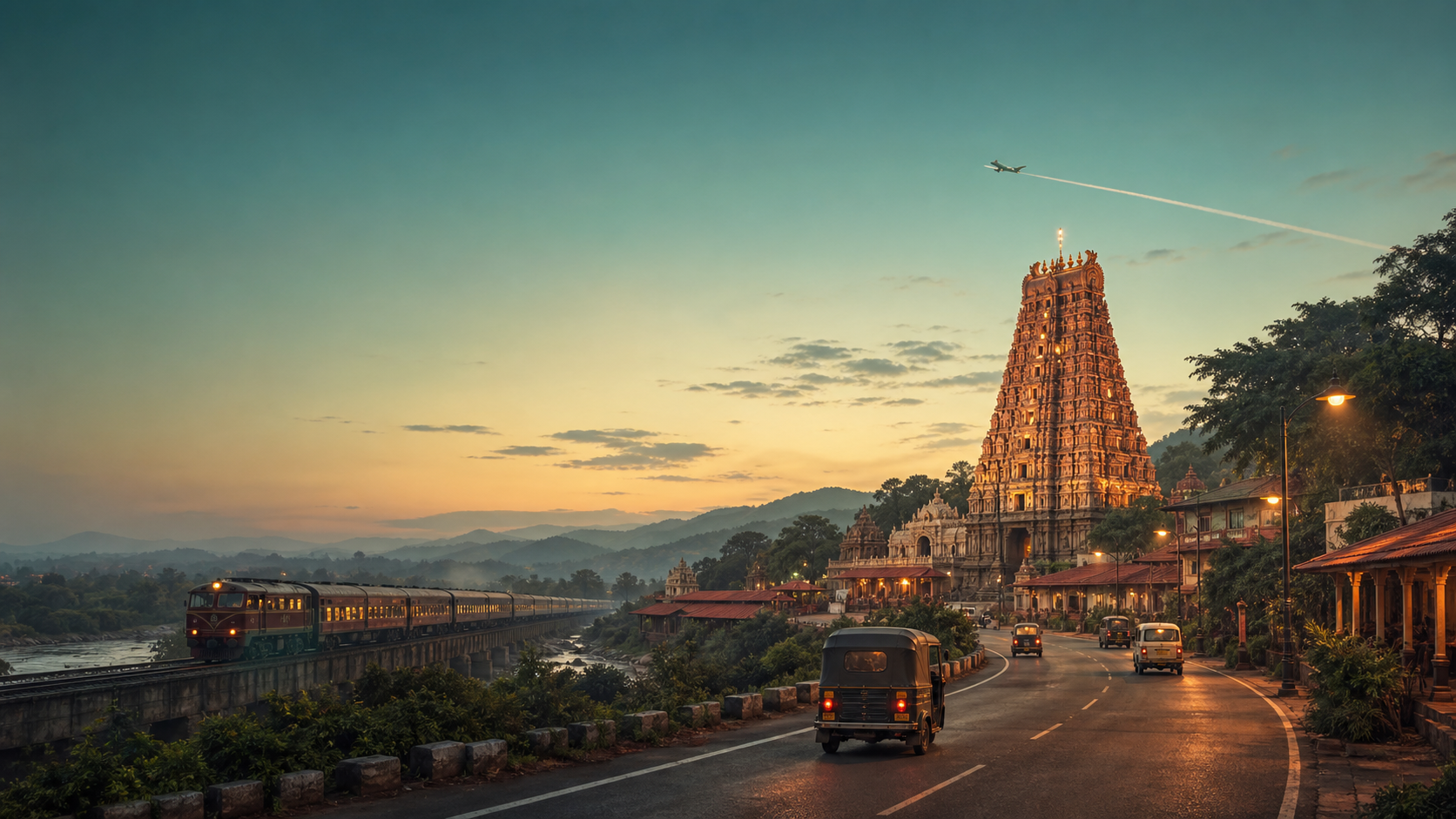
A complete pilgrim record drawn from the existing published article data.
Historical Foundation: Tracing Maheshwar's Ancient Roots
A Journey Through Time
From Mahishmati to Maratha Grandeur
Ahilya Bai Holkar's Vision
Architecture & Craftsmanship: A Blend of Styles
Maratha & Regional Aesthetics
Sculptural Details & Artistic Legacy

The Presiding Deity: Shiva as Maheshwar
Deity Profile: Lord Maheshwar
- Main Deity: Shiva (as Maheshwar, Kashi Vishwanath, Jwaleshwar, Kaleshwar, Mahaamrityunjaya)
- Consort Deity: Goddess Vindhyavasini Bhavani (Shakti Peetha)
- Secondary Deities: Kartavirya Arjuna, Dattatreya (Ek Mukhi form), Ganesha, Hanuman, Rama, Krishna, Narayan, Anant Narayan, Chintamani Ganpati, Bhawani Mata, Banke Bihari
- Tradition (Sampradaya): Shaiva
- Spiritual Classification: Shakti Peetha (Vindhyavasini Bhavani), Pancha Bhoota Sthala (Narmada as water element)
- Iconographic Uniqueness: Ek Mukhi Datta form (rare single-faced Dattatreya), Narmada River deified as Maa Narmada, Shiva as Maheshwar – epithet-based primary identity.
The Many Forms of Shiva and Shakti
What is a Shakti Peetha?
In Hinduism, a Shakti Peetha is a shrine or pilgrimage site where the body parts of the goddess Sati (the first wife of Shiva) are believed to have fallen. These sites are highly revered in Shaktism, a major tradition where the Goddess, or Shakti, is worshipped as the supreme being. Each Peetha is associated with a specific form of the Goddess and a Bhairava (a form of Shiva).
Unique Deities and Iconography
Festivals & Living Traditions: A Year of Devotion
Annual Celebrations and Rituals
| Festival Name | Month (Hindu Calendar) | Description |
|---|---|---|
| Mahashivratri | Phalguna | Major Shiva festival with special pujas and night-long vigils. |
| All Mondays of Shravan | Shravan | Weekly Shiva worship; last Monday features DOLA of Kashivishwanath with bhang prasad. |
| Nag Panchami | Shravan | Worship of serpent deities, especially during the monsoon season. |
| Gudi Padava | Chaitra | Celebration of the Maharashtrian New Year with traditional rituals. |
| Teez | Ashadha | Regional New Year celebration, particularly significant for women. |
| Samoti Amavas | Kartika | New Moon dedicated to ancestors and Shiva, involving special prayers. |
Daily Practices and Cultural Expressions
Plan Your Visit to Maheshwar
Getting There and Best Time to Visit
Maheshwar is easily accessible, making it a convenient destination for travelers:
- Nearest City: Indore, approximately 91 km away.
- Nearest Airport: Devi Ahilya Bai Holkar Airport, Indore (IDR), 91 km.
- Nearest Railway: Khargone Railway Station (approx. 15–20 km), though Indore (IND) offers better connectivity.
- By Road: Maheshwar is well-connected by road to major cities in Madhya Pradesh.
Exploring Maheshwar and Beyond
A suggested duration for your visit is 2–3 days, allowing ample time to cover the key attractions:
- Ghats & Temples: Spend time walking along the Narmada ghats, visiting the numerous Shiva temples, and observing the daily rituals. Don't miss the Sahasrarjun Temple and the Ek Mukhi Datta Temple.
- Ahilya Fort: Explore the majestic fort, which offers stunning views of the Narmada and houses the Ahilya Bai Holkar Chhatris.
- Weaving Centers: Visit the Rehwa Society or other local weaving centers to witness the creation of Maheshwari sarees and perhaps purchase some authentic handloom products.
- Narmada Boat Ride: Take a boat ride on the Narmada for a different perspective of the ghats and to experience the river's tranquility.
Maheshwar also serves as an excellent base for exploring nearby temple circuits:
- Omkareshwar (160 km): Home to one of the 12 Jyotirlingas, located on an island shaped like the 'Om' symbol.
- Mahakaleshwar Temple, Ujjain (~180 km): Another revered Jyotirlinga shrine.
- Bhedaghat, Jabalpur (~350 km): Famous for its marble rocks and Dhuandhar Falls on the Narmada.
- Chitrakoot (~300 km): A significant pilgrimage site associated with Lord Rama.
Pro-Tip for Visitors
To fully experience Maheshwar's spiritual ambiance, consider attending the evening Narmada Arati at the ghats. It's a mesmerizing ritual with lamps, chants, and devotional songs that offer a profound connection to the sacred river. Also, try to plan your visit around Mahashivratri for an unforgettable cultural immersion.
Key Takeaway: Maheshwar - A Synthesis of Devotion and Heritage
Maheshwar is more than just a temple town; it is a living chronicle of India's spiritual and historical depth. From its ancient identity as Mahishmati and its association with epic heroes to the enlightened patronage of Ahilya Bai Holkar and its unique Shiva-Shakti confluence, Maheshwar offers a holistic pilgrimage and cultural experience. Its architectural beauty, vibrant traditions, and the sacred flow of the Narmada ensure its place as a cherished gem in India's rich heritage.
Related temples: Aakkoor Thanthondreeswarar Temple | Aazhimala Shiva Temple
Sacred Stories & Mythology: Legends of Mahishmati
The Legend of Kartavirya Arjuna and Ravana
The Blessing of Agni and King Nila
Another captivating legend from the Mahabharata's Sabha Parva connects Maheshwar (Mahishmati) to the Nishada king Nila. King Nila had an exceedingly beautiful daughter with whom Agni, the lord of fire, fell deeply in love. The princess reciprocated his affection and always stayed near her father's sacred fire, causing it to blaze with vigor. Interestingly, King Nila's sacred fire would not blaze unless agitated by the gentle breath of her lips.
Agni, assuming the form of a Brahman, courted the princess for a long time. When the king discovered them, he became furious and ordered the Brahman to be punished. At this, Agni revealed his true, illustrious form and flamed up in wrath. Terrified, King Nila prostrated himself, acknowledging Agni as a god responsible for the Vedas and the source of all knowledge and Dharma. Pacified, Agni granted a boon to the Nishada king, who requested protection for his kingdom from invasions. Agni swore to protect Mahishmati on the condition that the king sanctify pleasure, leading to a unique tradition where women of Mahishmati were granted autonomy and respect, a tradition still honored today in various customs and rituals in Maheshwar.
Epic Connections: Ramayana and Mahabharata
Saints, Poets & Devotees: Echoes of Bhakti
Legacies of Spiritual Masters
Records, Marvels & Heritage: Maheshwar's Unique Contributions
Unique Spiritual and Historical Distinctions
Cultural Impact and Conservation
🗺 How to Reach
Hover a card to animate the journey on the map
Route to Mumbai
Common Questions
Where is Maheshwar Temple: A Saga of Shiva and Shakti located?
Maheshwar Temple: A Saga of Shiva and Shakti is documented at Mumbai, Maharashtra.
Which deity is associated with Maheshwar Temple: A Saga of Shiva and Shakti?
Maheshwar Temple: A Saga of Shiva and Shakti is associated with Shiva.
Related Temples


A Living Covenant