



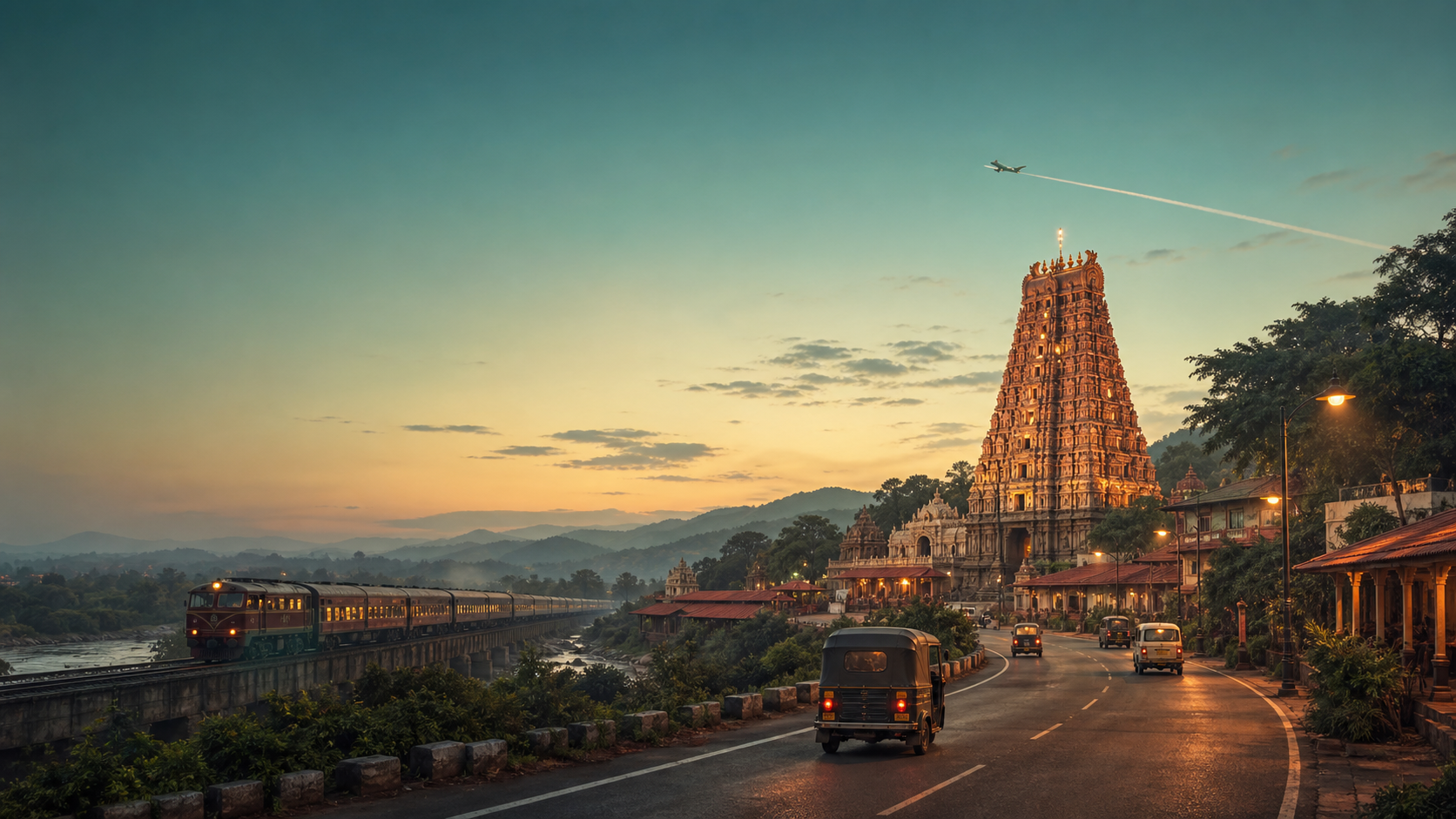
A complete pilgrim record drawn from the existing published article data.
Architectural Peculiarities: A Study in Sacred Geometry and Symbolism
The Chandramouleeswar Temple showcases extraordinary architectural features that blend sacred geometry with profound symbolism. Its most striking element is the rare three-faced Shiva Lingam, representing different aspects of Shiva. A unique internal shrine is dedicated to Vakra Kali, distinct from the main deity. Another significant feature is the Prayoka Chakra, associated with Varadaraja Perumal. Intriguingly, the temple exhibits a deliberate non-alignment of its key structures, such as the gopuram and the main shrine, a characteristic that adds to its mystical aura and architectural complexity within the Dravidian style.
The Three-Faced Lingam
The presiding deity, Chandramouleeswarar, is embodied in a unique three-faced Shiva Lingam, a rare iconographic representation in Shaiva tradition.
Vakra Kali's Shrine
An internal shrine houses Goddess Vakra Kali, whose fierce energy was pacified by Adi Shankara with the installation of a Srichakra at her feet.
Structural Non-Alignment
The temple's design features a deliberate non-alignment of its main entrance tower (gopuram) with the central shrine, a distinctive architectural choice.
Divine Manifestations: Shiva, Kali, and the Temple's Spiritual Core
At the spiritual core of Chandramouleeswar Temple lies the unique three-faced Shiva Lingam, representing Chandramouleeswarar, the presiding deity. This rare manifestation is central to the temple's Shaiva tradition. Complementing this is the powerful presence of Goddess Vakra Kali, whose fierce form is rooted in the legend of slaying the demon Dhunmuki. Her energy was famously pacified by Adi Shankara, who installed a Srichakra at her feet. Additionally, the temple houses Varadaraja Perumal, a form of Vishnu, significant for his association with the potent Prayoka Chakra, highlighting a blend of Vaishnava elements within the predominantly Shaiva and Shakta traditions.
Chandramouleeswarar's Three Faces
The primary deity, Shiva, is worshipped as Chandramouleeswarar, uniquely depicted with three faces on the Lingam, embodying his multifaceted cosmic roles.
The Legend of Vakra Kali
Vakra Kali's shrine commemorates her legend of vanquishing Dhunmuki, Vakrasura's sister, and her subsequent pacification by Adi Shankara's Srichakra.
Varadaraja Perumal and Prayoka Chakra
Varadaraja Perumal, an aspect of Vishnu, is also revered here, holding a significant Prayoka Chakra, adding a Vaishnava dimension to the temple's spiritual offerings.
Planning Your Pilgrimage: Visiting Chandramouleeswar Temple
For those planning a pilgrimage to Chandramouleeswar Temple in Thiruvakkarai, Puducherry, several key aspects enhance the visit. The temple is best experienced between October and March, or during the vibrant festivals of Panguni (April–May) and Vaikasi (May–June). Visitors are required to wear modest attire, avoiding shorts or sleeveless tops. A typical visit duration is 2–3 hours, allowing ample time to observe the unique three-faced Shiva Lingam, the Vakra Kali shrine, and the overall Dravidian architecture. The temple is administered by the Hindu Religious and Charitable Endowments Department, ensuring its preservation and accessibility.
Location and Accessibility
The temple is located in Thiruvakkarai, Puducherry. It is approximately 20 km from Villupuram Junction Railway Station and 15 km from Pondicherry Airport.
Best Time and Attire
The ideal visiting period is October to March. For festival experiences, April–May and May–June are recommended. Modest dress is mandatory.
What to Explore
During your visit, focus on the rare three-faced Shiva Lingam, the Vakra Kali shrine with its Srichakra, and the distinctive Chola-era Dravidian architectural elements.
| Deity | Chandramowleeswarar |
|---|---|
| Form | Chandramowleeswarar is uniquely manifested as a rare three-faced Lingam, representing a distinct iconographic form of Shiva. |
| Consort | Amirthambigai (Parvathi) |
| Sampradaya | Shaiva |
| Significance | This three-faced Lingam is one of very few such representations of Shiva, making the temple a site of unique spiritual importance. The temple's architecture also reflects a deliberate 'vakram' or contradictory alignment, adding to its distinct spiritual character. |
The Legend of Vakrasura and Vakrakali
Long ago, the land was terrorized by the formidable demon king Vakrasura. His reign of tyranny knew no bounds, and the heavens themselves trembled at his might. It was the mighty Lord Vishnu who descended to vanquish this evil, ultimately slaying Vakrasura. However, the tale did not end there. Vakrasura's pregnant sister, Dhunmuki, consumed by rage and grief, continued her brother's malevolent path. To quell her destructive fury, the fierce Goddess Kali intervened, confronting and slaying Dhunmuki. In a gruesome act, Kali pulled out Dhunmuki's unborn child and adorned it as an earring, a fearsome display that earned her the revered name Vakrakali, and thus, this sacred place became known as Thiruvakkarai.
Here, Shiva manifests in a rare three-faced Lingam, a profound symbol of divine complexity and uniqueness.
The fierce Vakrakali, pacified by Adi Shankara, stands as a guardian, embodying both wrath and serenity within these sacred walls.
Related temples: Aayiram Kaliamman Temple | Dharumapuram Yazhmoorinathar Temple
A Legacy Etched in Stone: Chola Dynasty and Sacred Status
The Chandramouleeswar Temple boasts a profound historical legacy, with its origins firmly rooted in the illustrious Chola dynasty. Built in the 10th century CE by Aditya I, its granite structure exemplifies the Dravidian architectural style. The temple's status as a Paadal Petra Sthalam underscores its ancient spiritual importance, having been glorified by the Tamil Nayanar saints Tirugnana Sambandar and Appar. It is recognized by the Archaeological Survey of India (ASI) and is currently administered by the Hindu Religious and Charitable Endowments Department, Government of Tamil Nadu, preserving its heritage for future generations.
Chola Foundations
The temple's core structure was established between 870–907 CE during the reign of Chola king Aditya I, marking its significant Chola heritage.
Paadal Petra Sthalam
Revered by the Nayanar saints Tirugnana Sambandar and Appar, the temple holds the sacred status of a Paadal Petra Sthalam, signifying its ancient spiritual sanctity.
Historical Inscriptions
Inscriptions from the reigns of Uttama Chola and Raja Raja Chola I detail temple maintenance and land grants, providing concrete evidence of its long-standing importance.
Unveiling the Enigma of Chandramouleeswar Temple
The Chandramouleeswar Temple, nestled in Thiruvakkarai, Puducherry, stands as an ancient and revered Shiva shrine. This sacred site is distinguished by its unique architectural and spiritual characteristics, drawing pilgrims and scholars alike. It houses a rare three-faced Shiva Lingam, a manifestation of the Hindu god Shiva, and features an internal shrine dedicated to the powerful Goddess Vakra Kali. The temple's rich history and profound spiritual significance make it a prominent destination for those seeking a deeper understanding of ancient Dravidian temple traditions. Its granite structure, built by the Chola dynasty, dates back to the 10th century CE.
Location and Significance
Situated in Thiruvakkarai, Puducherry, the Chandramouleeswar Temple is a significant Shaiva pilgrimage site. It is recognized as a Paadal Petra Sthalam, revered by the Nayanar saints.
Distinctive Deities
The temple is renowned for its presiding deity, Chandramouleeswarar, represented by a rare three-faced Shiva Lingam. Additionally, it features a unique shrine for Goddess Vakra Kali, a fierce form of Kali.
Ancient Origins
The core structure of the temple dates to the 10th century CE, built during the reign of Chola king Aditya I, showcasing classic Dravidian architectural style.
Restoration & Conservation
The Chandramouleeswar Temple at Thiruvakkarai, with its ancient origins dating back to the Pallava and Chola periods, presents significant challenges for preservation. Constructed primarily from granite and later enhanced with brick and stucco, the structure has endured centuries of exposure to the elements, including tropical humidity, rainfall, and natural weathering. This prolonged exposure has led to gradual deterioration of its intricate carvings, structural components, and the unique stucco figures that adorn its vimanas and gopurams. Issues such as moss growth, erosion of stone surfaces, and minor structural cracks are common, requiring a delicate balance between arresting decay and maintaining the temple's original aesthetic and historical integrity. The unique geological context of Thiruvakkarai, known for its fossil wood, also adds a layer of complexity to understanding the site's environmental impact on the temple's materials. Recognizing its profound architectural and spiritual significance, various governmental and non-governmental organizations have undertaken concerted efforts for the temple's restoration and conservation. The Archaeological Survey of India (ASI), responsible for many heritage sites in India, has periodically initiated projects focusing on scientific cleaning, structural consolidation, and the meticulous repair of damaged sections. These initiatives often involve traditional craftsmanship combined with modern conservation techniques, such as chemical treatment of stone to prevent further decay and careful re-plastering using lime mortar. Community involvement and local endowments also play a crucial role in supporting ongoing maintenance. These continuous efforts are vital to ensure that the Chandramouleeswar Temple, with its unique Vakra Kali shrine and ancient Shiva lingam, remains a vibrant center of worship and a preserved testament to South Indian temple architecture for generations to come.🗺 How to Reach
Hover a card to animate the journey on the map
Route to Auroville
Common Questions
Where is Chandramouleeswar Temple: Chola Grandeur, Shiva's Abode located?
Chandramouleeswar Temple: Chola Grandeur, Shiva's Abode is documented at Thiruvakkarai, Puducherry.
Which deity is associated with Chandramouleeswar Temple: Chola Grandeur, Shiva's Abode?
Chandramouleeswar Temple: Chola Grandeur, Shiva's Abode is associated with Shiva.
Related Temples

A Living Covenant