A complete pilgrim record drawn from the existing published article data.
Historical Foundation
Early History & Buddhist Presence

An artist's reconstruction depicting the possible appearance of the 3rd-century BCE Buddhist stupa at Katas Raj, as described by Xuanzang.
Hindu Shahi Zenith & Medieval Flourishing
What is a Hindu Shahi?
The Hindu Shahis were a Hindu dynasty that ruled parts of Kabulistan and Gandhara (present-day Afghanistan and Pakistan) from the 9th to 11th centuries, succeeding the Turk Shahis. They were patrons of Hindu temples and art, and their reign saw a resurgence of Hinduism in the region.
Later Dynasties & Modern Preservation
"Katas Raj is not just a collection of temples; it is a living chronicle inscribed in stone, echoing the voices of ancient pilgrims and the aspirations of diverse rulers who recognized its sanctity."
Architecture & Craftsmanship
Kashmiri Influences & Design Principles

Close-up view of the intricate stonework and characteristic ribbed domes, showcasing the Kashmiri architectural influence at Katas Raj.
Structural Elements & Materials
Notable Shrines & Features
Key Takeaway: Katas Raj Temples uniquely blend sophisticated Kashmiri architectural elements like ribbed domes and trefoil arches with ancient structural resilience, built from local stone and lime plaster around a sacred pond.
The Presiding Deity
Lord Shiva – The Destroyer and Transformer
- Main Deity: Shiva
- Deity Form: Lingam (specifically, a hand-made lingam, said to be established by Lord Krishna)
- Consort Deity: Sati (mythologically linked through the teardrop origin of the pond)
- Tradition (Sampradaya): Shaiva
- Spiritual Classification: Claimed as a Jyotirlinga by some traditions (though not officially among the 12), and implied as a Pancha Bhoota Sthala representing the 'Jal' (water) tattva due to the central sacred pond.
- Iconographic Uniqueness: Associated with the origin of the first lingam in some traditions; site of one of two ponds formed by Shiva's tears.
Shiva Lingam & Sati's Sacred Link
Secondary Deities & Iconography

A revered Shiva Lingam, the primary form of worship, enshrined within one of the ancient temples at Katas Raj.
Festivals & Living Traditions
Maha Shivaratri Celebrations

Hindu devotees participating in Maha Shivaratri celebrations at Katas Raj, a vibrant resurgence of ancient traditions.
Modern Revival & Cross-Border Pilgrimage
Plan Your Visit
Getting There & Best Time
Visitor Information & Facilities

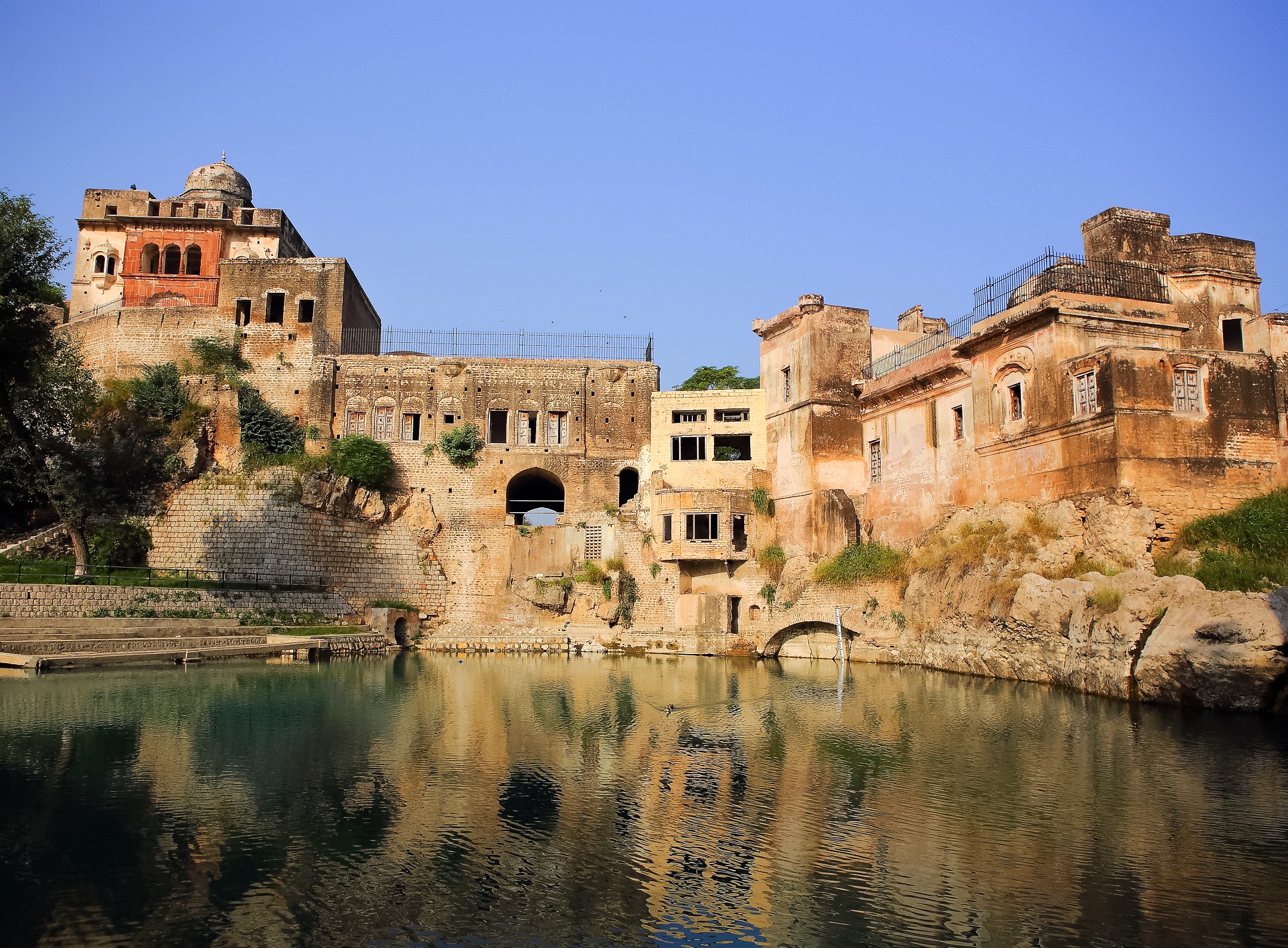
A panoramic view capturing the expanse of the Katas Raj Temples complex, showcasing the serene Katakshkund pond at its heart.
Did You Know? The sacred Katakshkund pond has a maximum depth of 20 feet and covers an area of approximately 1,000 square meters, making it a significant natural and spiritual reservoir.
Related temples: A. C. Bhaktivedanta Swami Prabhupada | Abhimanyu Temple, Vayotthidam
Sacred Stories & Mythology
The Katakshkund: Shiva's Tears
The most poignant origin legend for Katas Raj centers around Lord Shiva. After the tragic demise of his beloved consort, Sati, Shiva wandered the Earth in inconsolable grief. As he wept, his tears cascaded to the ground, forming two sacred ponds: one at Katas Raj and the other at Pushkar (or, in some traditions, Nainital). The pond at Katas, known as Katakshkund, meaning 'Spring of Tearful Eyes,' thus became a holy site, a place where divine sorrow transformed into a source of purity and spiritual solace. This myth establishes Katas as a site of immense emotional and spiritual power, linked directly to the cosmic grief of one of Hinduism's most powerful deities.
The Katakshkund Legend: Divine Grief & Creation
The Yaksha Prashna: The Riddle of Life
Katas Raj holds another epic connection through the Mahabharata. It is traditionally believed to be the very site where the five Pandava brothers, during their exile, encountered a philosophical and life-threatening challenge. While searching for water, four of the brothers – Bhima, Arjuna, Nakula, and Sahadeva – succumbed to a mysterious Yaksha's curse after drinking from the pond without answering his riddles. It was Yudhishthira, the eldest and wisest, who patiently engaged the Yaksha in a profound riddle contest, known as the Yaksha Prashna. His profound answers on dharma, justice, and the nature of life and death not only saved his own life but also revived his four fallen brothers. This episode makes Katas Raj a rare site directly linked to a pivotal philosophical and moral narrative of the Mahabharata.
The Yaksha Prashna Episode: Wisdom in Exile
"The waters of Katakshkund are not merely physical; they are imbued with the memory of Shiva's grief and Yudhishthira's wisdom, offering a spiritual cleanse to both body and mind."
Saints, Poets & Devotees
Guru Nanak's Visit & Sikh Connection

An artistic depiction evoking Guru Nanak's travels, emphasizing his role in connecting diverse spiritual traditions across sacred landscapes like Katas Raj.
Maharaja Ranjit Singh's Patronage
Records, Marvels & Heritage
Ancient Significance & Unique Features
Engineering & Archaeological Insights
Archaeological Significance
When visiting Katas Raj, take time to observe the varying architectural styles and building materials across the complex. The layering of different periods—from Buddhist stupa remnants to Hindu Shahi temples—offers a visual timeline of ancient South Asian history.
Conservation Challenges & Modern Efforts
🗺 How to Reach
Hover a card to animate the journey on the map
Route to چوآ سیدن شاہ
Common Questions
Where is Katas Raj Temples: Sacred Tears & Ancient Wisdom located?
Katas Raj Temples: Sacred Tears & Ancient Wisdom is documented at چوآ سیدن شاہ, Punjab.
Which deity is associated with Katas Raj Temples: Sacred Tears & Ancient Wisdom?
Katas Raj Temples: Sacred Tears & Ancient Wisdom is associated with Krishna.
Related Temples


A Living Covenant